On family history, parenting, education, social issues and more
Author: Hettie D.
My name is Henrietta (Hettie) Dombrovskaya. I was born in Saint-Petersburg, Russian (actually, back then – Leningrad, USSR) in 1963, and immigrated to the United States in 1996.
I love Saint Petersburg, the city I was born and raised in, and I think it’s one of the most beautiful places in the world. Similarly (but differently) I love Chicago, and can’t imagine myself moving somewhere else in the observable future.
I have three children, Igor, Vlad and Anna, all adults living on their own, and one (so far) granddaughter Nadia. I also believe that my children are the best thing that happened in my life.
As for my professional life, I am working in the field of Information Technologies. When I was twenty, I’ve declared that the databases are the coolest thing invented and that I want to do them for the rest of my life. Thirty plus years later, I still believe it’s true, and still, believe that the databases are the best. These two statements together imply that I think a person can have it all, and indeed, I think so! Keep reading my journals to find out how I did it.
I made quiche a couple of times in course of the past two weeks following that recipe. I love quiche, but I always thought that to make it right is a long and complex process. Besides, since I live alone, I was not sure what I was going to do with this huge thing.
It turned out, that humans can make quiche:), and that a large quiche tastes way better than a small one; and also, a slice of a large quiche can be frozen as well as a small one. And it is alway a good idea to share 🙂
Half with ham and cheese, and another half with spinach and mashroomsThe smaller ones were not that good!
I was telling about the University boarding house here, and for the next four summers, we would follow the same routine – staying there for two three-week sessions. It was all the same no hot water and tons of cockroaches situation, but since my living conditions in the city did not improve, it still worked great for me.
After I was fired from Urbansoft, I never had a stable source of income. The University paid close to nothing, and all the gigs were just gigs, but I was always ready for some extra work – more work meant more money. Thereby, even though I had four weeks of paid vacation in the University (and in any case attendance was optional), I had to take extra work whenever an opportunity would present itself.
The gigs tend to appear at a most inconvenient time, such as when I was about to go to the University boarding house, or when I just moved there. It would mean I have no time to relax, and that I have to craft a way to work without any equipment.
Fortunately for me, half a dozen teenage girls who stayed in the same boarding house loved Vlad and Anna and didn’t mind being a collective babysitter. Most of the gigs I had at that time involved technical writing. I had decent English, good enough to write User Guides, Helps, and How-to manuals. At one point, Boris was contracting for an Italian entrepreneur Dr. Conrad (I have no idea what kind of a Doctor he was). They were developing an HTML-editing tool called HighDoc, and I wrote all documentation for it.
There was a verbal-agreed pay for each portion of that work, and Dr. Conrad would bring payments in cash (in US dollars) when he came to Russia. He always tried to delay payments as long as possible, and I had these cinema-featured Italian arguments with him, yelling and pleading. And not just me, all people who worked for him did the same. The last project I did with him was so interesting that it requires a separate blog post. But now we were in summer 1994, and Vlad and Anna were two months shy of being three, and Igor was almost nine.
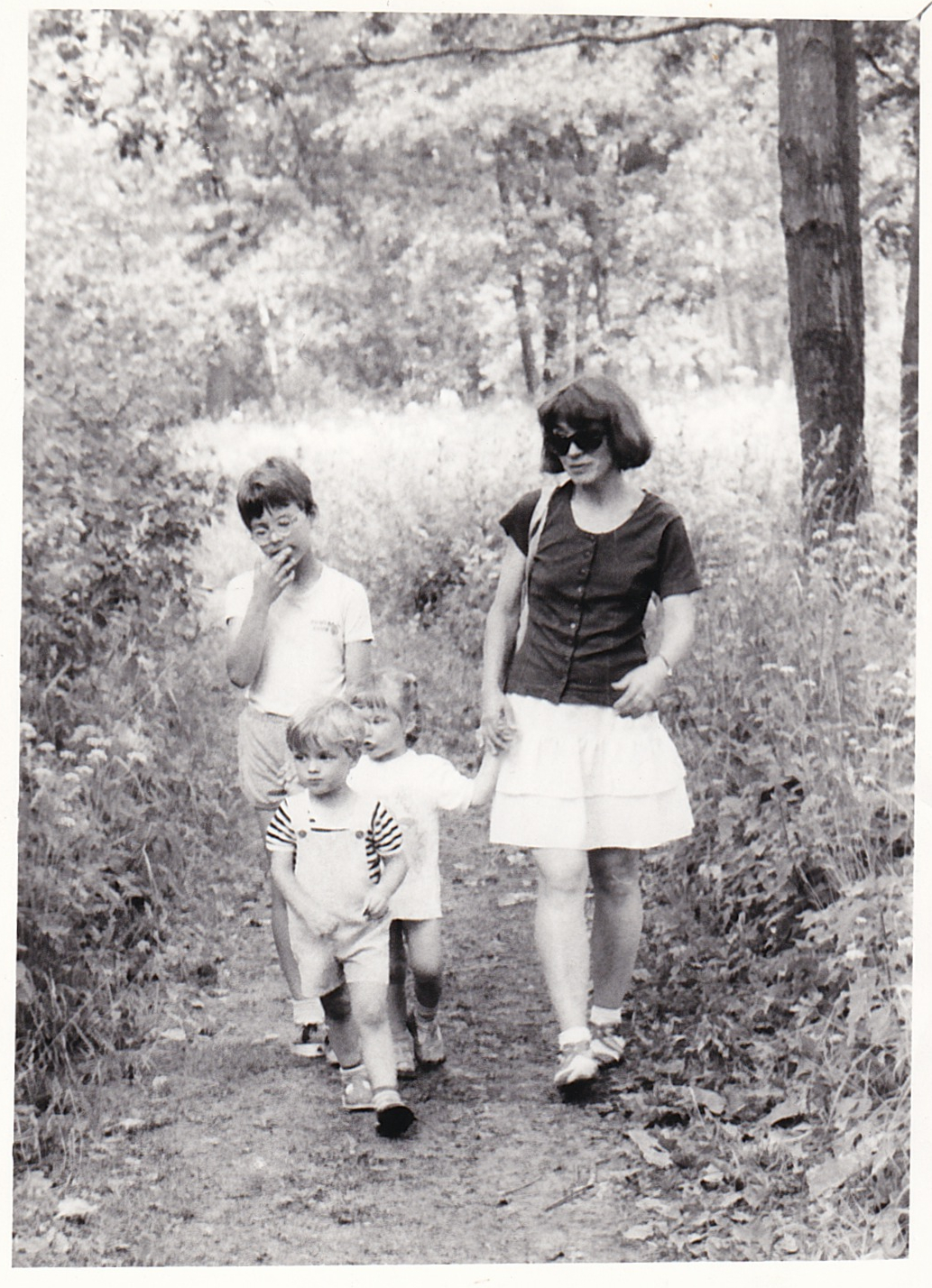
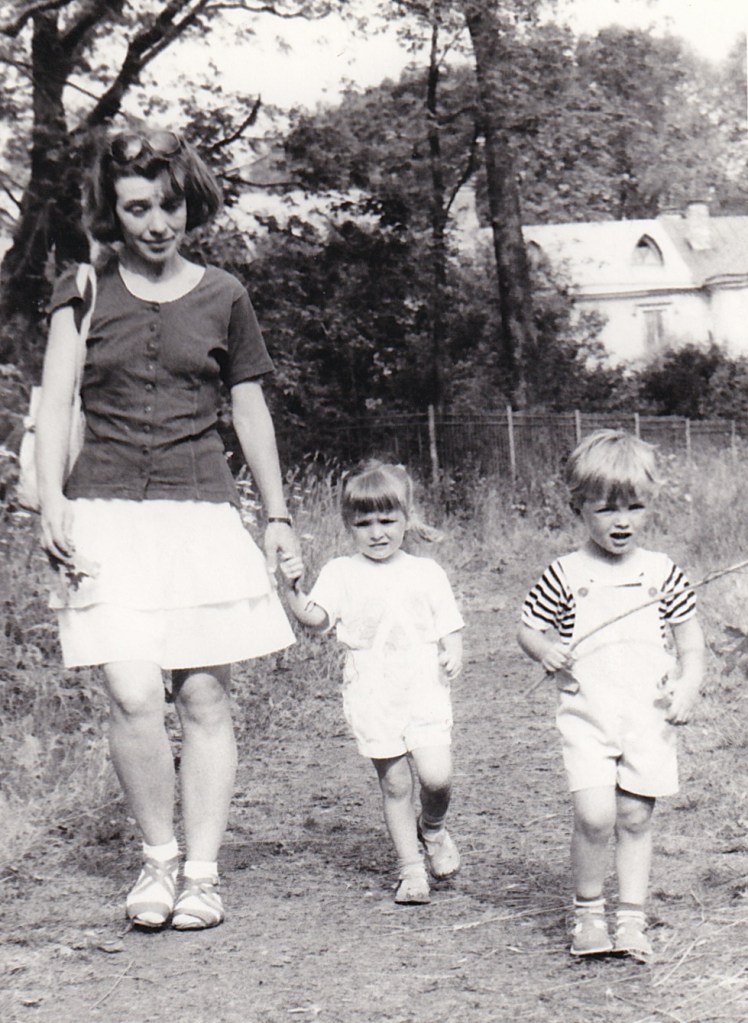
I still didn’t own a camera and didn’t take any pictures. Only when Boris came with his camera, we would get some. So all the pictures below show one day when we went for a long “hike” to the Old Peterhoff park.
So, twenty-five year ago we all wore socks with sandals :). Oh, and by the way, that blouse was timeless. It traveled with me to the US, and I only retired it a couple years ago! It was dark purple, with tiny buttons, and I loved it.Anna was always the first to climb a treeContinue reading “Summer 1994: Some Pictures”→
After more than two months break, I am resuming my historical posts. My granddaughter Nadia finally internalized the idea that there were times when her mother was a little girl, and that I am her mother’s mother. Thereby she started to ask lots of questions about what her mother was doing at her age. And since Nadia is almost three, I need to cover the missing period. That being said, welcome back to 1993.
As I mentioned in this post, our first daycare closed in January 1993. All the kids were transferred to another daycare, which was also subsidized by one of the industrial giants of the city. There was no Antie Galya there, but the teachers were reasonably good, and one of the teachers was great, and also she happened to live in the same building with us. That came handy because the new daycare was further away from our house, and to get there, I had to take a bus with two toddlers, and no double stroller. That teacher would occasionally help me to get the kids to the nursery, and sometimes, when only one child was sick, she would take another one to the daycare.
Anna and Vlad were about to turn two in summer, which meant they could attend the “older nursery group,” and one of them was pretty close to our house. That type of daycare was called Kindergarten (Detsky Sad in Russian), and they would take children from two to six or seven, depending on when the child was starting grade school. Theoretically, they all were supposed to have “junior nursery,” but most of the mothers were opting to stay at home with smaller children. Because of the combined reduction in supply and demand, it was challenging to place a child under two to any daycare, but after two, it was much easier.
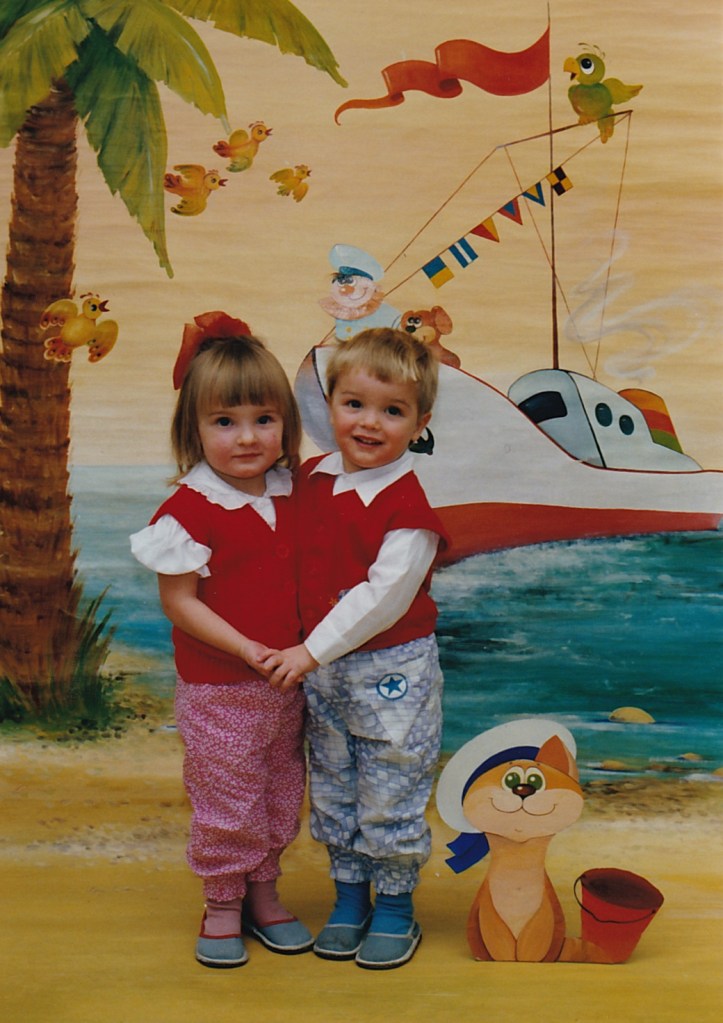
Anna and Vlad started to attend their “Kindergarten Number 24” in September 1993 and continued until we left for America.
Below is their first official picture, taken October 1993. Colored photos were unusual and expensive, and I only purchased two copies. And I do not have any more pictures till the next summer.
My historical posts are being published in random order. Please refer to the page Hettie’s timeline to find where exactly each post belongs and what was before and after.
Since we are likely to continue working from home for another two months or so, we are getting additional monitors for working from home. First, I thought I do not need a second monitor, and I am not going to ask for one. I thought there is not enough room on my desk. But Boris suggested to bring my “fitness monitor” downstairs and check how it will fit.
I brought it down, plugged it in, and realized that I completely forgot how nice is it to have a second monitor. I didn’t want to unplug it!
So I signed up. I could choose either office pickup or home delivery. First, I wanted to go to the office for pickup. Then I thought that I won’t be able to carry a monitor in my hands, and signed up for home delivery. And then I realized that I could take my luggage and put the monitor in it. And I changed my preference again:)
Today was the day. I took a 10-25 train to the city, walked around a little bit, and got to the office at 11-45, as I signed up. The building is opened, and there are the same people at the reception, only wearing masks. I got up to the 8th floor to our office. I do not know what I was imagining, but the fact that the elevators were working, and there was electricity in the office, and that I saw my boss, all felt very reassuring.
And overall, the city gave me this feeling that it is staying strong and making it through – not like when I was there in mid-March. Back then, I had a feeling that very soon it will be the scene from the “Divergent” movie.
On the train. There were just two people in my car, but I saw several people with bikes when I was boarding, and the car next to mine had a dozen of passengers. Nobody checks the tickets.
Somebody on our local nextdoor.com forum wanted to have some fun, I guess, or just test the neighborhood, and posted a survey: Should schools in America teach Arabic numerals as part of the curriculum? answers: Yes! No! No opinion.
I know it is hard to believe (especially since our school district, both Elementary and HS, are known for providing excellent education), but … at the time I checked, about 20% responded “No!” some with the comments “we are in America”, and 9% had “no opinion”.
And they were not joking!!!(It was clear from the subsequent comments). The post is already removed, so I do not know the final count 🙂
There was a heavy thunderstorm through the whole night and morning; and when it was finally over, I decided to take a short walk – just to get a breath of fresh air. And I met not one, but six deers less than ten minutes walk away from my house!
There are eight pictures in this instagram post – click on the side arrows to scroll.
One of the many things which are not normal these days is the fact that we can’t come to the stores with our reusable bags. “Until further notice,” as most of the stores as saying.
I washed all my reusable shopping bags and all my reusable mesh grocery bags and folded them on one of the shelves in the laundry room. I hope I will be able to use them again at some point. But each time I am placing a pile of plastic bags into the garbage, my heart wrenches.
Last week, I finally watched the documentary Plastic Wars, which was on my list for a while. It is horrifying to see all the damage that plastic does for the environment. It’s devastating to learn that even when you think you are recycling, you are often not. That makes you to disgust plastic packaging even more. And yet – that’s what we have to do these days…
I still highly recommend the movie – watch it here.
I watched this movie, although I didn’t have time, and I had other things to do. I dropped everything and could not stop. And now I can’t do anything until I write about it.
As a Chicagoan, and as a music lover, I know about Daniel Barenboim’s West-Eastern Divan Orchestra, how I could not know? He talks about this orchestra almost every time he talks about anything publicly. I also know that many people, both inside and outside Israel, do not like this project. Barenboim always says that that project won’t bring peace, won’t stop the war, but it helps to build understanding. Now I am wondering, to what extent this movie is “loosely based” on Barenboim’s story. Because it’s way worse. And hopeless.
Twenty years ago, I resolved that I will never speak or write publicly about the Israeli-Palestinian conflict. That is one of those conflicts, where everybody is right, and everybody is wrong, and there is no way to change anybody’s opinion. And sadly, this brilliant movie proves it.
I do not think that anybody who believes that there is a right side of that conflict, should watch this movie. There is a reason why on Vimeo, the comments for that movie are disabled. I wanted to cry through most of the movie. And I want to cry now.
Vlad made a surprise appearance in Palatine on Saturday. I know the story – he and Anna have ordered some stuff from Vanille for me, and then Vanille went on quarantine. Then Vlad decided that he and Dylon will just come and surprise me.
I am not sitting at home all the time, even during quarantine, and when Vlad arrived unannounced, I was not at home :). So I kind of figured that all out, when he called :).
We met outside, all of us wearing masks. Vlad brought me some French pastries and a bunch of red carnations for the VE Day celebration. I gave half of them back to him so that my mom could see then when we all get on the zoom meeting. He also brought a box of macaroons and told me that he wanted to give it to my neighbor, who was driving me around all the time before and after my surgeries. She was surprised and happy :).
It was a bittersweet encounter; it’s hard not to be able to hug and kiss, and to keep the distance. I am glad that Vlad and Dylon came down here, but I can’t wait till we can meet for real.
We decided not to tell my mom that Vlad was here. I told her that Vlad sent pastries and flowers by Uber (they do such deliveries these days), and I gave her Vlad’s flowers to take home after our quiet family celebration.
May 9, or otherwise a Victory Day, is when the VE Day is celebrated in Russia and some other countries, including Finland. This article summarizes all the reasons why different countries celebrate on different days.
When we first came to the US, we quickly realized how little did we know about the events of WWII outside the part of the war which took place on the territory of the Soviet Union. And we also realized how little the people around us knew about this very part of the war we identified the most. Since then, it became our family tradition to celebrate this day in a very personal way, preserving the memories of the family members who lived through these times, and not to shy away from the complexities of that part of history.
My mom is a survivor of the Seige of Leningrad. A big part of how we are celebrating now is to let her know that her struggles are not forgotten. Since May 9 is not an official holiday in the US, we were always combining the VE Day celebration with the Mother’s Day. That year, it would be perfect, and if not for the quarantine, it would be a lovely weekend.
Since this year is also the 75th Anniversary of the VE Day, we tried our best to make it a memorable day for mom.
We chose a time when everybody could join a zoom meeting. I kept it low, so mom didn’t know all the details. I only told her a day before – I will pick you up at a quarter to five, and we will go to my place to celebrate a Victory.
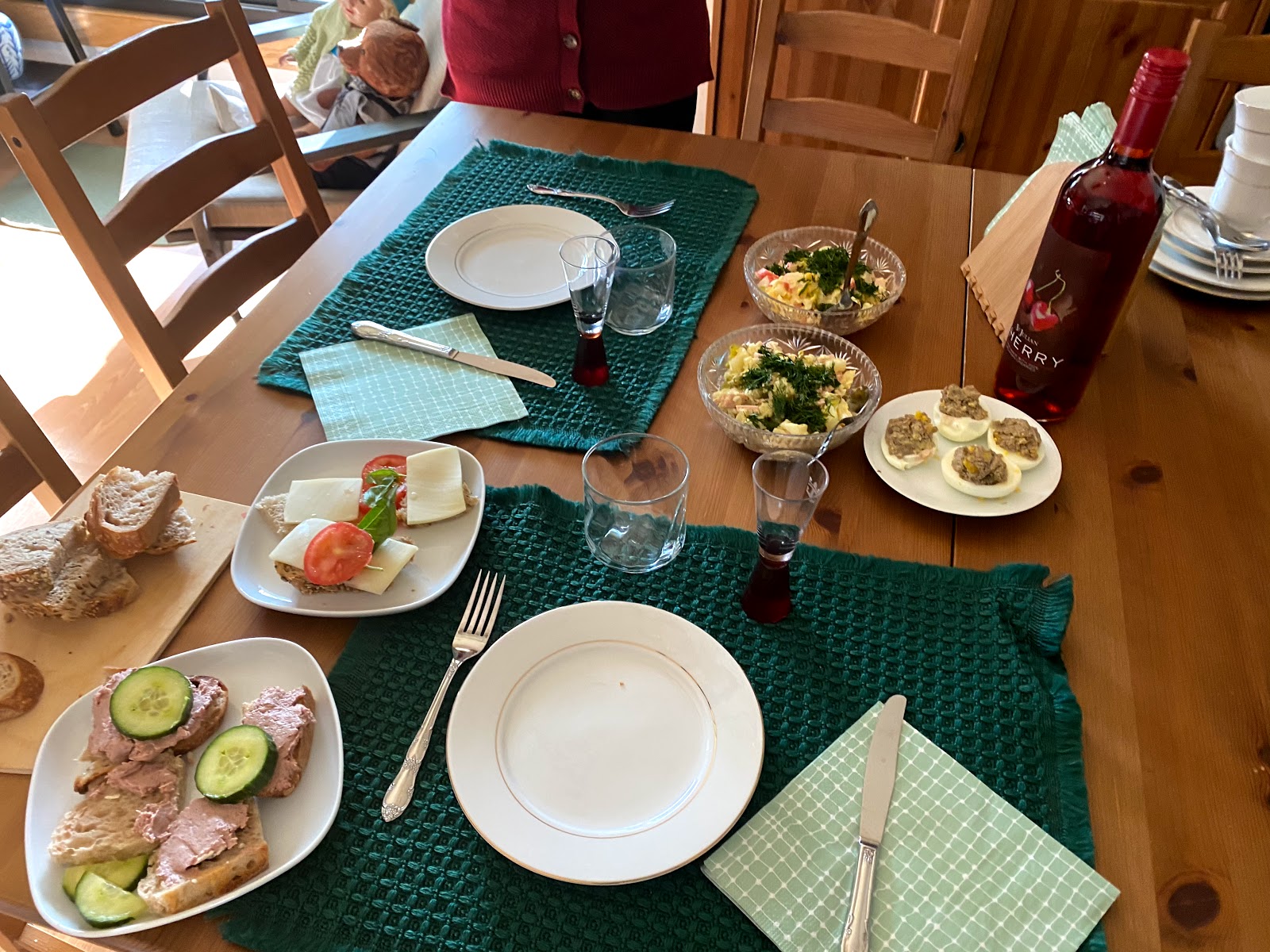
I made our traditional salads on Friday, and Igor made yet another trip to Palatine to pick up the salads and some other stuff from the trunk of my car.
On Saturday afternoon, I started to set the table. I had “a moment” when I realized that what I thought being a can of sprats is a can of sprat pate, which meant I had to make deviled eggs in fifteen minutes. Which I did, but it was a personal record.
Everything worked great; everybody was on time; everybody had red carnations on the tables visible to mom. Anna sang mom’s favorite wartime song for her (and she called later one more time, and sang more). We drank for Victory, then for Mother’s Day and all moms, and for Anna’s new job, which she starts on Monday. Anna told mom, that thinking about her struggles during the Siege of Leningrad gives her courage and strength to navigate the current crisis. And I think that that’s the message my mom needed the most.
A display of my maternal grandparents pictures before, during and after the WWII, which I made a couple of years ago
Mom was very grateful for everything: that I put up this display again, that I made all the traditional food, that the sweets were so delicious, and that I got everybody together. She said that it was a bright light amidst the grim situation.