I can’t believe I was at the Obama Center yesterday!!! Still can’t believe it! I got a free ticket for the shorts from the Black Harvest Film Festival as a member of the Gene Siskel Center, and I could make it, and it was amazing! The films, the people, and the smell of a new facility :). And the night view! And friendly staff! And just everything!
Yesterday was Igor’s birthday, and we went together to watch One Day in the Life of Andrei Arsenevich, Chris Marker’s documentary about the last days of Andrei Tarkovsky, whose full retrospective ran through September at the Siskel Center.
I really-really liked it. I find it difficult to say “I enjoyed it,” because it shows the last days of a terminally ill person, but it is really remarkable how positive Tarkovsky looks and sounds even when he can hardly lift his head off the pillows. The documentary included footage of him filming his last picture, The Sacrifice, and this scene alone told me more about him as an artist and as a person than I ever knew.
The documentary cites Pasternak, who apparently told Tarkovsky early in his career that he would make seven films. “Only seven?” asked Tarkovsky. “Yes, but the good ones!” replied Pasternak. And that’s exactly how many films he made, not counting his school works. Also, it mentions Tarkovsky’s fascination with Leonardo Da Vinci (which I share), and I thought that that’s something they had in common: Leonardo produced very few paintings during his long life, but each is a masterpiece. Isn’t it true about Tarkovsky’s films?!
Andrei Rublev is my favorite Russian painter and one of my favorite painters overall. The movie “Andrei Rublev ” is my favorite Tarkovsky film and one of my favorite movies overall.
The movie is sixty years old, almost as old as me, and you can still watch it without a facepalm and without adjusting your perception to these sixty years passed. The Siskel Center runs a full Tarkovsky retrospective, and when I saw that they would be screening Andrei Rublev when Anna is visiting, I immediately wanted all three of us to watch it together.
Still as brilliant as I remember it.
For those who have never watched it, especially my English-speaking friends, the trailer is not the best and does not do the film justice. And it’s not about the mysterious Russian soul. And it’s over three hours long. Worth seeing, though.
Last week I finally watched Odyssey. I watched it on Thursday at the AMC Dine-in Theater, not because I wanted to eat while watching, but because it was the only convenient option in terms of showtime and distance to the venue. That was my first time attending a screening in this theater, so now I know how the theater looks and what the best row is to sit in.
I think that’t the third Odyssey movie I watched in my lifetime. I liked, but without a hype. I think it says something that for thousands year, people still find inspiration in this epic. It’s a great story, and if after all these years, we still find something that draws us to the that plot, it’s not for nothing. The movie is very well done, the cast, the quality of cinematograthy, etc., except stepping away from the historical accuracty with costumes and armory (the wrong helmet types are bothersome, but I am unsure whether it was done on purpose to cater to the public expectations or not). Also, I didn’t like Polyphemus representation in a Gollum-like style, I like more the “traditional” presentation from the previous movies, and I think that Ancient Greeks thought about Polyphemus that way!
As much as I try not to read any reviews before watching anything, it was hard not to notice, that people were discussing the moral grounds of Odyssey’s decision, like sactrificing the lives of some of his men. But I believe that was the most true-to-the-story part! A special significans of Homer’s Odyssey is it’s representation of a snapshot in time, not only want people believed back than, but what they considered to be honorable, caurageous, what they considered being a treason, what they admired and hated, and what the “defaults” were.
I heardfrom some that this movie was better at IMAX, but to be honest, it was already enough noise for me to plug my ears from time to time, and I had no desire to be in a middle of a battle
I came back to Chicago on Saturday evening and had tons of plans for Sunday, which were only partially realized. One of the things I’ve done is watch the Wild Party movie at the Siskel Center. It was the first movie of the 20th Century Queer series, filmed in 1929. It was definitely an interesting one, especially in how openly it presented bisexual characters, and their balancing between lesbian and heterosexual relationships. You almost think that you are imagining things … except that you are not! Dorothy Arzner, the film director, was an open lesbian, and somehow, in the 1920s, it was still OK to make films like this (or nobody figured out yet that the homoerotic topic should be tabooed).
Now I am curious whether there were other movies like that!
Since neither Igor nor I had an opportunity to participate in any of the May Day events, and I couldn’t even get out of the office to watch a march, I suggested watching one of the Labor Movement documentaries screening at the Siskel Center during the first days of May. We went to see the American Dream documentary produced by Barbara Kopple in 1990. It shouldn’t be a surprise that I didn’t know about the labor strike against Hormel Foods of 1986. My complete cluelessness added suspense because throughout the whole documentary, I didn’t know how it would end! Sometimes (often?) it’s important to learn not only about impressive victories, but also about great failures.
There was something else, quite unexpected, that caught my attention while I was watching this documentary: the way everyone talked. A couple of weeks ago, I saw an article reporting a recent study finding that people now use fewer words than they did twenty years ago, and this documentary was striking proof of that! As a frequent participant in political rallies, I know very well how even the best speakers talk these days! In this movie, the union leaders, the members, and everyone talked intelligently, used a lot of words, and spoke complicated sentences. Nobody was shouting slogans; instead, people reasoned, considered different aspects of the matter at hand, listened to others’ arguments, and offered counterarguments. And trust me, none of this was rehearsed! There were heated debates, and at one point, a debate turned into a physical fight, but still!
I was shocked! Where did all of this go?! How did we get there? And how can we return to normality?!
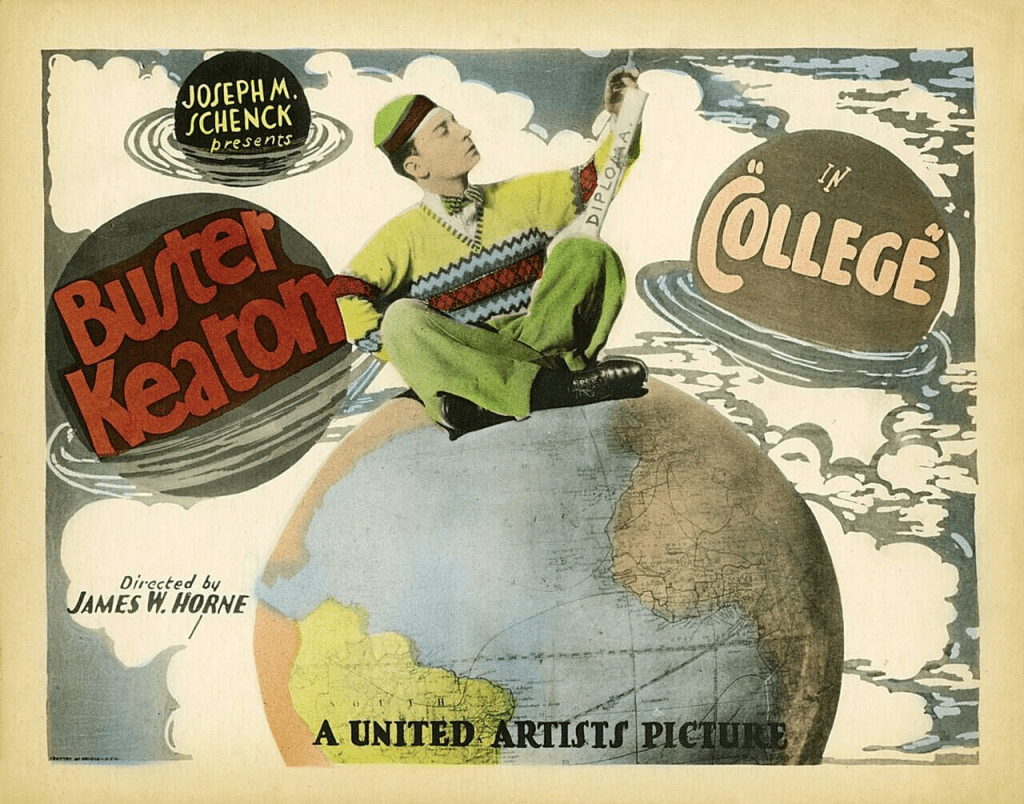
On Wednesday, I went to a show at Guarneri Hall for the first time after a long break. The show was rather unusual – it was an accompaniment for a classic silent movie.
Pianist and composer Stephen Prutsman returns to Guarneri Hall for the third time, amping up the fun for one of our most-anticipated events of the season. A Night at the Movies pairs a silent-era film comedy with a brilliant, original film score written and performed live by Prutsman and a small ensemble.
In Buster Keaton’s College, Ronald, a nerdy scholar, pans sports in favor of academics. This attitude wins him no points with his peers and especially coed Mary, who favors the athletic Jeff. Ronald’s effort to win back Mary through his failed attempts at various sports is the setup for Keaton’s unique physical comedy in this hilarious film from 1927.
I think that most of the audience had more fun than I did; for me, it was more educational than funny, and I am unsure what cultural context I am missing. Still, I didn’t regret going, but I liked the other two concerts I attended there more.
Guarneri Hall always has small receptions following each concert, where you can grab a glass of wine and some bites. Since that’s too late for me, I would grab some fruit, cheese, and crackers and not stay for long. This time, an older gay couple asked me if they could join me at the table, and at first, we had a lively conversation about silent movies. They told me about their visit to the Lumiere Museum in Lyon a month earlier, and I shared how I watched Lumiere le Cinema at Siskel. Then we talked about other cultural venues and places to have a pre-concert dinner. And then they asked me where I lived before coming to the US. Since it was not the first question they asked, I felt it was appropriate, and told them that I am from Russia, and that I have lived here for thirty years. Then they asked me whether I ever go back, and I replied: not since the war started. They nodded, but then immediately started telling me how they had visited Russia, what Moscow and Saint Petersburg were like, and how they loved museums. Then, they started about Navalny, “who is the only person who is capable of changing the course” (they spoke in the present tense, so it looks like they completely missed the last several years of development). At this point, I stopped nodding politely and told them that although I condemn the killing of political opponents, Navalny wouldn’t be better for Russia. To which they said that “they stay away from politics” and “of course, we were true innocents abroad“, but then kept going on at length about the great culture.
… just saying that when people are “selectively innocent” about politics, that’s when bad things happen.
I didn’t plan to go to any movies this week, but once again, that one was impossible to skip, so I ended up making time.
The film is based on a novel by Georgiy Demidov and tells the story of a recent law school graduate who learns about torture in Stalin’s prisons, and, believing that this is a plot against the Soviet state, tries to bring the case to the General Prosecutor, only to be arrested for this attempt (more details here). I didn’t do any research on the film before watching it, so I didn’t know who Georgiy Demidov was, which is why I was a little bit puzzled about the “target audience.” The movie is impeccably produced, the cinematography is brilliant, and no matter how much you know about the topic, you can’t take your eyes away from the screen. The story itself, however, was one of the thousands I’ve heard, so I wondered what was a reason yet another movie on this well explored and recently unpopular subject was produced.
Since the name Georgiy Demidov didn’t ring a bell for me, I looked him up. What I learned about him explained a lot, and everything started to make sense. He was one of these writers, who started to write after he became a prisoner of the Stalin’s regime, similar to Varlam Shalamov (with whom they were friends for some time). Then I realized that the movie is a time capsule projecting the view on what happened 90 years ago not from our current perspective, but from the perspective of people who were there at that time.
It doesn’t look like it’s easy to find books by Georgiy Demidov, but I keep looking.
I am still unsure whether it was a good idea, but that was my typical full-blown FOMO: I read about this new film, which tells the story of the invention of cinema by the Lumière brothers, featuring over 100 original shorts, and I really-really-really wanted to see it! And there was not a single screening I could attend. Finally, I decided to do this silly thing: I got a ticket for 8:15 PM on Tuesday, hoping I’d be able to come to the Siskel Center after the egg coloring in the ODS. I decided that if the residents wanted me to stay longer, I would not go, but we were done coloring by 7:30, so I left around 7:45, and was at the Siskel Center on time.
The film was very long. The program said it was 106 minutes, but it was still not over at 10:10 PM, when I decided I needed to go, otherwise I won’t be able to get up the next day!
My other laments: in the clip, the comments are in English, but at the screening, the comments were in French, and the subtitles were white, which made it difficult to read over the black and white screen, so often, I would choose to pay attention to the screen rather than the story. I found the most interesting to see how they chose what exactly they were filming, and how exactly.
Here is the Siskel Center description of the film, and the trailer:
In one of those wonderful coincidences of history, lumière, the French word for “light,” was also the last name of brothers Auguste and Louis, whose brilliant invention, the cinematograph, helped to inaugurate the most beloved art form of the last 130 years. Institute Lumière director Thierry Frémaux uses LUMIÈRE, LE CINÉMA! to guide the viewer through over a hundred shorts—some famous, some forgotten, some never before seen—directed by Lumière and company. In the process, Frémaux illuminates how the brothers employed the camera as a creative instrument as they (and their operators) mastered framing, staging, and subject selection for quotidian and exotic microdocumentaries as well as the first ever fictional motion pictures. The result is not only a glorious re(telling) of the genesis of cinema but a profound meditation on the beautiful world captured—and the mysterious world imagined—by the Lumières.
Even though I definitely did not get enough sleep on the third day after I came back from Finland, I think it was totally worth it!