Home Movies from the 1970s, Part 2

Here is the second movie from the 1970s. It starts in the summer of 1971 and ends in February 1972. 

As I’ve mentioned earlier, good mothers were expected to rent a summer home somewhere “on the fresh air.” Like many other leninradians, my relatives from my father’s side were renting summer houses, or more often, a couple of rooms in a home in Estonia. Saint – Petersburg (back then – Leningrad) is situated very close to the border with Estonia, and from 1940 to 1992, Estonia was a part of the Soviet Union. The Estonian city of Narva was just across the border, and there was a resort Narva-Joesuu, which was renting out almost each and single home during summer. 

We rented a room and a veranda, which served as a kitchen. My great aunt Fania would stay there pretty much all the summer. My aunt Kima, my cousin, and my Mom were there periodically; my uncle Misha and his wife Nadia were renting one more room at the same house. 

  • This movie starts with us going on a tour somewhere nearby, I do not remember where exactly. 
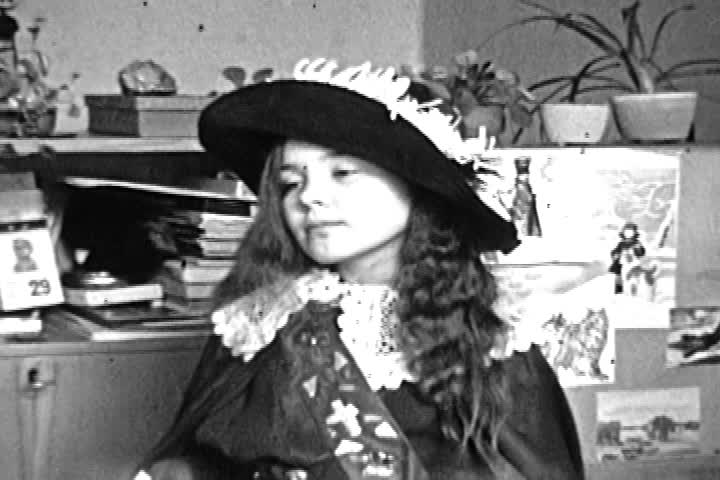
  • Then there is me in a costume of the Pirate Queen Grace O’Malley, I read something about here that year. I was so fascinated with her story that I wanted to impersonate her. Most of the costume is assembled from different pieces of adult clothes and jewelry. The wooden sword was made by the younger brother of my cousin’s best friend. I know that it sounds too distant, but they both were around quite often and felt like family members. 
  • The big black dog is a Newfoundland owned by the friends of the family. He was not a purebred and was given away for free. His name was Neron, and I loved him and used each opportunity to stop by the house where he lived and play with him. 
  • “A Musketeer” episode. Traditionally in Russia, both adults and kids would dress up for Sviatki – the time between Christmas and New Year, culminating at the New Year masquerade. Since all religious holidays were forbidden in Russia, the tradition reduced to the New Year masquerades. This costume was constructed for my school New Year’s party, and I wore it at home for the actual New Year celebration. I was eight years old (almost nine) and was at the peak of my musketeers’ fascination. Everybody pitched in for this costume. My great aunt sacrificed her dark blue pure silk dress, the top was used for the jacket, and the skirt made the cloak. One of my great aunt friends lent a dark-blue velvet hat, another friend – some real antique lace collar and cuffs (all to be returned after the holidays :)). Not Brabant, but most likely old Vologda :). The baldric was made of dark blue bookbinding material (acquired by my aunt who worked in the publishing house) and decorated with the pieces of colored foil collected from the chocolate candies consumption:). The feathers on the hat came from two sources: the black one was a real ostrich feather my great aunt owned, and the white one was made of paper by my aunt – that’s when I learned how to make them, and I still can do it on the spot. I think that covers pretty much the whole costume.
  • The figure skating competition. The caption reads: getting ready for the White Olympics 1980. But that time (February 1972) I was nine, and I was taking the figure skating classes for three winters. We rarely got a chance to train inside, so it was always “weather permits.” I loved figure skating (and I still do :)). Our coach arranged for us to have a very close-to-real competition with the obligatory figures to be performed and with your own freestyle program. The competition was graded by three judges. My great aunt hand made the figure-skating dress for me. It was made of dark red wool with the giant grey snowflake on the chest and beautiful patterns on the skirt – and that’s what I wore during this competition.

Enjoy 🙂

My historical posts are being published in random order. Please refer to the page Hettie’s timeline to find where exactly each post belongs and what was before and after.
Home Movies from 1970s, Part 1

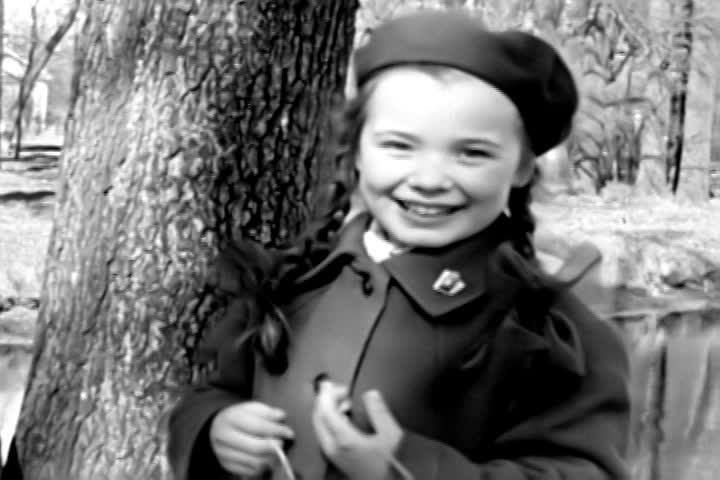
In 1971 my Mom bought a movie camera and started making home movies. We both enjoyed the process a lot. She soon acquired a magnetic board with letters, and we began to add captions to the films.

I do not remember what happened to the movie projector, but it disappeared a long time ago, and I was wondering whether I will ever be able to watch these movies again. Fortunately, nowadays, many companies can digitize your old movies, and several years ago, I sent the first two reels to convert them to mp4. I liked the result, and now that Mom brought several more back, I finally sent them to the same company, and I liked the results even more. 

Today, I am posting the first reel, which covers the time from early spring early summer 1971.

Apparently, if I spent enough time, I should be able to add captions to this movie, but I do not have time neither now, nor in the next several years, so let me just briefly mention what it is about.

The title says “Lialia’s school break.” Lialia was my nickname, and a break was a spring break in the first grade.  Everything was filmed in Saint-Petersburg (back then – Leningrad) and near suburbs.

By episode:

  1. I play with a big doll, which could “walk,” when you hold her by the hand. Her name was Walking Nina.
  2. I am walking around in the city center, close to the Church on Blood, not restored yet back then.
  3. In the Zoo
  4. In the courtyard of my home, playing “classes” on the asphalt.
  5. A canary named Solka. That was an amazing story – one cold November night, he flew inside our apartment when my aunt opened a window leaf for a minute. We tried to find out whether he was a runaway but didn’t succeed. Then we had to buy a cage and some books about canary care:).
  6. Waking at the Strelka – the edge of Vassilievski Island, then on the roof of the Peter-and-Paul Fortress, and then inside the fortress. Then I take a camera and record Mom.
  7. At Strelna, a near suburb. We are there with Mom and Grandpa Fedia, and it’s hilarious how he is trying to help me to climb on a tree, and then helps me to get off, and this all happens three times in a row.
  8. Walking along the Neva River, and then taking a trip on a small boat
  9. In the Alexandrovskiy Park, close to the St. Isaac Cathedral, and by the river again.
  10. Later in spring. Since we see balloons, it should be May 1 or May 2 – we didn’t have balloons on regular days, only for big holidays, and May Day was one of the occasions when kids got balloons. Mom is filming, and I am there together with Mom’s friend Alla and her twin daughters Sveta and Lera. They were three or four years older than me. As a prank, we attach our balloons to the teeth of one of the Griffons on the Neva embankment. 
  11. All of us are back to my house, and we play with a collie puppy in the courtyard (he is not my dog, somebody else’s).
  12. Later in spring, probably mid – May. Mom and I are in Central Recreational Park. First, everybody is casing a squirrel – they are unseen in the city. 
  13. Then – intensive rope-jumping:)
  14. We are visiting an exhibit, which is called “Made in Poland.”

My historical posts are being published in random order. Please refer to the page Hettie’s timeline to find where exactly each post belongs and what was before and after.

Health Updates

Most of my friends are aware that out of my multiple vision-related issues, the most annoying is my double vision. I went for years without any treatment until about five years ago, I got special prism-only glasses to address to issue. I can’t wear these glasses all the time, but I use them for driving and while in the movies or other shows. It helps a lot.

Recently, however, it became worse, and at my annual checkup, I’ve
complained to my eye doctor. She gave me a referral to the specialist, who is primarily dealing with that particular problem. That other doctor examined me and told me that she can work with my double vision, but first, I need to have my cataracts operated. That was news for me; I didn’t know I have cataracts, but that explained a lot about how I felt recently.

Continue reading “Health Updates”

Attending the University: Math-Mech Days

What else were we doing as students except for the studies? There were not many sports. Actually, among nerds it was not cool to do any sports, it was a strong presumption, that only people who can’t use their brain for anything productive, do sports. And the only sport I remember somebody was doing was our gymnastics team. If there were any other, they wouldn’t have any visibility.


There were obligatory political activities. There ere mathematical clubs in schools, which were called YMSCH – Youth Mathematical Schools. They were clubs, after-school activities, but we called them “schools.” And I will write about them at some point.


One of the highlights of student’s life was the Math-Mech Day. I can’t recall now, what was the way of choosing a date for it, but it was some time in spring, far enough from the finals. Later, it was transformed into the Math-Mech Week with different activities every day. But back then, it was not even a day, but just a performance – a student play, written, staged and performed by students, undergrads, grads and postgrads. That was probably the only one informal gathering I can recall from the Soviet era, definitely the only one in the University.

Continue reading “Attending the University: Math-Mech Days”

How I was Fired from Urbansoft

I always say that I never been unemployed for a single day, which is only partially true. There was a day when John called me to the hallway and fired me on the spot.

I mentioned earlier that it was virtually impossible to fire anybody in the Soviet Union. It continued to be the same in Russia on our “official jobs,” which were holding our “labor booklets.” But our official jobs would pay very little for most of us, including me. Urbansoft was probably the only place of work in the whole city, where you would be paid on time, and that money made most of my budget.

G. was in a sort of leadership position in the company. He was the one to call me to say that I am hired. As it turned out, he lived in a house next to mine, which is why he was a person who installed a modem at my place. He would also bring my code to the office on a diskette when I was not able to come to the office.

Continue reading “How I was Fired from Urbansoft”

My Ups and Downs at Urbansoft

At the end of December, John went back to the US for Christmas. I was still working at that “it’s great!” project and on my makeshift database. And I came up with something cool. Something I was very proud of. 

I did most of that work at home because it was time around the holidays. Although I did have a modem, that was before the times you could email a bulk attachment, so usually, I would compress my code with tar command and copy a .tar file to the diskette, and take this diskette to the office. 

The next day John should have to be back, and I was anticipating my triumph. At about 9 PM, when kids were already long asleep, I started to make my final .tar file. 

Nowadays, even some of the younger IT people might not know what the tar command does, yet along those of my readers who are not programmers. The fact is that the tar command has positional parameters, the first one is the name of the file, which is the destination of compression, and the rest of the file names are the files which you are compressing. My project consisted of one huge file with the actual code, and two smaller files with some addition. So I am typing this tar command and hit enter. And the next thing I realize is that I’ve omitted the destination filename! You figured out what had happened – the actual file with the code was used as a destination to compress two smaller files, and thus my code was deleted! 

Yea. Its was bare Linux in 1992. No Time Machine. No UNDO. It was gone. And it was 9 PM of the day before I wanted to show my progress. And it was a week’s work. 

I was going to have a sleepless night.

I found a several days old version of that code and started debugging all over again. It was easier the second time because as soon as I saw a bug, I could remember how I fixed it. But still – that was quite a work. By 3 AM, I was done, and I was still able to bring this code to the office the next day and still had my moment of triumph. But since then, I am very diligent in saving my work. And these days, when anybody is embarrassed with a mistake they made, I am always like – that’s fine, you can’t even imagine how many mistakes I’ve made!

Recap on Volunteering

And one more thing about volunteering. In just two days, several people told me something to the effect of “now I am retired, and I can volunteer.” And one person, whom I met at the volunteering-related event, responded to my question with “I do not volunteer, I work!” I know that in the latter case, I should skip any reaction entirely, but I almost automatically reply: I work, too!

I guess I do not know why people need any excuses for not volunteering. It’s just … up to you, no justification required. Maybe, it’s just a social situation. Or maybe peer pressure…

What Does Volunteering Mean?

Last week, I had several conversations, which made me first upset, then angry, and then angry at myself that I got angry:). And now, I am trying my best to abstract from particular conversations and to say what exactly was so upsetting. 

What does volunteering mean? It means that you want to do something with no pay. And this includes – possibly no thanks. You want to do something because you believe that this something is important. That somebody’s lives: people’s, animals’, plants’ – will become better if you will be doing this – whatever “this” is. 

You say: I want to volunteer. Great. By the way, nobody “has” to volunteer. I will never criticize anybody for not wanting to volunteer. A person can only decide by themselves, whether this is indeed what they want. 

But want I do not understand, and what makes me mad – when somebody expects to be rewarded for their volunteer work. When they get upset that they do not receive enough thanks. When they wonder why others do not want to listen to them or utilize their expertise. 

I’ve lost count of how many times I had heard this: I want to volunteer, I offered my services, why “they” are so picky and do not want me? Why am I not receiving thanks for helping out?

For me, it means that this person does not want to volunteer. They simply want a payment of a different kind. Because when you volunteer, you just give. You give and never ask for something in return. Sure, it feels good when you hear “thank you for all your do!” but that is not a reason why you volunteer.

Also, when you do volunteer, you do the whole thing. There is no “dirty work.” If you want to support this cause, you will do whatever is required in the current situation. In many cases volunteering activities are scary. Or at least uncomfortable. That is a part of the package. 

Student’s Life: Financials

The economic situation of a student in the Soviet Union was very different from the one of the nowadays US college student. Even then, different people had different experiences, and I am going to describe how it looked for me.

We didn’t have to pay anything for our education, and most of us didn’t work, especially during the first two years. As I’ve mentioned previously, most of the college students lived with their parents, so technically speaking, you didn’t have any significant expenses. Most of the college students had government stipends. You would get 40 rubles a month if you didn’t fail any exams in the previous semester, 46 rubles if you got all B and A, and 50 rubles if you got all A.

Different families decided differently on how their college-age children would spend their stipends. Some would request to contribute all the money to the “family fund,” some would say: whatever you want to do with this money, up to you. But most families presumed that their college-age child would start covering some of their expenses. Most often, it would be public transportation, lunches at the University, school supplies, and some of the clothing.

That was doable, but you needed to plan carefully, which not that many of the students could do. Although my Mom taught me to record expenses since I was twelve, it was challenging for me to stay on the budget, when I had my own money for the first time. I guess money management is something you have to figure out from your personal experience.

The most substantial expense was food, lunches in the University, and whenever in the city I would end up wondering after classes were over. We didn’t have a concept of a brown-bag lunch, neither in grade school nor in the University or later at work.

The University cafeterias had commercial espresso machines, although we had no idea back then, that’s what it was :). The “small regular” meant one expresso shot, the “large regular” meant americano, a “double small” meant double espresso, and then it was a “large double” – and americano with an extra espresso shot. And there was no milk of any kind to add to your coffee unless you buy a carton of milk.

The most common food was a hotdog, but it was not what you think. It was a single hotdog boiled in hot water with a piece of rye bread. No hot dog bun, no relish, no mustard, no onions. That would be my typical lunch. Or you could buy two hot dogs. There could be some pastry, and I am trying to recall why I didn’t buy it. Also, there were chocolate bars with filling. And it always felt very exquisite when you purchase a double coffee and a chocolate bar. The bar cost 55 kopecks, more than a hot dog, and it felt like a gigantic waste of money, but it felt so cool :).

If we planned to go somewhere after we return to the city from the campus, we would usually eat pyshkas, a kind of donuts, in a small place right by the Baltic railway station. One pyshka cost 5 kopecks, and a “coffee” – a drink made of dissolved sweet concentrated milk with a coffee flavor – cost 11 kopeks. So for 51 kopecks, you could get four pyshkas and a coffee and be hunger-free until late evening. That was my and other people’s dinner more often than you can imagine.

The public transportation cost from 3 to 5 kopecks a ride, depending on the type of transportation, and electric train tickets were discounted big for students, especially if you buy 3- or 6-month pass. Those passes were non-transferable and had an owner name written in.

A Typical Day of the Student of the Leningrad State University(circa 1980)

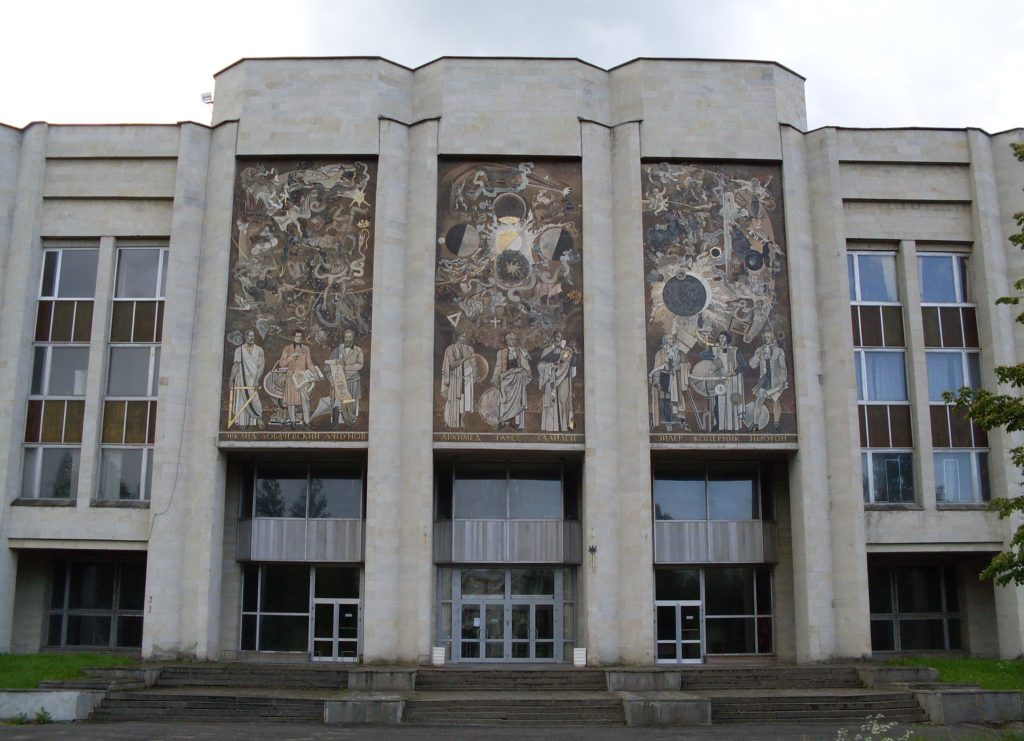
On a typical day, I would wake up, have a cup of coffee (instant or greek, we didn’t have coffee makers) with a little bit of something, and head to the Baltic railway station. There was no subway station close to where I lived back then, so I had to take a tram for about 20 min and then walk.

Each class in the University was divided into groups, like homerooms at school, and everybody in a group would have the same schedule for all subjects, except for English and PE. We felt like one unit, and usually took a train together. Many groups had a designated train car (something like “the third from the locomotive”), and everybody would sit together. In some cases, people might get on the train at one of the subsequent stops, but they would still find their group, and those who got on the train earlier, would hold places for them.

Continue reading “A Typical Day of the Student of the Leningrad State University(circa 1980)”