Young Pioneers

At the end of the third grade, “the most deserving” of us became “young pioneers.” Same as with Octobrists, everybody eventually would become young pioneers, but for this first group of “the most deserving,” it was a big deal. The earliest date for joining the Young Pioneers organization was April 22 – Lenin’s birthday. We had a classroom meeting a couple of weeks before that date, during which our room teacher would carefully guide a discussion about which students were “the best” and “deserve to be nominated to become Young Pioneers.” We would judge our classmates based on their academic records, whether they were “active” (actively participated in extracurricular initiatives), and whether they were “good comrades” for their classmates.

At the end of the discussion, everybody in the room raised their hand to vote for each of the candidates. The first “young pioneers” group was small – less than ten students. The ceremony was held in front of our school (fortunately, the day was sunny and not very cold. Our school’s “official supporter” was a leading ship-building plant. I am unsure what “supporter” means in this context. I wanted to translate it as a “sponsor,” but it was not about money. Although I believe that the plant would help the school financially in some cases, like paying for field trips, the true meaning was “ideological support” and demonstrating that “the school is connected with the working class.” To demonstrate that connection, the representatives from the plant (shock workers and the Komsomol leaders) took part in the ceremony of taking the Young Pioneer’s oath, and after we recited the words of the oath, the line of the plan representatives walked close to the line of newly minted young pioneers. Each of them tied the red tie on the neck of a student standing in front of them. From that day until we turned fourteen, we were supposed to wear a red tie and a young pioneer pin to school every day.

Subsequent groups of my classmates joined young pioneers during May Days, and the last group – in November, close to the Great October Revolution celebration day. I was not at school on the day of the last meeting (I believe I had a cold and stayed at home), but my friends told me that only Natasha Panasenkova was voted to be “not deserving” to become a young pioneer, but she cried, and the class decided to let her join.

By the beginning of the fourth grade, the class would become “a pioneer squad” divided into three “links.” The division was decided in the simplest possible way: based on each student’s desk location. Each link chose its link leader, and everybody voted for the “squad char person.”

We had regular meetings after school (hated by the “inactive majority”) and planned many activities; I will describe them in the next post.

My historical posts are being published in random order. Please refer to the page Hettie’s timeline to find where exactly each post belongs and what was before and after.

Helping In The Kitchen

Last week, my granddaughters asked me at what age their mom started to cook and at what age I started to cook. I could not remember when Anna started, although I remember that by the age of nine, both Vlad and Anna were cooking on a regular basis, and we had a schedule of who was making dinner each day.

As for me, the biggest problem was that in order to cook, I had to turn on a gas burner on the stove, and the burners didn’t have ignition. To start the burner, you had to strike a match, turn a gas knob up and move a burning match close to the burner. The scariest part for me was lighting a match. I was scared to scratch the head of the match with a force enough to produce sparkles. My mom was teaching me, and these lessons would end up with me crying and with her yelling at me. I do not remember why and how I overcame this fear, but it was definitely after I turned eight.

Even warming up the food was not that easy because microwaves didn’t exist (at least in our lives), so I needed to use our gas stove to warm up my food after I was back from school. The food would be most often “cutlets” (now I call them “Russian meatballs”) with potatoes or pasta, and I had to warm it up on a skillet, adding some butter so that it wouldn’t get burned and stirring constantly. I remember that for a period of time, my mom left one burner on (on “low”) in the morning so that I could turn it on “high” when I came home from school and warm up my meal. (There were other adults at home, so I do not know what was the deal and why others could not help me). This was supposedly “dinner,” but all this meal naming was a separate story.

Back to cooking. My help in the kitchen while I was limited to some low-skill level tasks. One of the things I was often assigned (and I hated it!) was to “watch the milk.” The unpasteurized milk from the barrel had to be brought to boil, and I had to stay by the stove and watch, and when it started boiling, I had to turn it off. Otherwise, it would “run away.” Of course, I would look aside precisely at the moment when it happened!
Another chore was making mannaya kasha, which pretty much meant stirring non-stop, making sure it was not burned. And another one was potato peeling. It was always done with a knife, and the quality of my work was judged by how cleanly I peeled potatoes and how thin the peel layer was so that the waste would be minimized. More than fifty years later, I am still a potato peeling champion.

My historical posts are being published in random order. Please refer to the page Hettie’s timeline to find where exactly each post belongs and what was before and after.

More Family Photos

Baba Ania’s birthday was on Sunday. When I went to Mom for our traditional afternoon Sunday coffee, I also took a small bottle of liquor with me, and we drank in memory of Baba Ania (for some reason, my mom was surprised I remembered the day (?!)).

Unfortunately, I can’t get any new information from my mom in addition to what I already know. Maybe I will be able to fill in the gaps later – I made some recordings of mom’s stories when she first came to the US, but now I need to find and decipher them.

I know that Baba Ania was “from a village”; however, the photograph below shows a group that could be anybody but peasants. These are four Grigoriev brothers; the first from the left, Petr, is Baba Ania’s father.

According to mom’s notes, Petr was either the second or the third of the brothers, next is Stepan, the fifth (the youngest) next is FIlipp (either the second or the third) next – Alexey, the fourth child, and last one is the oldest brother, Nikolay. Unfortunately, no information about when this photo was taken.

In this picture, Petr should be the first person on the left in the second row from the bottom, according to mom’s notes:

Was it the beginning of WWI? I can’t tell. One more picture, judging by its quality, taken by some “official” photographer, also hints the wartime, but mom’s notes indicate that she could not locate Grandfather Petr in this picture:

No images of Baba Ania’s mother. No images of Baba Ania as a child. The pictures I showed in the previous post were the earliest Baba Ania pictures I have.

And here is the last one prior to her marriage to my grandfather. For her excellent work, she was promoted, and the picture below shows her among the employees of the Eliseyev store – the number one grocery/delicatessen store in Saint Petersburg before the Revolution and later in Leningrad. See this wiki article for details.

Can you find my grandmother? She is in the top row, second from the right.

My historical posts are being published in random order. Please refer to the page Hettie’s timeline to find where exactly each post belongs and what was before and after.

My Mom’s Family Photos

Mom made several attempts to record her family history with various degrees of success.Since both of my mom’s parents came from peasants’ families, I do not think I will ever learn much more about them than I know now. I will start with the earliest photos I have and will record everything I remember about them.

I know that my mom’s mother, baba Ania (full name Anna Petrovna), was born in the Pskov region in October 1911. Her maiden name was Grigorieva, and I believe I have somewhere an information about her brothers in one of the recording sessions with my mom in 2018 . Unfortuntely, I didn’t even start processing them. Surprisingly, I might know more about her childhood than my mom because I spent a lot of time with her during my second and third summers, and she used to tell me stories about her being a little girl. I never herd this storied from my mom, only from baba Ania herself. Being minimally educated, she recognized the importance of reading and self-improvement. She might have attended school for just a couple of years, but liked to tell me how she “already knew everything before she came to school” because “she read books.” She told me: And the teacher said, “well, Nura, you already know everything, so go and help me check other puples work. And here I am, walking along the rows of desks and checking everybody’s work. And all because I read a lot of books, that’s why.”

She left the village and moved to Leningrad when she was forteen to become a live-in nanny. Neither me nor my mom know anything about the family where she lived, except for that appeared to be well off and educated – some books baba Ania owned presumably came from that house.

In two years, she was already looking for a more prestigious job – a store clerk. On this picture, she is sixteen or seventeen, and she works in a grocery store near Warsaw railway station in Leningrad.

Bakarey department
Grocery department
With coworkers in the same store
In the Red Corner studying something politically-important

Looks like it was cold both inside the store and in the Red Corner since most people stay in their coats.

I can’t decode most of the slogans from the third photo background, but I can tell what was sold in the grocery department. Th list includes tea (“natural” and “surrogate”, sugar, buckwheat, millet, oatmeal, flour, coffee (also real and surrogate), several brands of sigaretts, matches, candles, shoe polish, black pepper and mustard.

My historical posts are being published in random order. Please refer to the page Hettie’s timeline to find where exactly each post belongs and what was before and after.

After-School Activities

Thinking about most of my schooling years, I am retrospectively surprised by how little of the cultural events were there. There was almost nothing going on after school. In the third grade, I started to take piano lessons, which our school music teacher was giving. There was one 15-minute lesson a week for the price of 5 rubles (I was giving the money to the teacher at the beginning of each lesson). I neither liked nor disliked it. I thought the girls who played piano were cool, and I wanted to do the same. Nobody forced me to do piano, so it sort of went on until the eighth grade when I didn’t have enough time to do this and stopped. I didn’t play any sports, and I didn’t have any other extracurricular activities until I started to attend theater classes at the nearby House of Culture when I was already in the fifth grade.

I liked reciting poetry, and I was good at it – I still had an excellent memory and didn’t have a problem memorizing long poems and stories, and I enjoyed reciting all these pieces “expressively.” Like many other girls, I wanted to be on stage, but the teacher in the theater class wanted me to do storytelling – he thought I was better at that. Recalling the details, I believe he was a very good teacher, and he took the kids seriously. The core of the class was several extremely talented boys, and it was apparent to me that I was no match, not even close. In contrast to most of the amateur theatrical groups, our’s was constantly looking for talented girls rather than boys, with very intermittent luck.

These classes were no joke. Our teacher spent time with me one-on-one, going through the text. The first time I would start a new story, I had to copy it into my notebook and highlight the most important word in each sentence (and to be ready to explain why this is the most important word). Then, we would go through the text countless times. He said that this stage was not a creative stage but “craftsmanship.” Only after I passed this stage and learned the whole text by heart was I allowed to start adding emotions and other creative elements. I still remember that my best reward was when I saw my teacher laughing after I finished a humorous story at one of the concerts.

All of this, however, was happening in middle school. All the classes were free, and I went to the House of Culture and signed myself up – no parent’s content was required. As for elementary school (from first to third grade), there was nothing for me except for reading after school. Activities like going to museums or theatrical performances were extremely rare. The only “children’s” theaters were two puppet theaters (and it was hard to get tickets for these performances). Museums didn’t have any children’s studios or any kid-centered activities, and things like “children’s museums” didn’t exist. That’s for all this “most cultural nation”…

Most of the weekends (actually, Sundays only, since we had school on Saturdays) included sleeping in, going for some city walks, and almost obligatory visits to my grandfather. As I mentioned earlier, the apartment where my grandfather lived was very far from the city center. It was hard to believe that it was considered to be “within city limits.” The were multiple ways to get there, none straightforward, and all taking about one and a half hours each way. I can’t believe how much time was wasted so reproductively; I didn’t even read on the tram.

My grandfather, with his niece Tamara, who came to visit him from Beslan.

My historical posts are being published in random order. Please refer to the page Hettie’s timeline to find where exactly each post belongs and what was before and after.

Second And Third Grades

It does not look like I have any photos taken during my second grade. It could be partially because my mom was a lot into the home movies at that time. In fact, pretty much all home movies I have were filmed in 1971 – 1973 (See here, here and here).

When I was in the second grade, I started to develop myopia, and for some reason (although everybody in the family wore glasses), it was a world-class tragedy. The ophthalmologist wanted to try some new methods on me. I do not know what was the logic behind these methods, but both of them were essentially building more obstacles :). The first was that when I was reading or writing, I had to wear bifocal glasses, which had “plus” instead of “minus” on the bottom. I believe that the idea was that I would “try harder” and my vision would become better, which obviously just made things worse.

Another torture was of the opposite kind. Three times a week, I had to come to the ophthalmologist’s office and spend twenty or thirty minutes staring at the table for vision checking while wearing more “minus” than I needed. Again, I think that this way, I was supposedly “training” my eyes “to try harder.” It took a lot of time from my life (fortunately for my mom, she didn’t have to take me there; the doctor’s office was on the same street where I lived, but still, I remember how annoyed I was by the fact that I had to waste this time and by the torture itself).

Other than that, my life was pretty dull. I walked to school in the morning, walked back home at 1 PM or 2 PM depending on whether I had English class on that day, warmed up my late lunch, did my homework, which sometimes was very time-consuming and always boing, most times (unless I would forget), I did my chores, which included watering the house plants, dusting the surfaces and sweeping the floor in our room (if you already lost the context, mom and I shared a room in an apartment where my father’s family lived). I also had to shine my boots, because mose of the year, the weather outside required boots.

Whatever free time I had, I spent on reading. During my elementary school years, my mom started to attend different evening classes, and as far as I remember, she had something almost every evening. I remember that one year, she studied French, and another year, she studied German (I do not think she succeeded much in any of these languages, but she tried). Also, she was attending sewing classes and knitting classes. I was quite happy to be left “unattended,” and spent all this time reading. The bulk of my reading was Alexander Dumas, Fenimore Cooper and Walter Scott, with occasional Conan Doyle.

Good books, or just decent books were difficult to get, you could not buy the books you wanted in the bookstores, and you could not get the books you wanted in the library. Since my aunt worked in the publishing house, she had access to the “special” library, which is why I had a chance to read “The Lost World” and “Pippi Longstoking” (do not ask why the latter one was also “a deficit.” )

For a while, we only had one TV set in the apartment, which was placed in the “dining room” (actually, one of two rooms where my aunt and my great aunt lived). Sometime in the early 70s, my mam got a chance to purchase a TV just for us, so we could watch it in the evenings sitting on her sofa. She also got earphones (probably form work), and sometimes she watched something when I was already asleep, or at least was supposed to be asleep).

The radio (combined with the vynil disk player) was located by my mom’s bed, and one of our Sunday morning activities included listening to the “Good Morning!” show while still in bed. I know it is hardly possible to believe that there were times when I would get out of bed way past 9 AM!

A couple of pictures from 1973 that I could find!

Continue reading “Second And Third Grades”

Learning English At School: Visiting Teachers

A very unusual thing about my school was that we had “visiting teachers” from abroad – “zagranitza” felt unbelievably close. I remember two visiting teachers, both of them taught for a semester. 

The first teacher was Mr. McCarthy, and he was from the UK. I believe I was in the sixth grade then. He rotated through all of our English “groups,” so each group had him two or three times during a semester. It is possible that he taught the upper grades more frequently, but I was in the sixth grade and didn’t care. A couple of times, he gave presentations for a bigger assembly, talking about the UK and the educational system there. I remember that somebody asked him how much he was making, and he said that that’s the same as asking a woman how old she is, but that he would respond. I do not remember the numbers now. He explained that he would make more if he taught in a public school (in contrast to the US, the UK “public schools” are private, highly selective schools.) I also remember that our English teachers were ecstatic for the opportunity to have conversations with a native speaker.’

The second one (a year later) was Mr. McFerson, and he was from the US. The arrangements were more or less the same, so we had several classes with him. I remember how he told us a Goldilocks tale, and before he started, he explained two words from this fairy tale. I still imagine him saying: porridge – kasha, Goldilocks – Masha. However, the thing which impressed us most during this class was that he sat on the teacher’s desk and lifted one of his feet, putting it almost on another knee. I also remember how on Thanksgiving (which had to be a workday for him), our group monitor presented him with a souvenir doll and said: Mr. McFerson, we congratulate you with your national holiday Thanksgiving Day!

One thing to credit to our teachers: we didn’t feel like understanding the native speakers was “too difficult.” We understood English and American accents and were not shy to talk. 

My historical posts are being published in random order. Please refer to the page Hettie’s timeline to find where exactly each post belongs and what was before and after.

Learning English At School

I started the series about an elementary school in the Soviet Union by
stating that across the country, all schools were almost the same in terms of what they taught and how did the schedule look like. However, there was something special about the school I attended – it was a “specialized English school with several subjects taught in English.”
The overall quality of foreign language teaching in the Soviet Union was poor, and Soviet people were notorious for not being able to communicate in any foreign language,
In our school, things were better, although far from perfect.

In all ordinary schools, students started to learn a foreign language in the 5th grade, while we started in the second grade. More importantly, for English lessons, classes of 35 + students were divided into three groups, so we had more interactive instructions.
In the second grade, we had English three times a week (which meant that we had five periods instead of four on these days). At least once a week, we had lessons in “lingo rooms,” where our desks were equipped with headsets to listen to the tapes recorded by the native speakers and practice pronunciation.

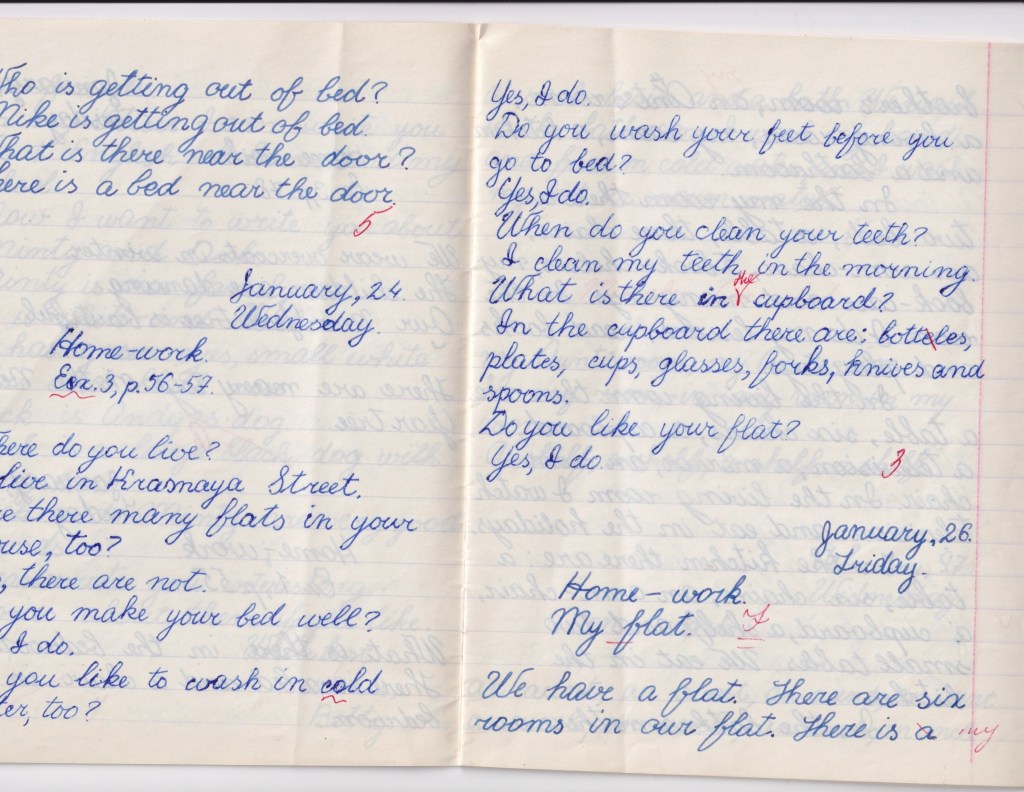
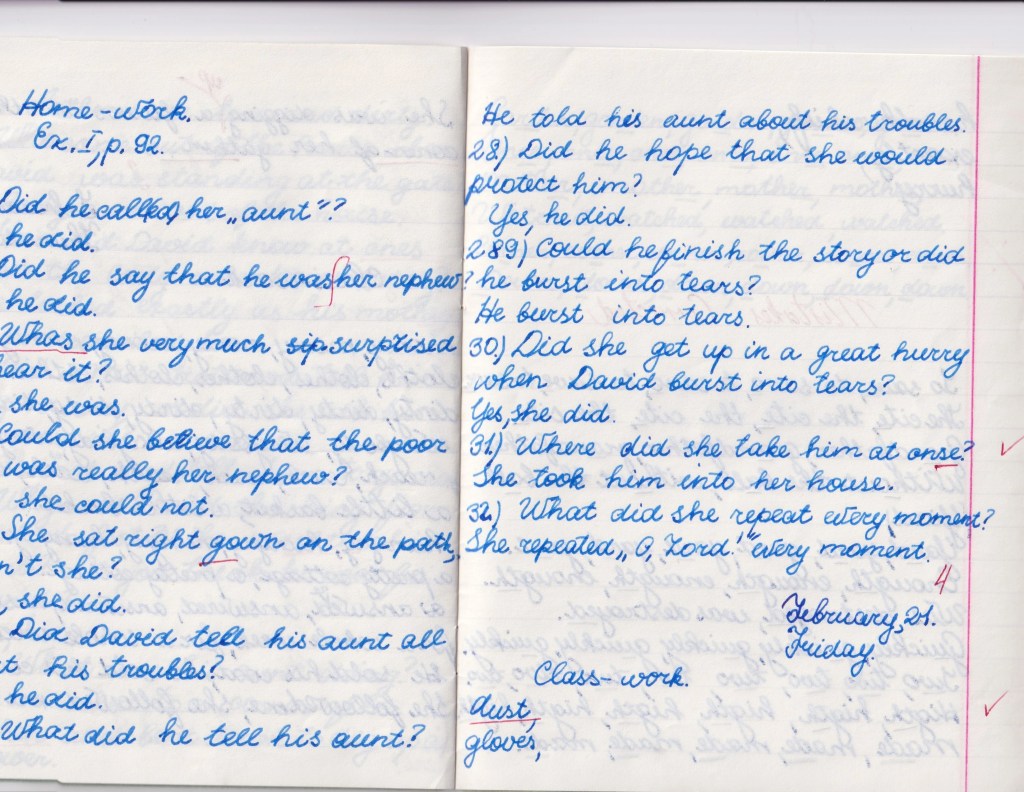
I should have my second-grade English notebooks somewhere, but I could not find them, so here are my third-grade ones. We did a lot of writing and reading but also a lot of oral practice, so by the end of the eighth grade, my English was fluent (I lost some during High School and got it back in the 90s when I started interacting with foreigners.

I think that by the fith grade, we had English every

In the upper grades, we used to joke that they were educating us to become spies, and we could not imagine how close to reality these jokes were.

My historical posts are being published in random order. Please refer to the page Hettie’s timeline to find where exactly each post belongs and what was before and after.

Elementary School In The Soviet Union, p.2

For the first three years of school, all the classes were held in the same room, except for PE and singing. Even in the first grade, the desks in the classroom were arranged the same way as in high school, three columns with six desks in each, with two students sitting at one desk. I know it is hard to believe now, but at seven, I was relatively tall for my age, so my place was in the fifth (out of six) row in the right column. My neighbor was a girl named Sonia Skorpileva. She was taller than me, clumsy, with messy hair and a leaking fountain pen. We all were as cruel as seven-year-olds could be and made fun of her. Unfortunately, the teachers often supported such behavior, publicly shaming the students for even minor mishaps. For example, on the days when we wore white aprons, we were also supposed to have white ribbons in our braids (and black or brown ribbons on regular days). One girl (and I even remember her name, Natasha Ponasenkova) had purple ribbons. Although it was our first First Day of School, our teacher called her out, put her in front of the class, and allowed everybody to laugh at her for these purple ribbons. And then she told her to tell her mom that the ribbons had to be white. She was a very pretty girl, but we never acknowledged that since she was from a “troubled family.”

Since the very first day of school, it was expected that we sit still for all forty-five minutes of each period. We were almost never allowed outside during the break, even though the school had a courtyard.

After a month or two, the teacher started grading both our classwork and homework. The grading scale was from 1 to 5, but 1 (“very bad”) was almost never used, 2 was already “bad” or “unsatisfactory.” Starting from the second quarter, we had “quarterly report cards,” which mostly presented the mean of all the grades one would receive in class through the quarter. At the end of the first quarter, all of us became Young Octobrists, the communist organization for kids aged from seven to nine. All Young Octobrists wore a pin on the left side of the chest: a small plastic or metallic start with the portrait of Lenin at the age of five in the middle. The name “Octobrists” (Oktiabriata in Russian) referred to the “October Revolution.” Since in 1917, the official calendar used in the Russian Empie was the Julian Calendar, all the dates were two weeks behind the rest of the world, thereby the Revolution happened on October 25, not on November 7. Although Russia switched to the Gregorian calendar in February 1918, by that time, the Revolution was already called “the October Revolution,” or “The Great October Socialist Revolution,” or simply “The Great October.” It was too late to change the trademark, so it continued this way. So, we all were “Young Octobrists” and wore these “Octobrists’ pins” on the left.

I know that all I am describing sounds pretty dull, but I didn’t think my life was boring or uninteresting at the time. My old post with the home movies covers the second half of the first grade, and there are lots of fun activities!

My historical posts are being published in random order. Please refer to the page Hettie’s timeline to find where exactly each post belongs and what was before and after.

Elementary School In The Soviet Union, 1

With this post, I am starting a series of “what were the schools like” in the Soviet Union, mostly for my grandchildren’s benefit.

***

Schools in the Soviet Union used to be way more uniform than in the United States. That’s why, although I describe the schools I attended, most things were the same no matter where in the Soviet Union the school was. The situation started to change rapidly during Perestroika, but until then, things remained remarkably unchanged.

Though the title of this post says “Elementary,” the concept of “elementary” was rather abstract. Except for rural areas and some specialized schools, a school would host all grades from first to tenth, and unless somebody moved (which didn’t often happen in the Soviet Union), you would be together with the same thirty classmates for five to six hours a day six days a week for ten years!

The majority of schools were what is called “zoned” schools in the US, meaning that you have to live within certain boundaries from the school to be able to attend it, and most times, there was no choice.
My situation was slightly different because the school nearest to me was a “specialized school with in-depth learning of English.”

This fact created an interesting disposition because the school had to take all the kids who lived nearby, but also, somehow, the kids who lived further away could get in through an interview. After Perestroika, the entrance exams to elementary school became common, but in the Soviet Union, these were uncommon and, if I get it right, sort of “unofficial.”

Unfortunately, my mom is not a source of reliable information anymore, and she can’t tell how exactly it worked. I remember she took me to an interview several months before school started, and I know she was anxious that they might not take me because I could not pronounce the “r” sound.

I do not remember the questions the interviewing commission asked me, but it was an easy conversation. Once again, I can’t tell why I had to go through the interview. There were several kids from “troubled families” in my class and some from “working-class families” whose parents were unlikely to care about what school their kids were attending.

In the first grade, our curriculum was identical to that of all the first grades n the Soviet Union. We attended school six days a week, and we had four periods each day. Three periods were always the same, reading, writing, and math. And for the fourth period, we had PE twice a week, “labor” (that weird subject included anything done “by hands” mostly crafts; do not ask me why “labor”), art (drawing) once a week, and music (singing) once a week. The order of periods differed each day: all three core subjects were taught by our room teacher, and different teachers taught the other three, so we had to fit into their schedules.

The classes started at 9 AM. Each period was 45 minutes, and the breaks were either ten or twenty minutes (“long breaks”). One of the long breaks was a lunch break. For the first graders, it was from 10-40 to 11 AM. While in elementary school, we didn’t have the option to choose what to have for lunch, and as far as I remember, we didn’t have an option NOT to have lunch. At the same time, lunches were not free. Each of us had to bring one ruble on Monday that covered that week’s lunches. Our teacher would call each of us to her desk in the morning, and each of us had to come up and give her that one ruble, and she would make a note in her list. I remember that once, a student gave her a ruble torn into two pieces, and I remember her yelling at him.

It was always a hot lunch, but the quality of it was relatively poor, as with almost all of the “public catering” in the Soviet Union. Surprisingly to Americans, milk was not a part of that lunch. Middle-schoolers had an option of buying their snack, which included milk and pastry, and we all could not wait for this option to become available. We barely ate this lunch; we would all go home at 1 PM and eat lunch there, so it’s not like it was so necessary.

The school was less than ten minute’s walk from my house, but I had to cross the street (not at the intersection), so my mom was very anxious about it. I even remember how she taught me to ask “an adult” to help me to cross. The short way to get to my school was through the passage yard, and the entrance was almost in front of our building; that’s why I was crossing not at the intersection. To be honest, there was no significant difference since the rules of the road were loosely obeyed by all parties.

My historical posts are being published in random order. Please refer to the page Hettie’s timeline to find where exactly each post belongs and what was before and after.