On family history, parenting, education, social issues and more
Author: Hettie D.
My name is Henrietta (Hettie) Dombrovskaya. I was born in Saint-Petersburg, Russian (actually, back then – Leningrad, USSR) in 1963, and immigrated to the United States in 1996.
I love Saint Petersburg, the city I was born and raised in, and I think it’s one of the most beautiful places in the world. Similarly (but differently) I love Chicago, and can’t imagine myself moving somewhere else in the observable future.
I have three children, Igor, Vlad and Anna, all adults living on their own, and one (so far) granddaughter Nadia. I also believe that my children are the best thing that happened in my life.
As for my professional life, I am working in the field of Information Technologies. When I was twenty, I’ve declared that the databases are the coolest thing invented and that I want to do them for the rest of my life. Thirty plus years later, I still believe it’s true, and still, believe that the databases are the best. These two statements together imply that I think a person can have it all, and indeed, I think so! Keep reading my journals to find out how I did it.
Yet another “one of a million” article about why people should take a vacation. Most time, no matter how many references to the rest of the world the author includes, these articles change nothing. What I like in this particular article is how the author, Alex Soojung-Kim Pang, emphasizes the importance of short breaks rather than long European vacations.
The full text below.
There are few things better for us than regular rest. Whether it’s breaks during the day, hobbies that take our mind off work, weekly sabbaths or annual vacations, routines that layer periods of work and rest help us be more productive, have more sustainable careers, and enjoy richer and more meaningful lives.
Too often, rest gets a bad rap in our always-on, work-obsessed world. It’s also the case that learning to rest well is actually hard. Why is that? And how can we rest better?
Americans have long been known for our industry and ambition, but until recently, we also recognized the value of rest. The Puritans had a famously strict work ethic, but they also took their Sundays very seriously. In 1842, Henry David Thoreau observed, “The really efficient laborer will be found not to crowd his day with work, but will saunter to his task surrounded by a wide halo of ease and leisure;” a decade later he wrote, “A broad margin of leisure is as beautiful in a man’s life as in a book.” Post-Civil War captains of industry didn’t rise and grind, according to business journalist Bertie Charles Forbes: “No man goes in more whole-heartedly for sport and other forms of recreation than” industrialist Coleman du Pont, while Teddy Roosevelt “boisterously… enters into recreation” despite a busy public life. At the same time, union organizers, mass media and entertainment, and the parks movement democratized leisure: rest became a right, enshrined as much in college sports and penny arcades as in labor law. Richard Nixon, during a campaign speech in 1956, predicted that “new forms of production will evolve” to make “back-breaking toil and mind-wearying tension” a thing of the past, and “a four-day week and family life will be… enjoyed by every American.” Together, these sources paint a vision of American life in which work and leisure are partners in a good life, and “machines and electronic devices,” as Nixon called them, created more time for everyone.
But in recent decades, the world turned against rest. Globalization, the decline of unions, and the rise of gig work are factors that have created an environment in which people and companies feel compelled to work constantly. The CEO, for example, who steadily worked his way up from the mailroom to the corner office has been replaced by the 20-something genius who makes billions by disrupting the system. Technology lets us carry our offices around in our pockets, and makes it almost impossible for us to disconnect from work. Even the blue-tinted glow of our screens and late-night traffic noise can have a measurable impact on the quality of our sleep. Add raising children and managing family schedules, and Thoreau’s “wide halo of ease and leisure” sounds great, but ultimately, impossible.
Early in your career, it’s easy to believe that passion and youthful energy are inexhaustible. But at some point, family demands, a health scare, or the passage of time forces you to find ways of working that rely on experience rather than raw energy, are more sustainable, and let us run marathons rather than sprints. Not everyone successfully makes the transition. But in studying everyone from Nobel laureates and emergency room nurses, I’ve found that people who are able to do the work they love for decades, rather than burn out in a few years, share a few things in common.
It took me a while to replace the toilet in the smaller bathroom, even after a plumber told me it was time to stop fixing it and get a new one. A new one required at least some thinking and planning, and I had enough going on. Finally, I went to Lowes, ordered a new one, and the installers came and installed it. Right after that, I went on my European trip.
Then I returned, and after a while, I was sure that something was not right: it was not flushing enough water. Boris told me that he would be able to fix it. I just needed to wait until he came next time, but I decided to call the installers because I thought they messed up and should fix it. As always, it took me a while to make a call, and while Lena visited me, she checked and said that she was not sure why the tank did not fill to the maximum. Finally, I called the installers and scheduled them to come back and take a look. Now, the funny part: when they returned and checked, it appeared that everything was working normally. I simply forgot that in some models, you need to hold the flush to keep the water running. And I completely forgot that this could be the case – I didn’t have such models for a while! So there was no need to suffer for two months. Just a user error 🙂
Yesterday, I went to see “Peelopiad,” a play by Margaret Atwood, at the Goodman Theater. I hadn’t been to any of Goodman’s plays for a while, and my experience with this theater during the previous two seasons was mixed. A couple of times, I felt like a total waste of time, and at some point, I regretted getting a “Whenever Goodman” subscription.
This time, however, was different. I liked each and every single thing about this play. Same as in “1776,” which I saw a couple of seasons ago on Broadway in Chicago, it’s all-female cast, and the same as with “1776,” after the first fifteen minutes of the show, you stop thinking about it. I copied all photos and videos that are available on the Goodman’s website, and I know they still do not give a full impression… All women playing male roles are incredible!
The best thing that happened to me in Pasadena was Amara Cafe! It was on the list of recommended places to eat from the hotel reception. I was a little bit suspicious because I didn’t know much about Venezuelan cuisine, and Mexican cuisine is not my favorite, but after some hesitation, I went there, and I was sold on the spot!
I asked the clerk what kind of hot chocolate he’d recommend, and he said: Venezuelan, of course! I ate my arepa and proceeded with hot chocolate. Never in my life, even in Lausanne, I tasted hot chocolate like this! I was sitting, sipping it slowly, and taking it in. It felt more than a drink, more than a food – a complete mind and body experience!
I returned to Amara one more time, on Sunday morning- thankfully, their opening time does not change, and although the city was mostly asleep at 7-30 AM on Sunday, the chocolate was ready.
The owner came out and asked me how I liked it, and I tried to describe my feelings:). He said: you can make it at home, and gave me a package: just follow the instructions! I am unsure whether I can really do it myself, but I will give it a try!
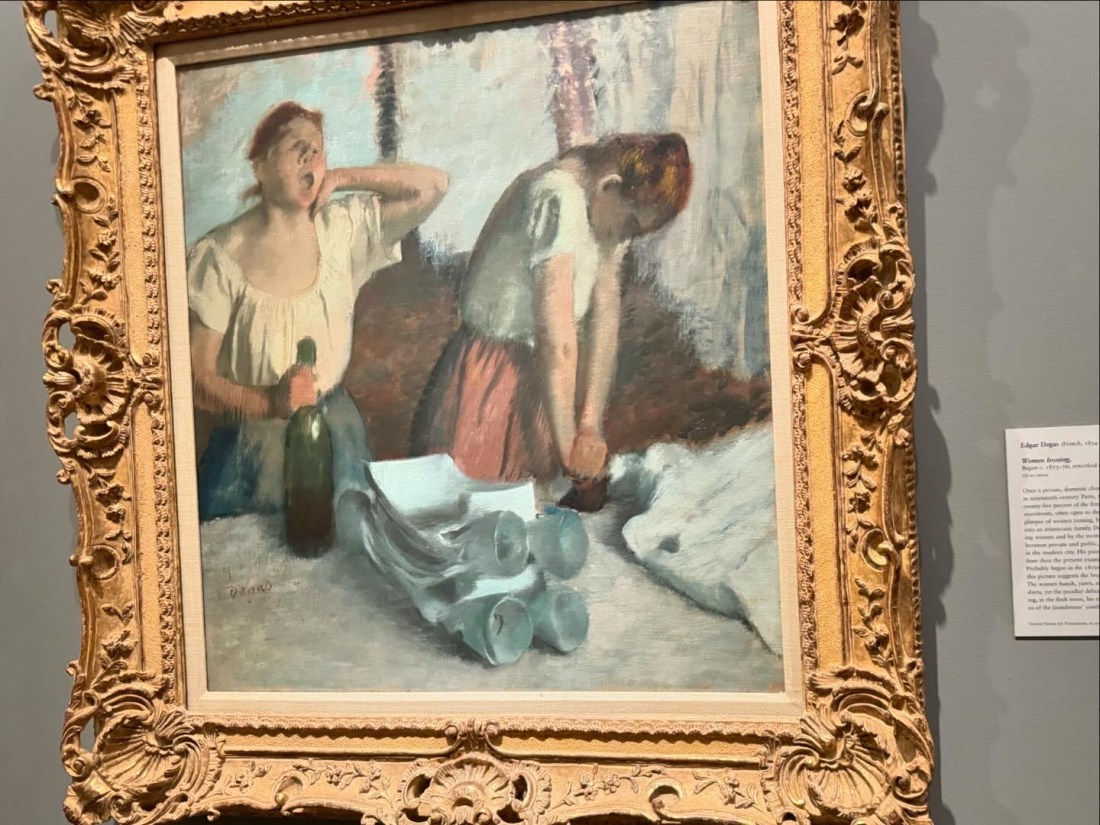
One of my old friends, with whom we unintentionally fell out of touch about ten years ago, lives very close to Pasadena, and I messaged her on my way to the conference. To my delight, she immediately responded, and we agreed to meet. We ended up meeting twice: on Friday night, when we mostly talked, and on Saturday night, when we went to the Norton Simon Art Museum.
The museum is incredible – the whole collection was put together by one person, and although relatively small, it contains an amazing selection of the finest works of world art. I also quite enjoyed reading the annotations to the artworks: detailed, clever, thought-provoking. I didn’t even notice the time when we were informed that museum was about to close.
Just a couple of artworks to illustrate my point: in an hour and a half, a complete history of European art from 13th to 20th century is unfolding in front of you, and each major trend and style is covered. I recall this visit and smile 🙂
The most interesting part of our DC trip was the visit to the National Arboretum, specifically to their Bonsai exhibit. Vlad asked us whether we would be interested, and we said yes, but then all the plans got mixed up because of the weather, and I guess Vlad didn’t want to pressure us. We still said we wanted, and it was great! Vlad and Dylon are a lot into bonsai, and they train several bonsias on their deck. Vlad’s knowledge on the subject is really impressive and he talks about it with real passion. I learned a lot of new things from him, like the fact that most often bonsais are found in nature, and then people keep training them and guiding their development. A lot of bonsais in the Arboretum are more than a hundred years in training, and for many, the date they were discovered is unknown. Vlad explained to us the differences in bonsai styles, and which species are used most often. When he was in Japan, he was gifted a catalog of the first after-WWII bonsai exhibit, and we looked through it:).
I took a lot of pictures; I will post a small portion of them, just to demonstrate the variety of what we saw.
There have been several personal finances-related publications in TIME magazine recently, and I read all of them because they help me to understand what others are having trouble with. I often talk to people who are “afraid of credit cards,” and I could never understand what’s the problem: using cards is convenient, and I record all my spending anyway; what’s it to be afraid of? I also never understood the recommendations to close all your credit cards. For me, it’s a gigantic convenience, and I could never understand how not having credit cards would help control spending.
Apparently, I am in the minority. People are still shocked when I say I never had any credit card debt. I am extremely uncomfortable when, for some reason, I can’t record my daily expenses for a day or two, and losing my Excel files with expenses is my worst data loss nightmare. I need to know how much I spent this month, this year, and today in each expense category. As I mentioned recently, I am not a “saver”; I am at least half a “spender.” Still, I find it very difficult to understand the behaviors described in this article, and I am trying to understand them.
My credit card is a mangled thing. Its blue plastic backing is peeling so much that it doesn’t work in swipe machines; it looks like a dog chewed it up and spat it out. It seldom leaves my wallet anymore. But that doesn’t matter. In the two weeks before I wrote this story, I spent more than $4,000 on my card without laying eyes on it.
Each of these transactions was made online, where my card number is stored by Uber or Walmart or Google Chrome. That’s probably why I didn’t flinch when I spent $333 on groceries for a weekend with friends, or $48.34 on a pizza through Uber Eats, or even $1,533 for an Airbnb when my extended family comes to visit. Without having to type in my card number, the pain of the purchase was dampened.
Frictionless transactions are common in today’s economy—you can wave your cell near a cash register, press “buy” on Amazon without really knowing which credit card you’re charging, and send money to a stranger via your phone without having met them in person. There’s even a company, McLear, marketing a ring that you can use to pay for things.
These technologies, often referred to as “fintech,” for financial technology, make spending easier than ever before— and there’s growing evidence that they’re making us shell out more than we realize. With so many different accounts to keep track of and so many merchants smoothly debiting what we owe every month, we just keep on spending, whether we can afford it or not.
U.S. consumers spent a record $19 trillion in December 2023, up 6% from a year prior and 29% from February 2020. Spending has soared despite high inflation, high interest rates, and repeated commentary from economists that this ebullience can’t continue. And yet it has.
There are, of course, a few reasons why people are spending a lot of money right now. Consumers saved a lot of money when they were stuck at home during the pandemic, and now they’re making up for lost time by traveling, eating out, and doing all the things they couldn’t’ during quarantine. The government helped consumers feel flush by sending out stimulus checks and pausing student loan payments. After years of slow wage increases, workers’ payments are finally growing more quickly than prices, giving them extra pocket money.
But there’s one additional factor that has changed since the beginning of the pandemic: people are more accustomed to using financial technology to pay for things, which eliminates barriers that might have once slowed their spending. “Convenience makes it much easier to enjoy the process of shopping, removing the additional difficulties of buying things,” says Yuqian Xu, a professor at UNC’s Kenan-Flagler Business School who has studied frictionless payment methods. Research shows that the more frictionless the payment method, the more money people spend.
By 2023, 73% of consumers had paid for something through a website or browser on a phone or computer, according to a McKinsey survey, up from 46% in 2019. People are also more comfortable using mobile payment apps like Apple Pay, Google Pay, PayPal, and Venmo; more than 53% of Americans surveyed by Forbes Advisor in 2023 said they used digital wallets more often than traditional payment methods.
Paying with a mobile phone is faster than using a credit card—it takes an average of 29 seconds versus 40, according to Xu, the UNC professor. That speed and convenience accelerates spending, Xu and her colleagues found in a July 2023 study that tracked spending after the launch of Alipay, a mobile payment service. It indicated that credit card transaction amounts increased by 9.4% once people could use a mobile device, while the frequency of transactions increased by 10.7%.
The result is a cycle of tech adoption that has loosened customers’ wallets. Once consumers started using mobile payments, they became more comfortable with making credit-card payments on their computers, and started moving more money digitally. And once they were comfortable spending money digitally, they started spending more money overall.
Elizabeth Mendoza, a 33-year-old who lives in Washington state, says she was getting her debt under control before the pandemic by setting aside cash twice a month for various budget categories like groceries, gas, or her cat. She found that she spent less using cash, because she would think twice about parting with a large bill.
But once COVID-19 hit, Mendoza got into the habit of buying things online and saving her credit card information in different apps. Soon, she found herself back in about $20,000 worth of debt. “Once I stopped using my cash,” she says, “I stopped paying attention to what I was doing.”
In October 2023, Mendoza vowed to get out of debt and removed her credit card from any app that would save it, including Apple Pay. She creates colorful envelopes every month to put her cash in to make the process more fun. It’s more of a hassle to buy things online now since she has to go find her wallet and type in her information. But she says it’s made a huge difference in her spending. “It’s just so easy to fall into using your credit card and not keep track of what’s going on,” she says.
Economists refer to the way people organize and spend their money as mental accounting. Humans are often irrational with the way they choose to spend and save money—splurging with a $100 bill found on the sidewalk while fastidiously saving every penny of their salary, for instance, or spending more money on the same item if they’re paying via credit card than if using cash.
Mental accounting is a big reason people spend more with frictionless payments. Consumers think of new apps like Buy Now Pay Later or Apple Pay as a separate budget category that enables new spending, says Michael Gelman, a finance professor at the University of Delaware. In an experiment, Gelman tracked the behavior of consumers who had received a random credit card in the mail. While those consumers’ spending behavior on their old credit cards remained the same, they started to splurge on their new one, dropping 26% more than people who had not received a new card. “Once you open a new budget category, you manage it separately,” he says. “It can have an effect on total consumption: you consume more because you have the opportunity.”
Yanibel Colon, a 35-year old account manager who lives in the Bronx, was once the type of person who would buy things with cash and use her credit cards for emergencies. But cooped up at home during the pandemic, she started putting more things on her credit card, and using Buy Now Pay Later services. She mentally categorized Buy Now Pay Later spending as cash, which got her into trouble. “I was like, ‘Well, it’s not a credit card, I don’t have payments,” she says. Now, she sets a budget every month for certain categories like food, and makes sure she doesn’t exceed them, no matter how she is paying.
Strong consumer spending has helped stimulate the economy and provided healthy profits for companies that depend on the American consumer. Walmart, for instance, saw online sales grow 17% in the last quarter, and made about $1.2 million a minute in 2023. Amazon reported its highest operating profit in history in its February earnings report.
But many American consumers are spending beyond their means. Household debt reached a record $17.5 trillion in the fourth quarter of 2023, and has increased by $3.4 trillion since the end of 2019, according to data from the Federal Reserve Bank of New York. Credit card debt has “passed a milestone,” says Michele Raneri, VP and head of U.S. research and consulting at TransUnion. Credit card balances now stand at $1.05 trillion, 13% higher than a year ago. The percent of credit card balances that are 90 days or more delinquent ticked up in the last quarter of 2023, according to the New York Fed, reaching nearly 10%.
That’s partly because people have a hard time keeping track of all the places they’re spending money, credit counselors say. The rise of digital payment systems like Apple Pay and Buy Now Pay Later “creates this scattered universe of different payment options that can lead to overspending and financial instability.” says Bruce McClary, senior vice president at the National Foundation for Credit Counseling (NFCC), the largest nonprofit financial counseling organization in the U.S.
“People ask me, ‘How could you let this happen,’” says Britt Reynolds, 28, who uses TikTok to chronicle her journey getting out of $36,000 of debt. “I want to say, ‘Credit card companies gave me a $43,000 credit line, and spending money is the easiest thing in the world.’”
Tanya Menendez, the co-founder and CEO of Snowball Wealth, a financial tracking and education app, says she frequently sees clients who have lost track of their spending because of the many ways they can pay for things. She recently held a workshop for clients and asked them to estimate how much they spent every month on ride-share apps like Uber. They’d estimate they spent $400, she says, only to find that they spent double that on average.
Many of the apps that helped people track their spending have disappeared in recent years. Mint, the personal finance app, will be shutting down on March 23, according to Intuit, the company that owns it. There aren’t many good free options left. “Tracking your spending is really difficult,” Menendez says. “It’s like a vitamin that people aren’t taking.”
Credit counselors have a variety of tips to help combat overspending on frictionless transactions. Jessica Spangler, a money educator whose book, Invest Like a Girl, comes out March 26, recommends not storing payment information in apps. She also tells people to set up their phones so that they get a notification every time they make a purchase, no matter what payment method they use. “That way you’re not just swiping into the void,” Spangler says.
McClary, of NFCC, recommends having only a few accounts where you spend money so you can more easily track them. It’s easy, he says, to set up new accounts through Google Pay, for example, and then forget which credit card it’s linked to, which makes it harder to calculate whether you’re overspending. And those mobile accounts aren’t doing you any favors—the more time you have to think before you make a purchase, he says, the more likely you’ll evaluate whether you can afford it.
As for me, I’ve started putting reminders on my calendar to check my credit card balances so that I can track how my spending on apps is piling up. Not that it’s easy. Digital payments are swift but the process of logging into my account to track them is a headache that involves remembering bank passwords and logins and then waiting for the bank to send me a code to verify my identity. If spending money was as hard as tracking it, we might not do so much of it.
I thought that, in general, the younger generation is less susceptible to online scams, but I was wrong! That’s what TIME magazine explains.
The internet reacted in horror last week at the story of how a financial-advice columnist at The Cut lost $50,000 in a scam, but for many young adults, the tale may be uncomfortably familiar.
While younger, digital savvy folks may be adept at using the internet, Generation Z—born between 1995 and 2012—is more than three times as likely to fall for online scams compared to baby boomers, per a 2023 Deloitte report.
Experts say part of the reason for that is scams are often tailored to the younger generation—more than half of which spends an average of at least four hours on social media daily. “Older generations are going to [fall for] standard phishing schemes through email, or where they get you on the phone, and tell you that your children and grandchildren are in trouble,” says Jonathan H. Swanburg, president of TSA Wealth Management. “The younger generation may just see an ad on Facebook, or Instagram, or TikTok for some investment that’s going to pay you 10% a month with no risk.”
Financial planners point to these get-rich-quick schemes as opportunities to prey on the generation that has inherited inflation, high housing costs, and increased debt. At the same time, younger adults are generally more trusting of what they see online. A Pew Research Center report from 2022 found that adults under age 30 are almost as likely to trust the information they see on social media as information they learn from national media outlets.
“They are not vetting the way you would vet a property manager, or would allow the property manager to do the right amount of research to fix something for you,” says Catherine Valega, a certified financial planner based in Winchester, Mass. “You have too much information coming from people who aren’t really credentialed. With the onset of social media, it probably made things 10 times worse for the younger generation.”
Falling for a scam can prove pricey. In 2023, consumers lost an all-time high of more than $10 billion to fraud, according to data from the Federal Trade Commission (FTC). That number is a 14% increase of reported losses compared to the year prior.
Experts warn that the number of people that fall for frauds or scams may only increase as scams become more complex. Andrew Fincher, a certified financial planner, notes that scammers often attempt to disguise their messages as real emails, texts, or phone calls from a bank—which could be particularly pernicious for the younger adults more comfortable living their lives online. Advancements in AI can also pose risks to consumers as technology makes the scams increasingly elaborate and realistic. “If you’re not paying attention to it, it’s a lot easier to let things go by the wayside,” he says. “Younger adults, typically are going to have a lot more of their finances online—so they do mobile banking, saving passwords in your phone, using similar passwords.” That can make it a lot easier for scammers to access multiple accounts if there’s a security breach.
“The older generation doesn’t have a problem with that because they were never addicted to [being] online and things were never that easy,” adds Valega. “They’ve also had complete distrust of everything online and digital.”









 Hettie's Reflections