How I Feel Here

Several people asked me whether Finland requires a two-week quarantine upon entering. My friend checked in for me when she was contacting the Finnish Border Control, and they told her something to the effect “recommended, but we do not check.” When I exited into the terminal, there were airport personnel meeting returning passengers. They were giving everybody the following flyer:
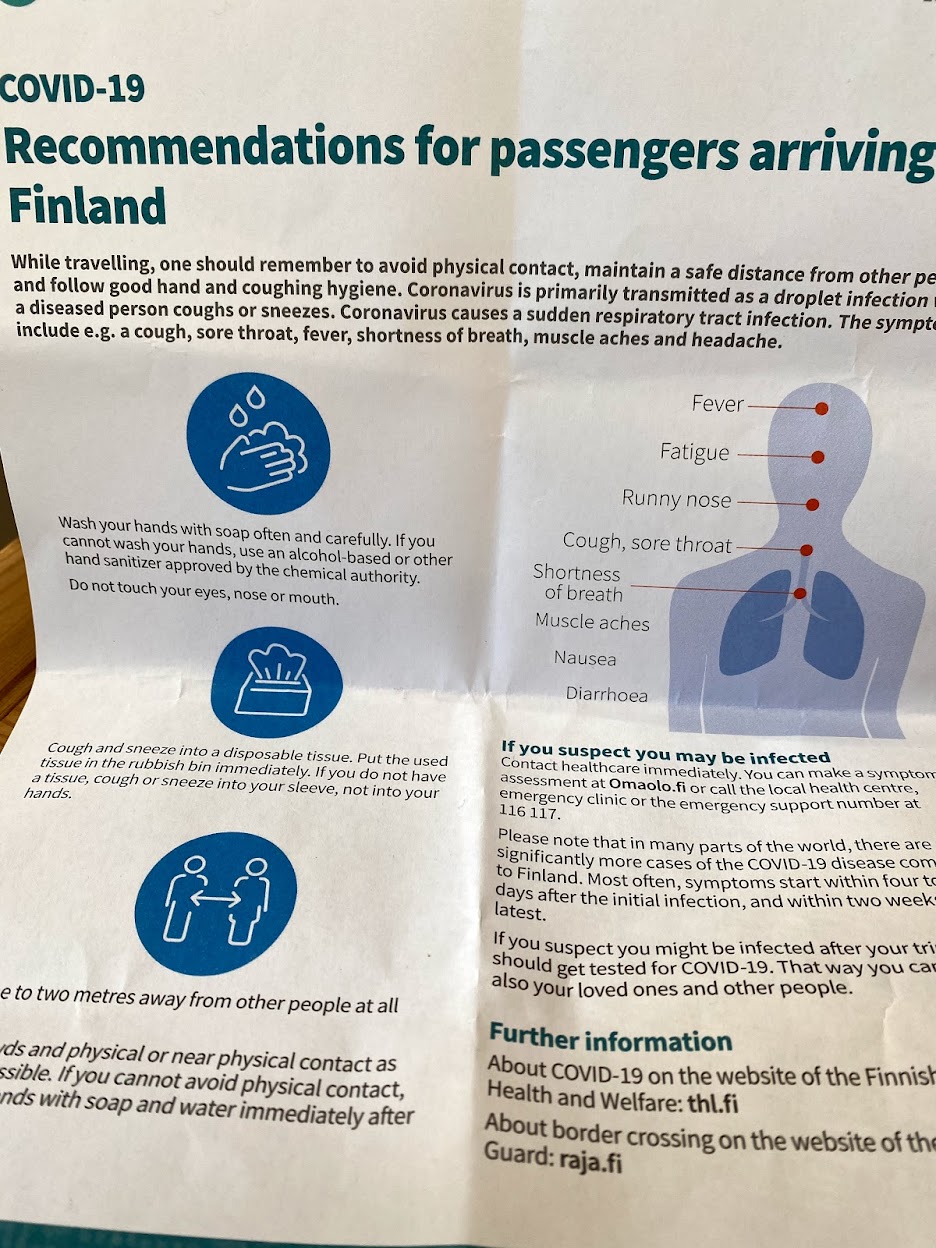
Granted, I am doing way more than that, starting from the fact that I didn’t go anywhere except my mom for five days before departure. I told Boris that he should buy all the food before I arrive (normally it’s one of our favorite things – to go to a grocery store together).

Looking at the rest of the world and Finland, I want to say that Finland is lucky not to have air conditioning and tourists. Or rather, both are present in small enough quantities not to make a negative impact.

Since there was never a mandate for wearing masks in public, and even a mask advisory didn’t stay for long, it looks like most people do not quite understand that masks protect the general public, not mask wearers.

Finland has close to none cases for over a month, and most of the restrictions are already lifted.
I do not know how I would feel about what I see around if my personal circumstances would be different. Right now, the whole thing feels pretty surreal, so details do not matter :). But I would say two things.

First, what I see proves to me that our normal norm is not gone forever. Perhaps, the most unbelievable thing was seen crowds of people going to the stadium on Saturday night:). There is still a lot of protection on place, and if you pay attention, you notice, but it does not prevent most of life going as usual.

Second, on the second day of being here, I got a very strong feeling, which can be described as “there can’t be heaven in one place if there is hell in the rest of the world.” This first moment when I thought, “I want to stay here forever” was fast gone. Through that first day, Boris was telling me all the time: relax and see how peace looks like. But he agreed with me when I told him: it can’t be peace when there is a war all around. Until the virus is defeated in the whole world, it won’t be the end. We are very thankful for the forces above us, which gave as that holiday in the rear at the time of war. But that’s a time off from the front, not the end of the war.

In the course of the past several months, we were often saying to each other “when this all will be over,” presuming we won’t be able to see each other in person earlier than that. And now we feel very distinctly, that “this” is not over. We got a leave warrant for good behavior 🙂

Air Travel During Pandemic

In case you are wondering how it is to travel in these crazy times, here is how it went.
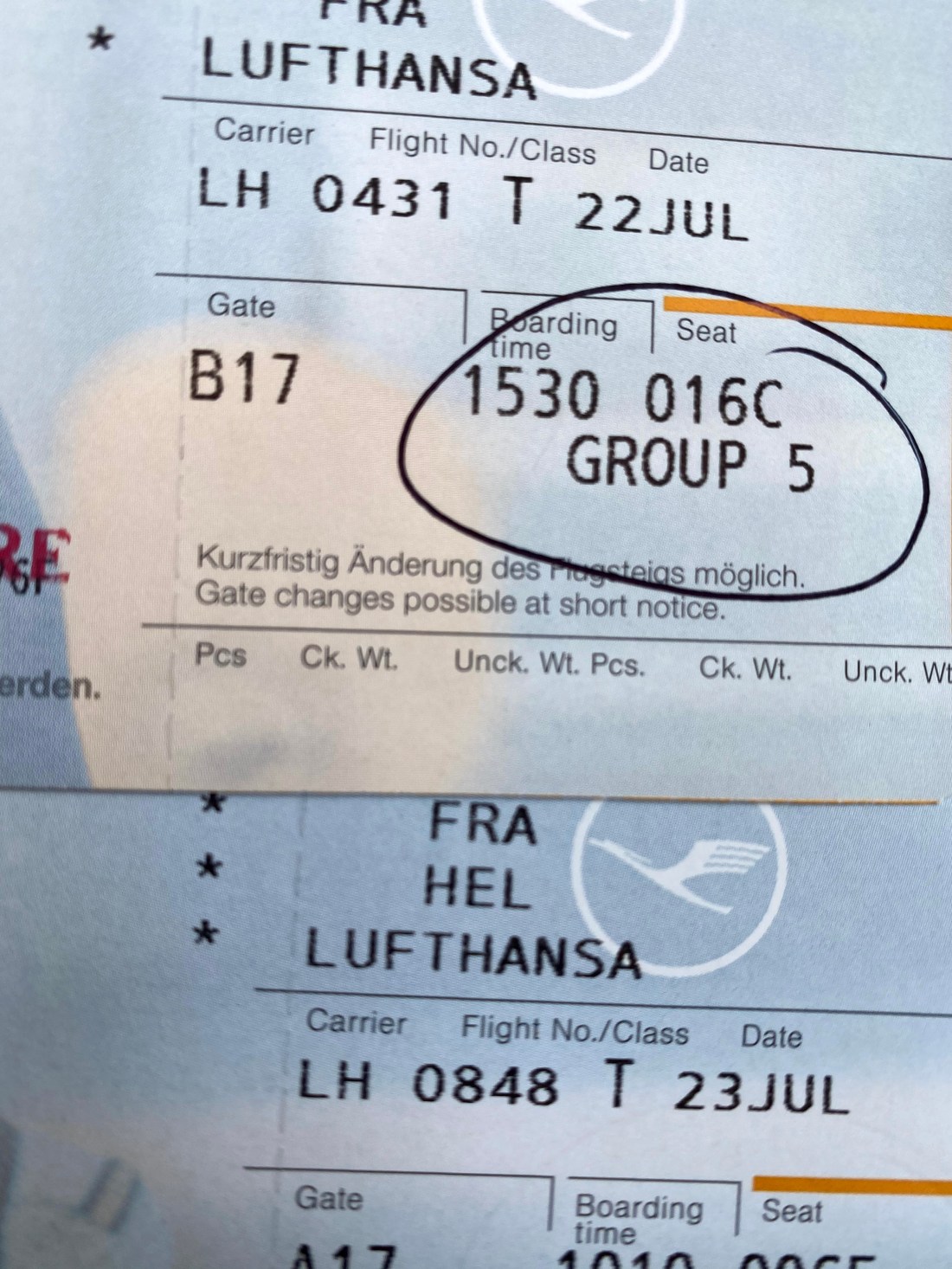
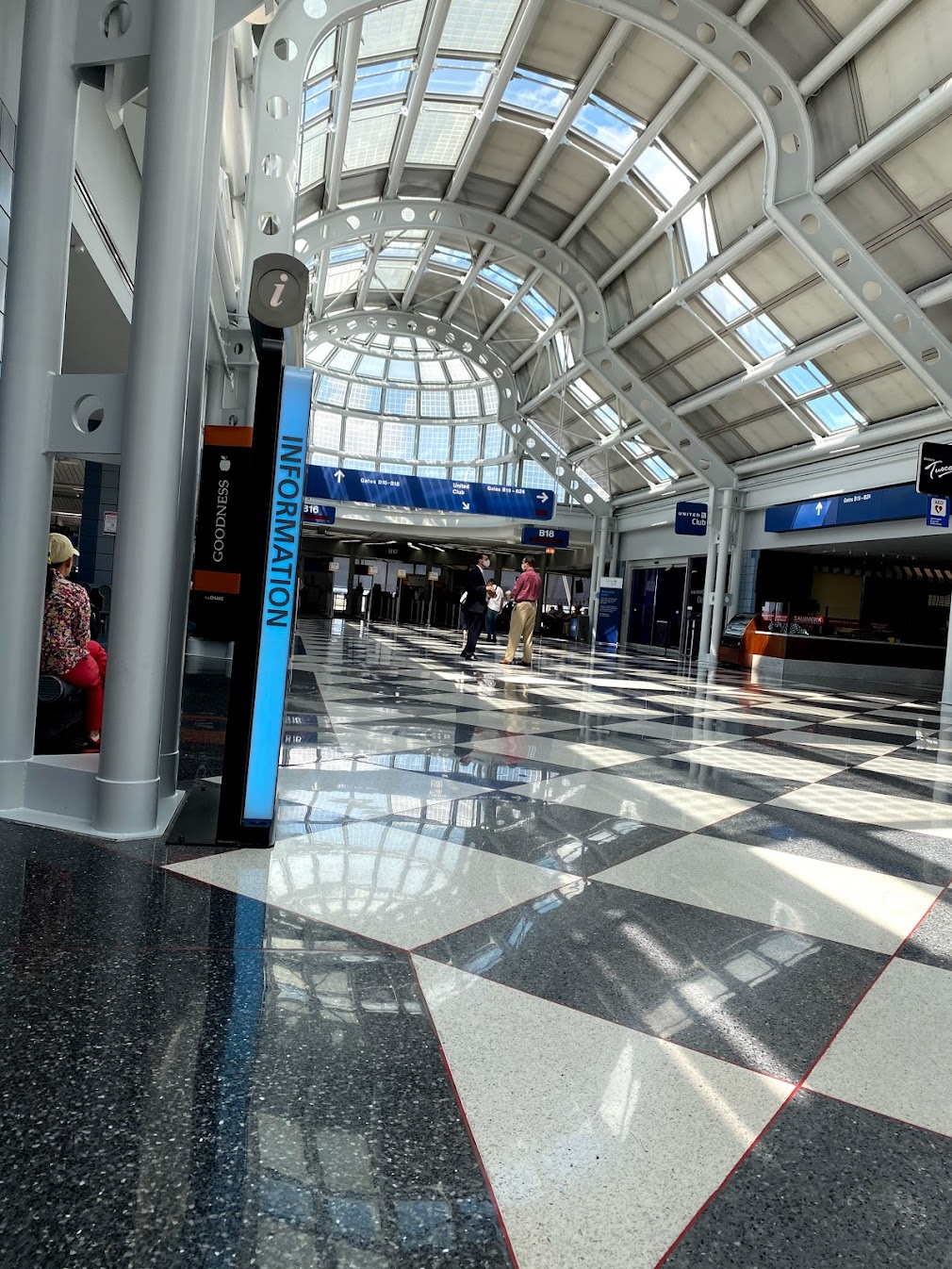
The First Terminal of ORD was pretty empty. After the check-in line (which was long but very socially distant and everything), I went to the TSA, and there was nobody before or after me. They have glass shields in front of each officer, and they asked me to take the mask off for just a couple of seconds, and then I went to have my luggage scanned, and I was also scanned, all as usual, just very fast since there is no wait.

There were very few people in the Terminal, some cafes open, others closed. I didn’t get any food because I was still feeling nervous and could barely eat since morning.

The notoriously long Lufthansa boarding line was also shorted, although the aircraft was far from being empty. They left the middle seats unoccupied, and also there was almost nobody in the first and business class. But more of the other seats were filled.

Continue reading “Air Travel During Pandemic” →

***

How It All Started

On July 10, the new EU regulations regarding border control were announced. It was already expected that the US would be banned from entering Europe. When we talked with Boris about it the next day, about the fact that for many countries, the doors are now open, I asked him whether he checked for details at the Finnish Border Control site and whether I should check, and he said – no, it will be just one more reason for me to be sad.

So I didn’t, but on Tuesday, July 14, I decided to check it, and to my surprise and amazement, I found out that some restrictions were relaxed. The website said that now not only families of EU citizens can visit, but also families of Finnish permanent residents can visit. I emailed Boris immediately, and Wednesday morning, we talked, and he asked whether I am coming next week.

Continue reading “How It All Started” →

Air Conditioning and the Virus

Copying yesterday’s Tribune article – exactly what I was talking about for weeks. Source – here

There’s an invisible obstacle to reviving Chicago’s economy from the coronavirus pandemic.

Potential transmission of the virus through air conditioning and heating systems is the latest issue employers and building owners are focusing on as they prepare for more people to head back to office towers and other non-residential buildings, whether they’re office workers or school teachers and students.

Continue reading “Air Conditioning and the Virus” →

I am in Helsinki

And I can’t quite believe it. It was not going to work, but it worked. It feels like a dream, but this dream is going to last for a week, and I can’t ask for more.

Continue reading “I am in Helsinki” →

The Fall of 1995. Anna’s Ballet Classes

Since now Anna is wondering where her older daughter got the idea of wanting to be a ballerina, I have to remind her about her ballet classes.

Here is the story. My cousin Anna is a musician, and one of her side jobs in 1996 was playing piano for ballet classes in one of the nearby schools. For my life, I can’t remember whether the lady who ran these classes was affiliated with the school, had an independent “circle,” or whatever. But she ran these ballet classes for children of different ages, and the youngest dancers were six. As an exception, she would admit children who were five and a half and were exceptionally gifted.

Let me tell you that there was some rationale behind that age limitation.

For smaller children, coordination of the movements of different parts of their bodies is challenging. Anna just turned four, and she wanted to be a ballerina :). I was trying to teach her that when asked, she has to tell that she was five and a half, but I didn’t hold much hope. My cousin suggested that we will pretend we were a little bit late and that I should push Anna into the audition room when all the children already start to repeat to movements. Then, my cousin was hoping the instructor will already like Anna and will be more willing to make an exception. She showed Anna the moves which she most likely would have to repeat during the audition, and Anna was practicing on her own, tirelessly. It was unbelievable.

Continue reading “The Fall of 1995. Anna’s Ballet Classes” →

About July 17 Events

Saving this video for a historical record: how the last weekend’s violence in Chicago was organized.

The first video is a recording of the briefing of Chicago Police Superintendent David Brown, where they show the footage and explain what’s going on. And the second video is just that 6 min footage.

‘Radioactive”

Yesterday, I watched the movie “Radioactive” (a part of Siskel center membership). It’s a great movie, but watching it at that moment and in my current state of mind was a terrible idea.

It’s such a tragic story, of which I knew almost nothing. On a personal level, it elevates the fears I am trying to dismiss. I cried a lot while watching…

June 1995. Our Trip to Poland. Part 4

The last part of our travel to Poland I wanted to write about was a voyage to the Copernicus Museum. I didn’t feel that doing nothing except for going to the beach was the best idea of vocation. When we stayed in the University boarding house, I organized different excursions, museum visits, etc. We did some of that in Gdansk, but I wanted to do more. 

I learned that boats are departing from the pier a couple of times a day, which would take us to the Copernicus Museum and decided that we should go. Funny enough, now I barely remember anything about the museum itself. Partially, because the boat was late, so we arrived later than planned and then, we had to hurry back for our return journey. 

The reason for the late arrival was a storm. The waves were rocking the boat, and almost everybody got sea-sick. In our family, Anna was notorious for never getting sea-sick, and the rest of us was the opposite. I remember Anna cheerfully running around the boat while most of the passengers were miserable. 

The reason I want to tell you about this trip is different. We happened to book the tickets for the cruise, which took on board a large group of families where one of the children had Down syndrome. On the way onward, I could not take my eyes off these families.

We ere not living in the Soviet Union anymore, but the way people perceived things was still very much from the Soviet era. And in the Soviet Union, you were not supposed to have a special needs child. People with disabilities, especially with mental or emotional ones, were non-existent. Invisible. There could be nothing worse happen to a mother than having a child with a disability. If we came across such a child on the street or at the playground, we would try to walk away as fast as possible. 

Women, who gave birth to children with Down syndrome, were expected to leave them in the hospital, “in care of the state.” That was the norm. 

A year earlier, my friend gave birth to a child with Down syndrome, and she was fighting fiercely for her right to keep the girl. But even those who supported her would say that she needs to leave her daughter “in care of medical professionals” for at least six months (there were other complications in addition to Down syndrome) and keep visiting her, and “maybe later” take her home. Her daughter died several days after, because of other complications, and my friend was inconsolable. 

But I was to reiterate that the expected behavior was to leave a child with a known disability in the hospital. Nobody would criticize the mother; on the contrary, people would understand and not even mention that she ever had that child. 

We felt for all mothers, who had “to carry their cross” and pitied them a lot. If you had a child with a disability, whom you chose to keep, you would only take her to the playground when there are no other children. You would never go out with her. 

And here, on board of a boat, I saw two dozen families who adored their children with Down syndrome. You might ask – where is the inclusion, why a separate group of special-needs kids, but that was a huge step forward that these kids were even going out. 

I looked at the mothers. I watched a mother cooing over her three or four months old the same way as if that child would be an average healthy baby. I saw her smile and could not take my sight away from her face. That was one of the biggest revelations in my life – she loved him!

I saw bigger kids, smiling, talking to their siblings, and each other. They had nice stylish haircuts and fashionable clothes. I noticed for the first time that each of them had their unique facial expression. I should be ashamed of myself because it all was news for me at that time, but I wanted to write honestly about my feelings because that can explain how bad things ere in the Soviet Union and for many years after it’s collapse.

Twenty-five years later, I can still close my eyes and see their faces and hear their voices.

The biggest takeaway from that cruise was: things can be different!