My neighbor gave me tulips for International Women’s Day, and they lasted for nine days! Can you believe that the second photo was made on March 17th??


On family history, parenting, education, social issues and more
My neighbor gave me tulips for International Women’s Day, and they lasted for nine days! Can you believe that the second photo was made on March 17th??
Today was one of these days when I wondered what I would do without Wellness Fridays?! My flight is at 10-30 PM, and I spent the day catching up on everything.
I had to go to Palatine because I finally had my crown ready, and that was my last visit to my wonderful dentist. As much as I love her, going to Palatine for regular dentist visits is non-sustainable.
Since I was already going to Palatine, I also scheduled a haircut before the dentist. I knew I would have almost two hours between the dentist and the train back and thought I should meet up with somebody, and then my Palatine neighbor called.
I do not think she ever called me since I moved; she only texted me from time to time. This time, she called and asked me how I was doing, meaning the situation with the war. It was so good to know she cared; many people around me did not even understand why I should be concerned. Being an emigrant from after-WWII Austria, she understood.
We talked a lot about the war, what was happening, why Putin did what he did, and why many Russians supported him. She asked me how this war could end and what I thought about the best outcome. She told e that in the place where she does her hair, the owner is Ukrainian, and the staff is Russian and Ukrainian, and how everybody is devastated, and how she decided to give them money so that they could send it where it is needed most. It was one of these conversations which brought me hope and reinstated my belief in humanity.
The war highlights the worst in people and the best in people.
***
Now I am sitting at the airport gate waiting for my flight boarding. And just arriving at the busy airport, almost as busy as before the pandemic, and seeing how the boarding procedures got back to where they were before the pandemic – this all felt incredibly optimistic. I remember all the cries of how “it will never be the same,” – I knew even back then, that they were wrong.
It is indeed everywhere, it’s not like there is nothing but the war on my mind, but whatever I do, whatever other people are doing – the war is in the background, the war is visible, and the news about the war shape the news broadcasts everywhere in the world.
I mentioned the other day what my neighbor said about Tosca. It turned out that it was not just her or me, but that was the intention. Last Saturday, the opening night of Tosca started from the Ukrainian Anthem, and the cast dedicated that performance to the struggles and courage of the Ukrainian people.
Yesterday, one of my coworkers mentioned in the speaker’s slack channel that the PG Day Poland was postponed. People started to talk about how it is sad but understandable and started to ask what is the new date. Then another person (the one I respect a lot) said: it’s a little surreal to me that people are being bombed, and we’re talking about it in terms of the impact on our conference schedule.
This conversation triggered something for me. For the past several days, watching the stream of Ukrainian refugees arriving in Poland and Poles going out of their way to accommodate them, I thought that my “historical Motherland” needed some financial assistance.
During that conversation on slack which I mentioned earlier, somebody said: you should reach out to A. to find out the details [about the PG Day Poland]. And then my immediate reaction was: why I never thought about reaching out to her on the subject of donations?
She was indeed delighted when I reached out and said that Poland is “out of everything,” warned about the fake charities, and gave me a vetted list of trustworthy charities that assist refugees’ resettlement.
For now, I plan to give 2/3 of my donations directly to Ukraine and 1/3 to this Polish resettlement agency I chose.
Then, I was terrified by the news about the potential peace proposal from this BBC news program. It sounds so evil that I can believe this could happen! President Zelinskiy cares about the Ukrainian people, and he can go a long way to stop the bloodshed. But what will happen if peace in Ukraine is achieved at such a price? Looking at what the Russian government is saying these days, and knowing Putin, you can bet he would announce such peace as Russia’s victory. We wanted to liberate the Russian people in Ukraine, and we did! We wanted to stop NATO expansion, and we did! And we got a Crimea! And things are going our way! If the condition of the peace would be disarmament of Ukraine, it is an insult to the heroic Ukrainian army and all her people, and what will stop Putin from repeating the attack? And most importantly, he would emerge from this war unpunished! And that would be the most unjust thing, and I do not want to let it happen.
I really liked it. And since I know that people do not like to click on the links – here is the full text.
To Belarusians, Russians and Ukrainians, few historical events loom as large as World War II. One would be hard-pressed to find an Eastern Slav who doesn’t have some relative who fought in the war, died in a war or lost something to the war. Many Eastern European cities still have lasting scars.
I grew up in St. Petersburg, a city that survived the nearly 900-day Siege of Leningrad, where over a million people perished from bombings, disease and starvation. A ring of mass graves around the city’s former outskirts serves as a lasting reminder of the sheer scale of the toll. My grandmother on my mom’s side was only 6 when the Siege happened, and she lived through the first year before she was evacuated.
Grandma Nina never sugarcoated the realities of the war.
“One winter day, I was playing in the yard when a young couple approached me,” she told me. I couldn’t have been older than 9. “They said, ‘Little girl, would you like some candy?’ But I knew better. There was no candy during the Siege. So I ran into my building as quickly as my little legs would carry me. And it’s a good thing I did — otherwise, I would’ve gotten eaten.”
Grandma Nina wasn’t my only connection to the war. Three of my great-grandfathers served in the military, in some capacity or another. My Belarusian grandfather and his sister (also named Nina) lived through the Nazi occupation of what is now Belarus. Even the relatives who barely saw any fighting have war-related memories.
When I was a kid, there was a lot of emphasis on the toll the war took, how we must remember this toll because we must never allow anything like that again. But I feel like something shifted in the last 20 years, as members of my great-grandparents’ generation, and even older members of my grandparents’ generation, died of natural causes in growing numbers.
There was less talk about pain and suffering, and more emphasis on the glorious Red Army heroically overcoming odds and triumphing over Nazis. Talking about some of the harsh realities of the war suddenly became controversial.
When I was growing up, calling someone a Nazi was about the worst thing one could do to another person. Our teachers told us to use the word carefully because “words have meanings.” But whatever restraint there was seems to have completely evaporated.
In 2014, when Russia encouraged separatists in the Donbass region and the war broke out, Russians and Ukrainians accused each other of being Nazis. It wasn’t that unusual to see social media posts and news segments where World War II veterans encouraged their grandchildren to fight against Nazi invaders. Aside from the language and national signifiers, they sounded practically identical.
Now, as the long-simmering conflict erupted into a full-fledged war, the Nazi labels flew with renewed vigor. The Russian government quickly positioned the “special operation” as “denazification” of Ukraine, and as the attacks intensified, Ukrainians were quick to call Russians Nazis.
Of course, what’s different this time is the sheer scale and devastation of the attacks. When I saw photos of people huddled in Kyiv and Kharkiv subways to escape the bombings, I immediately thought of people hiding from Nazi bombings of Moscow. When I read about Mariupol getting encircled by the Russian army, its besieged residents huddled in the cold, it’s hard not to think about Grandma Nina talking about burning everything there was to burn in the house just to stay warm. When I see families fleeing west, I think of Grandpa Gena talking about how he was only 5 years old when his family tried, and failed, to outrun the Nazi advance.
“When the war started, my dad went off to serve, so it was just me, my mom, my older brother, Nikolay, and my younger sister Nina,” he told me. “I remember when we were trying to flee, my mom carried Nina in her arms, while I ran with her.”
I was taught to be careful about using the word “Nazi,” and I’m not going to stop now. But when one gets that kind of association … I know it makes at least some Russians pause. A couple of days ago, I saw a photo of a flier somebody put up in St. Petersburg. “A city that survived the Siege is against the war!” But so far there is also plenty of support, including from some of the people who were kids during World War II.
This war will end someday. Kyiv, which was shelled during World War II, will rise again, just like it did last time. And the scars of war will linger.
Maybe this time, the generations to come will not so easily lose sight of the toll the war takes.
Maybe this time, Russians won’t need a personal connection to understand the horror the war inflicts.
… i always pack a night before departure? And why does it take five hours?…
Yesterday, we went to see Tosca in the Lyric Opera. We – meaning, myself, mom, and my neighbor. My neighbor dreamed about this night since the day I got these tickets. And yes, the performance was outstanding, especially the soloists who sang the leading parts. Everybody was invited to see how the stage crew changed the set during the first intermission. The stage manager explained to us that the set is fifty years old and told us a lot of details about its construction, and then about costumes and wigs – most of the costumes came from the Convent Garden 2005 production.
After the performance, my neighbor told me that she could not help but think about Ukraine and all the historical parallels. I feel that no matter what show we watch these days, we see the parallels with the war, and each injustice we see on stage resonates with what we see on our screens in the reports from Ukraine.

Saturday marked a return of the St. Patrick’s Day Parade, but it also marked a sharp temperature drop (down to 11F in the morning). Because of that (actually, because of both), I decided against any outings on that day. I attempted to go to escort (the last shift), but it turned out that we were not even needed, and I could leave an hour later.
My fellow escorts asked me how did I get there. I replied – “interestingly,” and they immediately suggested giving me a ride to any CTA station further North. For those who haven’t been on the CTA on St. Patrick’s Day – good for you! For those who took CTA on that day previously – it was twice worse than you ever saw!
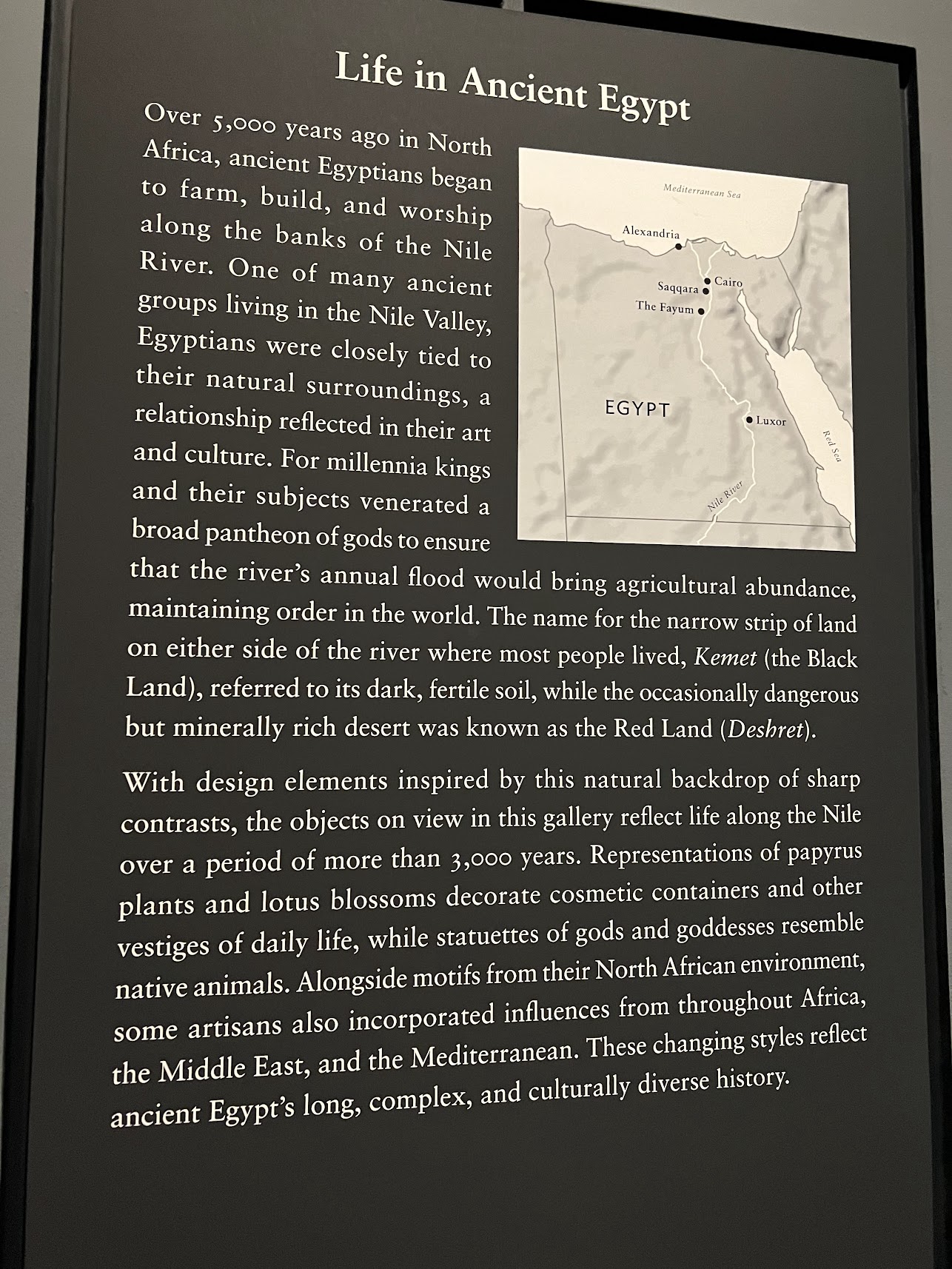
But to compensate for it – Sunday was beautiful, quiet, and the weather was gorgeous! I thought I needed to do something together with mom, because then I will be gone for ten days, so I suggested we go to the Art Institute during the member’s hour. And it turned out to be a very nice outing. I was finally able to see the Egyptian Exhibit without the crowd.


I had to cancel Wednesday’s meetup – the speaker canceled on Friday evening. I attempted to find a substitute speaker, but it was too late. Usually, in cases like this, I volunteer myself, but it would take me too long to prepare a new talk this time. I am actively working on the presentation for the conference at the end of April, but it is very far from being done.
I feel it is a personal failure each time I have to cancel, so I am contemplating two meetups in May instead. Also, I want to make sure that May meetups will be hybrid. I think I now have enough energy to accomplish that 🙂
Also, I submitted proposals for two European PG Days, and I will submit something to Pgconf Europe. With just a couple of days until Nordic PG Day, I am so excited to see everybody in person!

As it often happens, after I started the daycare (detskiy sad), frequent colds started, but in addition, several times, they ended with pneumonia. Back in the 1960s, that sounded even more serious than now. A part of the reason for our trip to the Black Sea in 1968 was a belief that it should strengthen me against the frequent colds. At least that partially influenced mom’s decision.
Most likely, the situation somewhat improved, but not drastically, and the doctors recommended a sanatorium. Back then, a sanatorium mostly meant that I would stay “on fresh air” more than I would do otherwise. Also, it meant almost free boarding, which was a relief for mom.
That summer, she sent me to the sanatorium in Solnechnoe, in Karelia. It’s not like she had a choice where I would go; pediatric clinics were getting quote, and they would decide who should go and where.
Solnechnoe, former Finnish Kuokkala, was the most southern resort in the “Russian” part of the Baltic Seashore. This territory has a long history of changing ownership; some details can be found here. It is not like I cared back then, and I do not even think that mom cared. She mentioned that they routinely called Karelia “Finland,” so there was no confusion about this land.
I came to Solnechnoe in mid-May, shortly after “the May holidays” – the sequence of May 1st, 2nd, and 9th, which were all days off, plus the weekends in between. In the beginning, it didn’t feel at all like summer, we wore coats outside, and the spring bulbs just started to bloom.

Other than that, I didn’t see much difference between being at the dacha and in the sanatorium. The building was somewhat better, and for sure, it was somebody’s summer cottage nationalized by the state. In the picture above, you can see how close the building is to the seashore.

Our building housed the “younger group” and “the older group,” which included children from 5 to 7 and even two school-aged girls, Lilya and Laylay (the very back row on the left). Looking at the class picture, I remember most of the kids, how they looked in real life, what color their clothes were. For some reason, I do not remember the names of the kids with who I played most often but remember others My best friend was a girl who is the fourth from the left in the second row, but I don’t remember her name. And I remember that the girl on the very left of the second row was Ira Kolesnikova, but I was not that close with her. Also, I am surrounded by boys in all pictures, but I do not remember hanging out with the boys that much. I mostly remember the fights :).

Looking at these pictures, I remember one funny thing: there were some rules about what we should wear in certain weather. For example, we had to wear sweaters over the dresses when the temperature was below 20C (68F). On the other side of the building, the beach was right there, but we were not allowed into the water until both the air and the water temperature reached a certain degree (I have no idea what it was). There were still days when we swam, and that was a real delight!

More pictures in the next post!
My historical posts are being published in random order. Please refer to the page Hettie’s timeline to find where exactly each post belongs and what was before and after.
It’s hard to believe, but that’s true! The legislation passed the Senate last Monday, and I can’t believe that it took so long!
Below is the text of the article from the Chicago Tribune March 8 2022 by Darcel Rockett.
==========
Legislation to make lynching a federal hate crime and prevent racist killers from evading justice was introduced more than 200 times but never once passed into law, according to Illinois U.S. Rep. Bobby Rush.
That path is clearer now that the Senate unanimously passed a bill Monday that criminalizes lynching and makes it punishable by up to 30 years in prison. The measure passed the House last month and now goes to President Joe Biden’s desk.
“Who would have imagined that lynching, that was visited upon literally over 6,000 citizens of our nation, that lynching was not a federal crime until our present day,” Rush told the Tribune on Tuesday. “We’re looking forward to a more perfect union.”
The Emmett Till Anti-Lynching Act, named for the Chicago teen and authored by Rush, states a crime can be prosecuted as a lynching when a conspiracy to commit a hate crime results in death or serious bodily injury. Emmett Till, the 14-year-old son of Mamie Till-Mobley, was murdered in Mississippi in 1955. The act first passed the House of Representatives in February 2020, but was blocked when Sen. Rand Paul, R-Ky., objected to clearing it by unanimous consent in the Senate.
Rush reintroduced the act on the first day of the 117th Congress in January 2022. The previous text of the legislation set the maximum sentence at 10 years and made lynching a crime that could only be prosecuted under specific circumstances, such as if it took place while the victim was engaging in a federally protected activity such as voting.
Now, the act amends the United States Code to include a maximum sentence of 30 years for a perpetrator convicted under the anti-lynching act, in addition to any other federal criminal charges the perpetrators may face, and the legislation applies to a broader range of circumstances.
Thousands of Americans were lynched between 1865 and 1950, according to a 2020 report from the Equal Justice Initiative.
Rush, who is in communication with Till’s remaining relatives, said they were very determined that the bill was going to pass and they did all they could, including praying that President Biden would be able to sign it.
Rush said the prayers have been answered. He wants to see if a formal ceremony can take place to honor the measure. Rush, who will leave his office after this term, doesn’t see this as a feather in his cap, but he does see it as a victory for the American people — for Black Americans specifically.
When the Till act was passed by the U.S. House of Representatives in 2020, a boyhood friend of Till’s said the law refreshed our memory of what our history looks like, placing value on history, so we don’t repeat it.
That was before the Department of Justice’s Civil Rights Division and the U.S. attorney’s office for the Northern District of Mississippi closed their investigation of the Till case in December 2020 after Carolyn Bryant, now Carolyn Donham, the wife of one of the confessed murderers and a witness to events leading up to Till’s murder, alleged recantation of events in a 2017 book by Timothy Tyson titled “The Blood of Emmett Till.”
Per a DOJ statement, the government’s re-investigation found no new evidence suggesting any living person was involved in Till’s abduction and murder. Till’s remaining relatives said the “findings came as no surprise.”
Two white men, Roy Bryant and his half-brother J.W. Milam, were tried on murder charges about a month after Till was killed, but an all-white Mississippi jury acquitted them. The trial is the basis of a recent immersive stage adaptation of the 1955 trial transcript performed by Collaboraction, “Trial in the Delta: The Murder of Emmett Till.”
WMAQ-Ch. 5. news anchor Marion Brooks found the transcript in her research on Till and wanted to get the information out. The play will also live on screen as part two of Brooks’ documentary on Till, “The Lost Story of Emmett Till: The Universal Child.”
Days after Till was killed for allegedly whistling at a white woman, his body was pulled from the Tallahatchie River, where it was tossed after being weighed down with a cotton gin fan. Months later, Bryant and Milam confessed to the killing in a paid interview with Look magazine. Bryant and Milam were not brought to trial again, and they are now both dead. Donham has been living in Raleigh, North Carolina.
G. Riley Mills and Willie Round, co-creators of the play, said the bill was a long time coming.
“While we’re glad it was finally passed by Congress, it’s hard not to feel anger and disappointment at how long it took,” Mills said. “We salute Congressman Rush for his tireless efforts championing the cause for Emmett and Mamie.”
Christopher Benson, an attorney, Northwestern University Medill School of Journalism associate professor, and co-author with Mamie Till-Mobley of “Death of Innocence: The Story of the Hate Crime That Changed America,” said people have to take encouragement from the new legislation.
“One hundred years and there never was agreement on a way forward to address this horror of racial violence,” he said. “It’s a good start, but now we have to enforce it.”
For the past four years, Benson has worked with the Till family. He said Till’s family is highly supportive.
“Whether this compensates for the lack of justice in Till’s case is another matter,” he said. “We have to ask, what does justice require? Justice would have meant that Emmett Till came home alive. So we can never truly experience justice in this case. We have sought some level of accountability from his killers and the government structure that enabled that lynching. Because the killers of Emmett Till believed that they could get away with the destruction of a Black body, because of the horrible system that exists in this country, particularly in Mississippi at the time.”
Rush shares similar sentiments.
“It’s a victory for Emmett Till, his legacy, his family and the over 6,000 people who were lynched in our nation, all the way up to this moment,” he said. “This is really an intergenerational, historical victory.”
Foto, travel, St.Petersburg, Stokholm, Tallin
aka operasandcycling.com
We explore and grow together
Jeremy Schneider
A journey of curiosity and unfinished thoughts
Shaken, not stirred
Information about SQL (PostgreSQL & SQL Server) from the Asylum.
Chasing Wellness
Curiosity to Infinity
SQL help, examples, tips
Musician and Network Engineer
Living life to the fullest
Life in Copenhagen, Denmark, after moving during Covid-19.
Spontaneous Blogger! Doze on Sunday @7 PM IST
a written collection of souvenirs
ramblings of a crazy lady living with MS
Every Family has a story to tell..........Welcome to mine
Travelling without Limits
Researching, Preserving, and Sharing Genealogical Information For Future Generations
 Hettie's Reflections