Mayor Brandon Johnson’s administration spent $814,000 on a giant fence as part of an effort to shut down one of the city’s largest and most visible homeless encampments ahead of the Democratic National Convention, City Hall records show.
The massive barrier was part of an “emergency” effort to permanently lock out unhoused people from the location near the United Center, where the convention was held, the records obtained by the Chicago Sun-Times show.
The Johnson administration had refused to say how much taxpayer money went toward blocking off the green strip of land between the 1100 block of South Desplaines Street and the Dan Ryan Expressway just north of Roosevelt Road, until after the nationally televised gathering was over. The Sun-Times has been asking for those records, which should be public under state law, since July, when that tent city was cleared of its residents, the tents and the items they left behind.
I am asking the same question as this article: why has busyness become a status symbol? Or maybe not? Is it the objective thing these days? I agree with every word they say: in the past, not having to work was a status symbol. What happened with that? See the article below.
Over the weekend, I watched the movie “Freedom Writers.” It’s a relatively old (or at least not so new) movie, and the events took place in the 1990s. For some reason, I had never heard about this movie, and even more interesting, the person who recommended it to me was not even American.
How I feel about this movie… It is very realistic in depicting the communications of troubled teens. I had never been to a class in a US high school, But I saw enough of these situations in the youth shelter. However, I have to sadly agree with the antagonist in the movie that this one unique experience is not a methodology that can be applied by any high school teacher. Another issue that the movie does not mention is the environment. No matter how good the teachers are, there is still the environment where these kids spend the rest of their time. Also, when they graduate from high school, that same environment won’t be necessarily supportive.
I know, and I always tell this to everyone who care to listen, that there is no universal solution for these problems, and that we can only do “one person at a time.” Still, it incredibly frustrating.
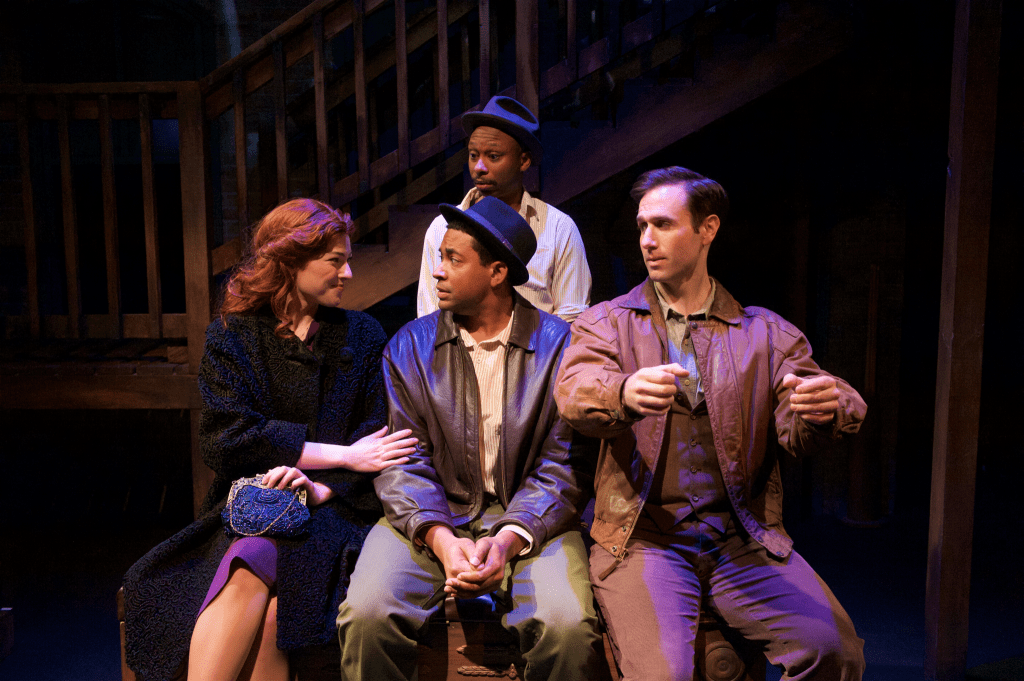
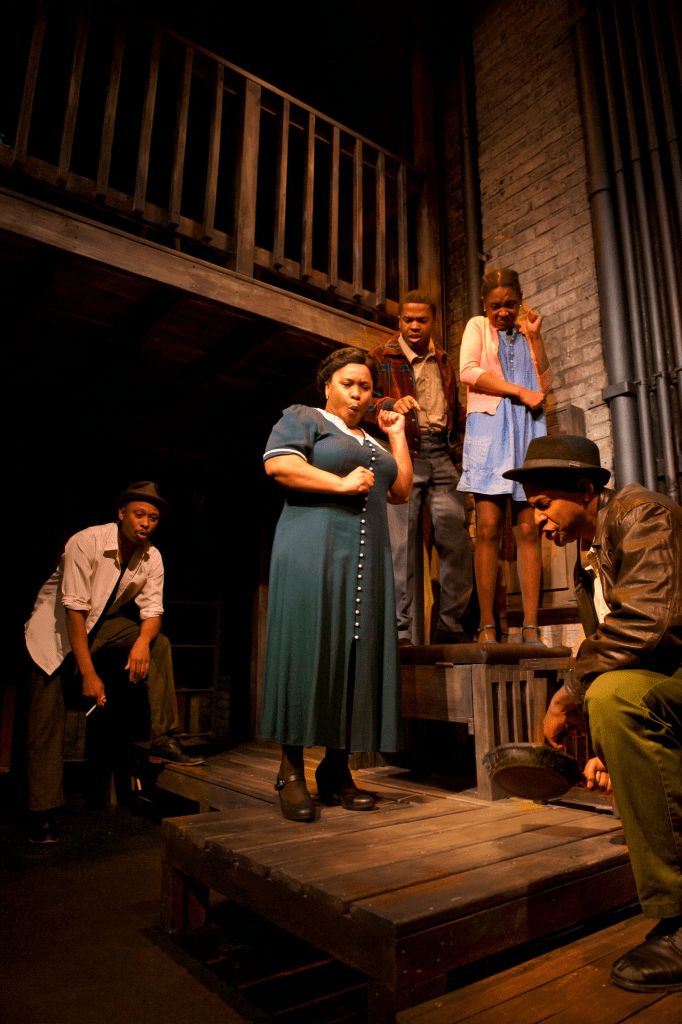
On Saturday, I saw the “Native Son” at the Lifeline theater. It was a very powerful performance; One-and-a half hours of breathtaking action. I really like this review from Evanston Round Table (and that’s where I found these pictures):
What does this play have in common with the Freedom Writers, is the sad fact the things didn’t change much since the events took place. I went to see this play with one of my Black friends, and when I told her how I felt she said:no, Black people have way more legal right now, they can defend themselves in the court. I said: but Black teens are still stopped for minor violations times more often than White teens – and she agreed.
Which is, circling back to the movie, the dead end : it’s not only about breaking the cycle of violence. It’s more about breaking the cycle in people’s heads.
I am still on my vacation (for two more days), but today, I am recalling my escorting shift on June 15. It was early morning, and only our shift lead and I were there. Our shift lead brought some food for those who didn’t have time to have breakfast at home, as she always does, and as always, the food was inside the lobby.
We just got outside when a young Latinex man approached us and started to ask about something. It took us a couple of minutes until we realized that he was asking whether we had any food. B. (our shift lead) asked: do you want a banana? He nodded, and she rushed inside. I saw her putting together a parcel with bananas and bagels, adding some cream -cheese to bagels and adding more bagels. When she finally emerged and handed the parcel to a young man, he burst into “thank you” and “god bless you.”
B. and I started to talk about Venezuelans who had been kicked out of the shelters just before that. She talked about their wounded dignity and how men can’t stand the situation when women find work, and they don’t. I keep wondering what happened with the promise to issue work permits for Venezuelans. We have enough open positions in the Department of Streets and Sanitation or on CTA. Why not let people work, make money, and make the city cleaner? That’s what I thought when Biden announced the path to citizenship. I mean, it’s all great, but that will be “sometime,” and what about now? Why are they not allowed to work?! I can’t understand that…
On Thursday, we had our first meeting of the Howard and Evanston Community Center (HECC) Community Board. This is my newest volunteering activity, and I had many thoughts on whether I should engage before I said yes.
The most significant decisive factor was the idea that I would be able to make a big impact with a relatively low time commitment by joining the Strategic Planning Group. Now, I am trying very hard to stay with this task and not jump into my usual mode “let me do things myself because otherwise, nobody would do it.”
Overall, I have a good feeling about this meeting in terms of knowing how to ask the right questions and having a good idea about the areas of potential improvement. The worst part is that it looks like the budget figures remain a mystery, although I am determined to resolve it.
We’ll see how it will turn out!
***
Today, I went to the clinic for escorting for the first time in a while. I went for the morning shift, and it was very quiet. The first group of protesters appeared ten minutes before the end of my shift, although they were very loud and annoying right away. At least, it was not like two weeks ago – I was not there, but others told me that there were over a hundred protesters. The noise-controlling city ordinance is still hanging up in the air, and our team leader says that she doesn’t foresee it being approved in the observable future.
I guess I will keep escorting when I retire, which was always my plan.
Here is the article I wanted to discuss. The topic (“How we can fight economic inequality”) is not new, and many people write about it. The fact that the earning gap between the lowest and the highest earnings in the USA is much bigger than in Europe is equally well-known.
The idea that is not discussed very often is viewing one’s work not only as a source of income but also for its importance for independence, identity, and community.
In this Time Magazine article, R O Kwon addresses the topic that pretty much remains taboo even in the most liberal societies: not only are there people who choose not to have children, but also there are people who regret having children. She approaches this complex topic very carefully, understanding that no person in the world would wish to be this child their parents “would rather not have.” Still those parents, who regret, need to know that are not alone in the world.
After years of listening to the Freakonomics podcast, I finally realized that there is a book and a documentary with this name and that the whole idea came from the book by Levitt and Dubner. Yes, I expect to have such late discoveries for the rest of my life! I watched the documentary last weekend (in parallel with doing other things), and I am going to read the book. It felt like a gap in my education that had to be filled. The documentary is almost twenty years old, and it’s surprising that so many things that are mentioned there are still not commonplace and still not taken into account. And politicians and voters still debate on the consequences of potential actions or lack of those without consulting the data which is already available. A couple of takeaways.
The first episode in the documentary (about how a name defines a person’s future) is probably the only one that is well-known and frequently cited. In fact, the reason I turned “to the source” was a citation in another book I was reading at that moment. It’s good that we know what might drive our biases, but unfortunately, it rarely helps the situation.
The episode about the impact of Roe-Wade on the crime decline twenty years later was a shock. I never saw this research results, I never heard anybody speaking publicly about it, and if that’s me, a person heavily involved in the reproductive rights struggle, what does it say about the general population? And another question – what should we expect twenty years from now?!
The last episode (about monetary incentives for falling behind students to improve their grades) conveys a very important message, and not only in the field of education. It demonstrates that when the gap is too wide (somebody falls too far behind), even a relatively big incentive is not enough for a person to start moving in the right direction. That’s the rationale for many programs that offer support for people in a challenging situation to help them on their way out. For many people, no legislation and no financial support is enough to reverse the course of their lives, and more targeted actions are needed.
A friend asked me whether I watched it and said that she didn’t like it, so I finally made an effort to watch it (rented it on Amazon and watched it in parallel with some boring home activities). And I didn’t like it, exactly for the same reason as my friend didn’t like it: It’s an extremely important topic, and the movie had great potential which, in my opinion, was not fully realized. Yes, there are some excellent dialogues and monologues, but in my opinion, they do not blend into the movie fabric, and the whole movie is losing its point. Maybe I got it wrong, but for me, it sounded like women should not be discriminated against. Instead, men should be discriminated against and removed from everywhere.
There is definitely a problem statement in the movie, and lots of important questions are raised, but then nothing happens.
I take it as a positive thing that at least it raised awareness and prompted many people (of all genders) to speak up. So far, conversations seem to be productive, and we’ll see what will change.
There was one more talk at the PG Conf EU, which I wanted to mention. I am not posting in my professional blog simply because I already saw at least a dozen posts about it, and I have nothing to add. But since not all of the readers of this blog follow me on professional platforms, I thought it’s worth sharing here.
My friends and peers, two fantastic women whom I genuinely admire, Laetitia Avrot and Karen Jex, delivered a talk, “Trying to be Barbie in Ken’s Mojo Dojo Casa House.” Unfortunately, the conference organizers put this talk in parallel with another very important talk, so the attendance was lower than it should have been, but there was still a big crowd attending, and Laetitia and Karen received a standing ovation. The recording of the presentation is not available yet, but both slides and the talk transcript are available. I am posting both links here, so that anybody interested could download, see and share.
Unfortunately, there were some reactions from some attendees to the effect that “why can’t we have just database talks at the database conference, and why should we instead focus on the gender of a few people?” I believe the response on the social media was perfect: “a few” is exactly why.



 Hettie's Reflections