Russian Lies #1

A friend shared with me a series of Ukrainian documentaries uncovering the tools Russian propaganda uses to mislead both the world and its own people about Russian and Ukrainian history, culture, and their respective roles in the world and how the Russian-Ukrainian war is the logical continuation of all of the above. I want to present these documentaries one by one and write (hopefully) detailed comments about each of them, mostly targeting my American friends.

The first documentary is about the history of Russia. Most of my friends likely remember only some episodes of Russian history that, for this reason or that reason, were mentioned in popular culture or were taught in school in relation to US history. The bottom line is that I do not expect anybody to have extensive knowledge of Russian history, so here is some explanation.

The first part of this documentary talks about the Medieval state Kyivan Rus (or Ancient Rus), with Kyiev being its capital and the language being the predecessor for three languages: Ukrainian, Russian, and Belarusian (and if you ask me, I’d say that nowadays Ukrainian is the closest of three to this old language). After the disintegration of the Kyivan Rus (the stage all the Medieval states went through) and after the Mongol invasion, the Moscow Principality gradually rose to power and eventually conquered most of the original Kyivan Rus land, but the rest of the world referred to it as Moscovia, not Rus. As this documentary states correctly, “Russia” as a name of the state appeared way later.

The most striking fact is that nobody ever made a secret of it! I was very much into history when I was in school, and by the time we started to study Russian history in the fourth grade, I already knew “all of it.” Nevertheless, I remember our textbook as clear as if I read it yesterday, and all of the above facts were mentioned there!

There were many facts I didn’t know about the newer parts of history; for example, I knew nothing about the joined annexation of Poland and the Soviet-Nazi parade in Brest, but everything related to Ancient history was well-known and was always in plain sight. I can’t explain why I never questioned the moral grounds of “conquering Siberia” and other colonial acquisitions. Let me repeat it again: while 20th-century history was heavily censored and presented as the “liberation” and the “fight for justice,” there were never any attempts for a similar cover-up of the earlier history. We all knew it, and we all thought it was OK.
***

I talked to a co-worker the other day. He is not Russian, not Eastern European – nothing that would make him especially sensitive to the current political situation. I do not recall what prompted his comment about “as a Russian,” but I replied as usual that “it is not what defines me.” He proceeded with, “You are not denouncing your Russianness” and “It has nothing to do with this political situation.” It started to be more serious than a breakfast conversation in the cafeteria, but I couldn’t drop it at that point. I replied that I felt like I had everything to do with the situation because it’s my generation that didn’t follow up after the collapse of the Soviet Union and the dissolving of the Communist Party. It was my generation that let it go, and thereby I do feel responsible.

He said: I have Ukrainian neighbors on one side and Russian neighbors on the other side, and my Russian neighbors are afraid to speak Russian. And then he talked about his closest friends who are Russian and about some bets and about drinking. The latter one is a serious trigger point for me, so I said that this conversation was making me uncomfortable.

We both had to go to our desks, but I hope to continue this conversation with him. I want to ask him whether his Russian friends feel that they have something to do with what the Russian government does or if they do not think it is related to them. As for speaking Russian, I am acutely aware that at this moment in history, the Russian language for Ukrainians sounds like German during WWII for many European nations, so I do not think it’s appropriate to speak Russian in their presence (unless it’s their initiative).

Recently, I read an essay by Michael Shishkin – a Russian writer who is not at the top of the list either in Russia or internationally. I was deeply moved by this essay – my thoughts and words exactly. I agree with him that it is extremely important to understand that everybody born and raised in Russia, no matter how progressive or even radical was their upbringing, carries the baggage of imperialism. The paragraph which particularly struck me was this one:

Throughout my life, I felt I could stand steadily on the foundation of the great Russian Culture. Nowadays, there is emptiness under my feet.

Also, the way he describes the silence of the Russian writers and other intelligentsia as “hosting regular events” and “pretending that nothing is happening.” That’s exactly how I feel when I read about cultural events or new productions in Russia: I can’t take it in that people “do normal things.” And yes, I am hypocritical, I know. And yes, I understand that living under permanent pressure is impossible, and a person’s mind finds ways to accept reality as a norm. And yes, I understand that I am making many people upset. And no, I do not think I am always right, and I do not think I have any moral right to criticize others. Still, I want to be honest and convey how I feel.

Link to the essay

Current Events On The Front

I kept quiet and didn’t want to jink it when things started to unfold last week, especially because even BBC was quiet. My friend Lena has relatives in Sumy, so she started to message me “did you hear the news” in the beginning of the week. At that time, her relatives experienced retaliation shelling from the Russian forces, and they had to shelter for over 24 hours.

When I visited Lena several days later, she said: I was hoping that now Russian people will understand something, but it doesn’t look like it! Unfortunately, I have to agree. Moreover, I am shocked with reactions of those few politicians who appeared to be normal so far. Now, all of a sudden, “you can’t be happy when your fellow citizen suffer” and “you can be against the current government, but you can be against people”.

I have no comment on that. None. Except for citing one more time late Frau Traudel: “Of course, we wanted Germany to be defeated!”

For My Russian-Speaking Friends Only…

…since no Google Translate will ever be able to decode this.

Email subject: Fwd: О прекращении сотрудничества, в связи с получением уведомлений об отказе в выдаче заключения в целях заключения образовательной организацией договора по вопросам образования с иностранными организациями (или иностранными гражданами)

What it was: an email to the University faculty informing about the termination of all collaboration with foreign educational institutions… (don’t even try to translate!)

My Russian Passport

Another Russia-related Kafkian story. I knew my Russian passport was to expire in 2024, but in January, June seemed far away, and then life happened. Three or four weeks ago (not like life stopped happening, but I suddenly remembered that I was about to create a huge problem) I realized that I needed to apply for a new passport immediately: if I did not have a new passport before the old one expires, I would have to go through the “citizenship verification process.” That could take several months, and only then could I apply for a passport.

I went to the Russian Consulate in New York website and filled in the application. Then I needed to make an in-person appointment (they are not accepting applications by mail.) I started to look for an available slot, and it turned out that the first available was in mid-August. I took it, but I knew this was two months after my passport expiration, so I also signed up for a queue to receive the offers for the spots that could be released and offered to people in the queue.

Now, check out what were the conditions to stay in this queue:

  • Each time they send you a slot, you have to accept or reject it within 24 hours, otherwise they kick you out of the queue
  • On the other hand, if you login to the portal more than twice a day, they disable your access because “you might be a bot” and require you to reset your password, and you have to wait for an hour before you will be allowed to reset it
  • After you reject, the next offer comes almost instantaneously, and if you reject it, you are out of the queue
  • And all of the appointments that were offered to me were after my August appointment!

Although I tried very hard, it was impossible for me to keep monitoring all of these conditions while doing my day job and the conference, so eventually, I was kicked out. Not knowing what to do, I emailed the Consulate, asking them what I could do and what would happen if I did not get an appointment before my passport expired.

To my surprise, they replied in a couple of hours with the following: Right now, there are several openings on the following days (days listed). Do not get into a queue; go to the portal and reserve your spot. I did as they said and booked an appointment for May 2. I hope that it will go well, although there is a whole bunch of things I need to prepare, including cash for the services (they are not allowed to use banking systems at the moment) and a stamped return envelope. But at least I have an appointment!

P.S. If anybody wonders why on Earth I need a Russian passport, here is why. 1) Even if I choose to denounce my Russian citizenship, I have to have a current passport; otherwise, I can’t legally do this. 2) I do not want to pay the Russian government the fees that I have to pay for citizenship 3) If I don’t have a passport and don’t properly denounce the citizenship, I can’t get a visa to Russia either.

To be continued.

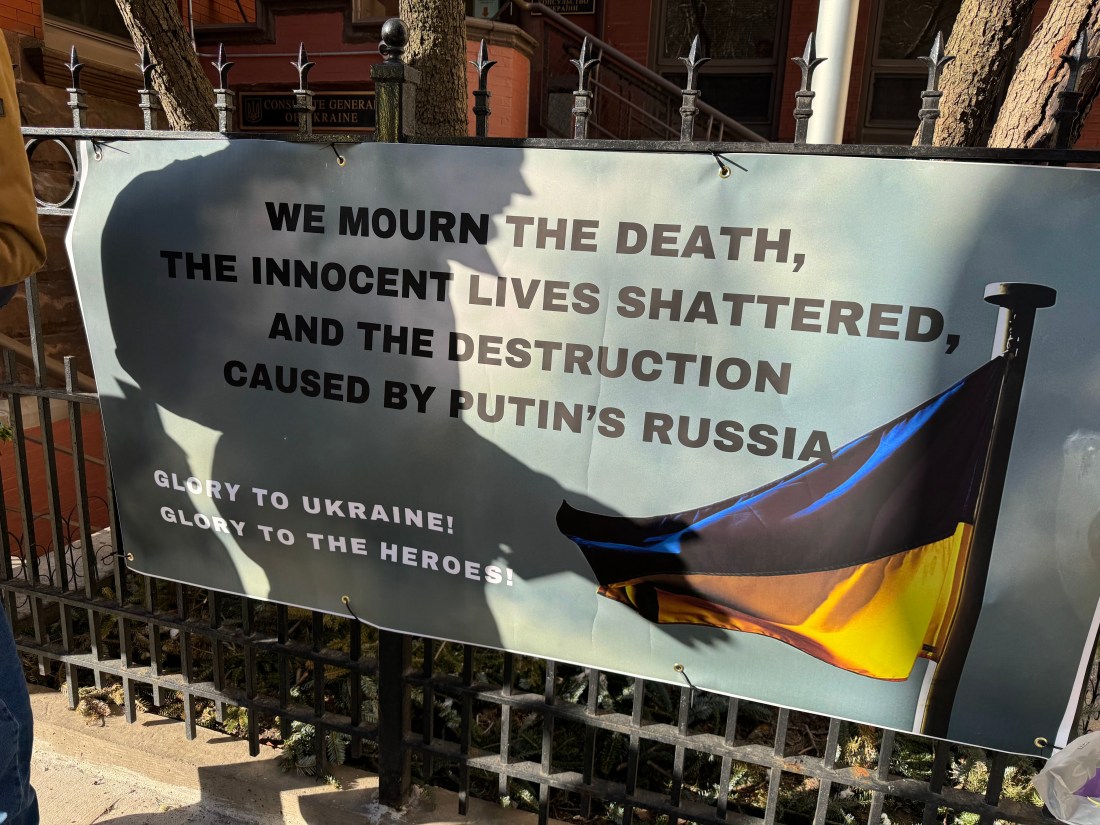
Anti-Putin Protest In Chicago on March 17

February 24 Again

When Lena and I went to the Ukrainian rally, we made sure to be quiet and not speak Russian. On our way home, Lena said: all went well, we showed our support, and we didn’t get beaten at the Ukrainian rally.

I recalled what Boris said in the early days of the war: now, Russian sounds the same as German after WWII, and it will take at least fifty years, if not more, for this association to go away. (I would add – if…) I had an acute feeling of exactly that at that very moment, and looking at the posters depicting bloody Putin, I was thinking: screw you, what did you do with Ukraine?! What did you do with Russia?! And immediately, I stopped and thought: no, not him. We allowed it to be done.

After we got back home, we talked for several hours. We talked about the necessity of Russia’s complete defeat as the only way to start over. I shared with Lena Igor’s thoughts about educating people and creating the base from which another country could be born. Lena told me about the large Latvian community near where she lives, and how these Latvians were keeping the language and the culture alive for three generations, hoping to return “when the occupation will be over.” Still, when the occupation was over, none of them returned.

I understand what she says, and I agree that people who have lived away from their country for generations are extremely unlikely to go back. I do not think I will ever come back for good, but that’s because there was no political reason for me to leave Russia. I consciously chose the country I now call home. But I hope that the day will come when I will be able to come and help to build a new and better society.

But before that, as I promised to a person who is hopefully reading this now, I will invest in their nursery garden. And I am sure that this day is closer than we think.

More Coverage Of February 24 Rallies

A short but very much to-the-point episode from ABC7 here.

WGN coverage:

Igor took a lot of great pictures, I especially like this one:

DSC_3598

But all of them are pretty amazing, and you can see all of them here.

I will try to write more about How I feel and what I think these days.

On This Unbearebly Difficult Day.

The day when we marched in a group of anti-putin Russians to pay respects to the victims of the Russian invasion, when we chanted, “Ukraine needs your help!” That day, I felt more hopeless than ever. I remember the somber mood of the first rallies in February and early March of 2022. I remember when the mood started to be more elevated and more hopeful, when we marched, fired by our anger and energy. Today, I marched, but I felt hopeless. On the way to the rally, I read an article in TIME magazine titled “Ukraine Can’t Win the War.” To tell you the truth, it does not matter what the article says exactly. You just don’t publish articles named like this on the grim anniversary of the invasion. Lena and I briskly walked to the meeting point of the Russian rally for Ukraine, holding the Ukrainian flags in our hands and passing the groups of tourists and locals for whom there was no war going on. Two years, and people are asking, “Which war?”

I know that the world is driven by the economy. I know that the world economy needs peace, and there is no industry, including weapons manufacturing, actually benefitting from the war. But why people don’t understand the consequences?

Lena and I chatted for hours tonight, asking each other the same questions: why do companies care about their profits next week and do not care what will happen to them and the world two years from now? I do not have an answer.

The Ukrainian Rally two hours later

What They Say

I saw this video clip in my friend’s blog, and I agree with her that more people should see it. It has English subtitles, which I can confirm is accurate. I wish I could say it’s a fake, but it isn’t.