Revolution(s) At Goodman

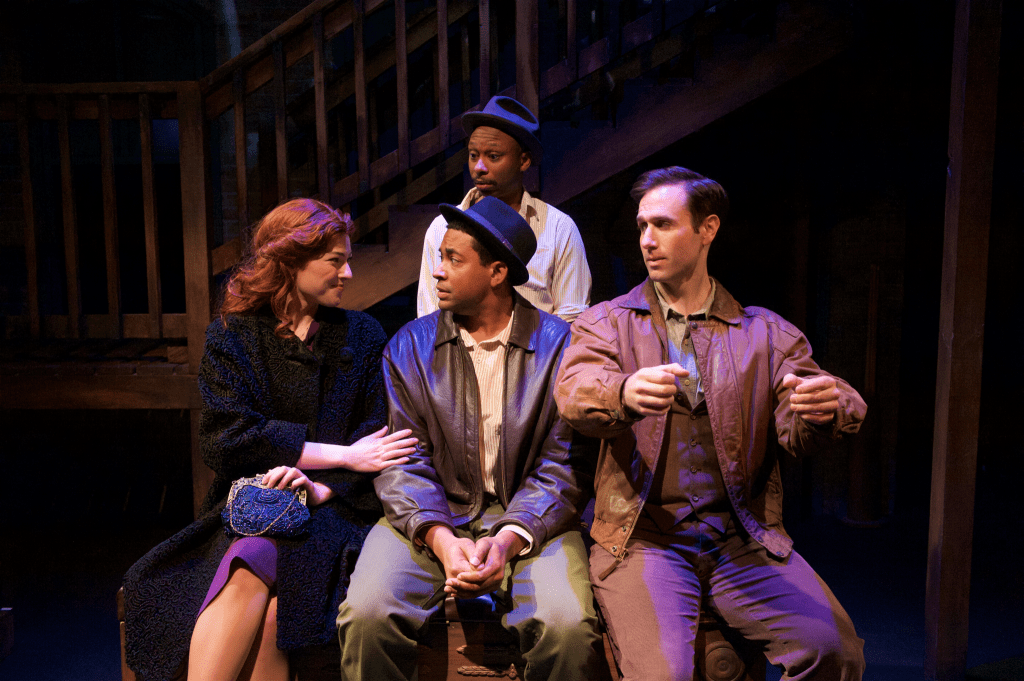
I am writing this post during the intermission, sitting in the first row of the Owen Theater in Goodman.

I am glad I decided to go, and made time to see the one before last performance,

I am glad I went on my own, not inviting any of my girlfriends.

The play is extremely loaded. A part of me wants to leave and not watch the second act, because I think it will be even more intense, but I won’t.

I worked from home today, so that I could see mom after work, and still go to Goodman. That scenario worked surprisingly well, so I think I will be doing it sometimes.

I am glad I am here. The second act is about to begin, unveiling a drama that’s way too close to what’s happening on the streets outside the theater. It’s a call for action, but I am not sure which one.

RIFENSTAHL

I just exited the Siskel Center after watching “RIFENSTAHL.” I missed the first screening (with director-in-person) last week, because I hosted the Prairie Postgres User Group at the same time. Today was my only chance to see it, because I am leaving tomorrow and the last screening will be on September 26, before I return. Well, there will be more screenings later, but I will be travelling again, and also – I didn’t want to wait!

I just saw the movie. For the past several months, I was reading my friend’s blog about Riefenstahl’s memoirs, and I wanted to know more, so I queued a couple of books about her in my future reading list. But let me tell you that: it’s one thing to read what she says about herself, and a different thing to hear it, in her own words, with her facial expressions, with her intonations. To see the immense pleasure on her face when she watched the “Triumph of the Will,” conducting the screen music.

Starting with her cynical phrase: The movie was commissioned by Hitler. If Roosevelt were to commission a movie, I would also try my best. If Stalin were to ask me to make a movie for him, I would do my best as well. And all her screams: no, it’s a lie! What people disappear?! There were no such people around me! We didn’t know! No, I didn’t see! And: I would never make a movie about cripples! And isn’t it in all cultures that we admire beautiful bodies?

Oh, and there is footage of how she was making these pictures of Nuba! How she treated them like animals. I will never buy her albums.

Evil, evil, evil. No shades. No “buts”.

Racism

Over the weekend, I watched the movie “Freedom Writers.” It’s a relatively old (or at least not so new) movie, and the events took place in the 1990s. For some reason, I had never heard about this movie, and even more interesting, the person who recommended it to me was not even American.

How I feel about this movie… It is very realistic in depicting the communications of troubled teens. I had never been to a class in a US high school, But I saw enough of these situations in the youth shelter. However, I have to sadly agree with the antagonist in the movie that this one unique experience is not a methodology that can be applied by any high school teacher. Another issue that the movie does not mention is the environment. No matter how good the teachers are, there is still the environment where these kids spend the rest of their time. Also, when they graduate from high school, that same environment won’t be necessarily supportive.

I know, and I always tell this to everyone who care to listen, that there is no universal solution for these problems, and that we can only do “one person at a time.” Still, it incredibly frustrating.

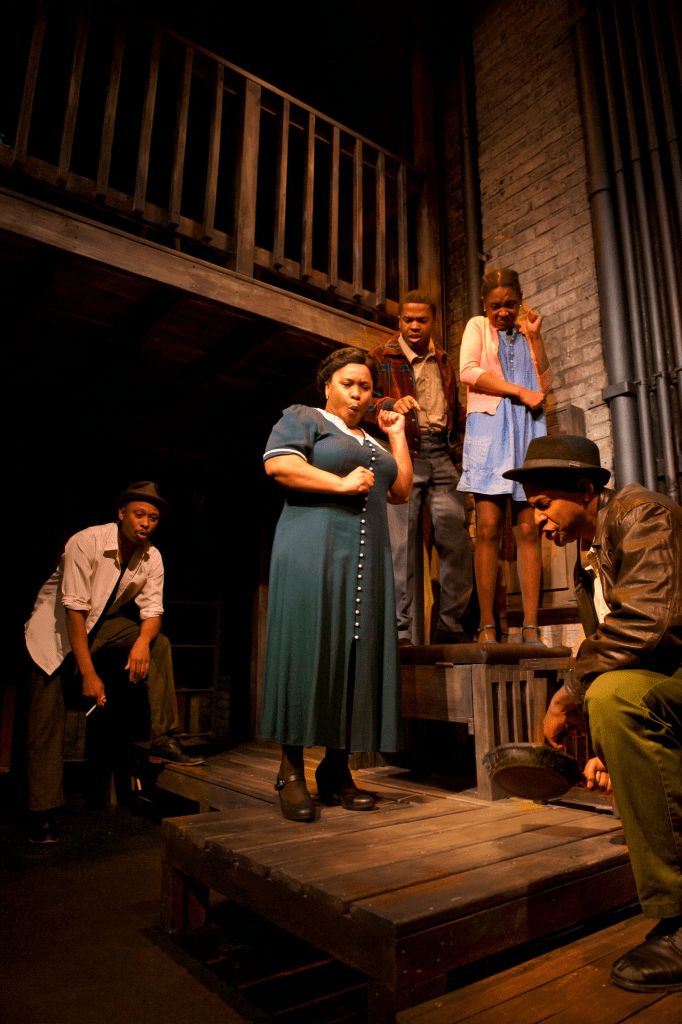
On Saturday, I saw the “Native Son” at the Lifeline theater. It was a very powerful performance; One-and-a half hours of breathtaking action. I really like this review from Evanston Round Table (and that’s where I found these pictures):

What does this play have in common with the Freedom Writers, is the sad fact the things didn’t change much since the events took place. I went to see this play with one of my Black friends, and when I told her how I felt she said:no, Black people have way more legal right now, they can defend themselves in the court. I said: but Black teens are still stopped for minor violations times more often than White teens – and she agreed.

Which is, circling back to the movie, the dead end : it’s not only about breaking the cycle of violence. It’s more about breaking the cycle in people’s heads.

Human Zoos

On our trip to Antwerp and Ghent, we had a photo stop at Atomium, and our tour guide told us about the Human Zoo which was open during the 1958 World Fair. I had not idea that they still existed in the 20th century, yet along that recently, so I rushed to read more about it. I am sure that everyone less ignorant than me saw that picture, but I saw it for the first time, and frankly, whatever else you read about Human Zoos wouldn’t make the same impression as that one photo. Shocking is not enough of a word.

It’s easy to Google more details about human zoos; I do not want to put any more links here. I can’t imagine people tossing bananas and other food in the direction of humans which are literally “on display.” Just can’t imagine.

The Ripple, The Wave…

Flexible theatre memberships always look appealing because you think you will just choose the day which works best for you when it is closer to the show. And then, since a show is not on your calendar, you forget that you must choose.

This happened to me with my Whenever Goodman membership: the play “the ripple, the wave which carries me home” looked very interesting, but I thought, “I will look at it next week, this week is too busy,” until all of a sudden, I received an email saying that the show must close the upcoming Sunday.

Fortunately for me, I opened this email before Sunday, and luckily, Igor and I found one show time that worked for both of us.

We were almost late for the show because we went out for dinner and got very engaged in our conversation, so when we rushed into the Owen theater five minutes before the show started, and ended up sitting close to the extended family of the actress who played a leading role!

It is surprising how many people are unaware of the history of pool segregation and how many horrible things were happening fairly recently. Even the author of the play admits in the interview that she was not aware of many of them before she started working on this play. For me, the show’s most shocking moment was when the main heroine’s mother talks about three boys, two black and one white, who were killed (she does not give details of what happened, except “out of four only one returned”), and she says about their funerals:” They should have been buried together, but no cemetery would do this.”

I am glad we got a chance to go. This is one of the plays which is almost too close to reality, and although there are a lot of funny moments, it is very tragic, and very close to ho

The South Side

“Do you like the Soth Side?” a young woman in the youth shelter asked me. We talked about her home; she said she is from St. Louis and wants to return there. “What about Chicago?” I asked her. 

– Chicago is my second best. The South Side

-Which places do you like on the South Side?

-It’s not places; I like being there. I like how I feel. It gives me good vibes. People are friendly, and I feel good when I walk there and people say Hi. 

-I like how you said it! It’s very important to feel good vibes!

And then she asked: Do you like South Side? 

She asked with hope in her voice, and I avoided the answer. 

I do not know it enough, although Igor took me to tour the South Side landmarks on multiple occasions. It is a foreign land for me; even though people are indeed nice and friendly, I do not belong there. And this young woman is blissfully ignorant of that. 

I don’t know what to make out of that except for acknowledging the fact..

Privileges And What Is Not

Thinking about myself in the times of the Soviet Union and how I felt in other “socialist republics,” and thinking about the cries of “discrimination against the Russian language,” whether it is in Ukraine, Estonia, or another independent country, I feel like what some people call “discrimination,” is, in fact, taking their previous privileges away. 

I think it is true in many different settings. 

In the same way, men often do not believe women are discriminated against because they consider their entitlement a norm. When their privileges are taken away, they consider it a deprivation of their rights. And in the same way, some white people believe they are placed in a disadvantaged position only because their white privileges are taken away.

I am shocked that so many people do not realize the level of police profiling and do not see any problem with it on the basis that “Black really commit more crimes!” From the moment when the Highland Shooting happened, I knew it would draw public attention primarily because both the suspect and the victims were white. After all, there were a couple of shootings on the South Side the same weekend, which went virtually unnoticed because “there are always shootings on the South Side.”  

I do not know what will it take to change that.

Did You Know That Lynching Was Not a Crime?

It’s hard to believe, but that’s true! The legislation passed the Senate last Monday, and I can’t believe that it took so long!

Below is the text of the article from the Chicago Tribune March 8 2022 by Darcel Rockett.

==========

Legislation to make lynching a federal hate crime and prevent racist killers from evading justice was introduced more than 200 times but never once passed into law, according to Illinois U.S. Rep. Bobby Rush.

That path is clearer now that the Senate unanimously passed a bill Monday that criminalizes lynching and makes it punishable by up to 30 years in prison. The measure passed the House last month and now goes to President Joe Biden’s desk.

“Who would have imagined that lynching, that was visited upon literally over 6,000 citizens of our nation, that lynching was not a federal crime until our present day,” Rush told the Tribune on Tuesday. “We’re looking forward to a more perfect union.”

The Emmett Till Anti-Lynching Act, named for the Chicago teen and authored by Rush, states a crime can be prosecuted as a lynching when a conspiracy to commit a hate crime results in death or serious bodily injury. Emmett Till, the 14-year-old son of Mamie Till-Mobley, was murdered in Mississippi in 1955. The act first passed the House of Representatives in February 2020, but was blocked when Sen. Rand Paul, R-Ky., objected to clearing it by unanimous consent in the Senate.

Rush reintroduced the act on the first day of the 117th Congress in January 2022. The previous text of the legislation set the maximum sentence at 10 years and made lynching a crime that could only be prosecuted under specific circumstances, such as if it took place while the victim was engaging in a federally protected activity such as voting.

Now, the act amends the United States Code to include a maximum sentence of 30 years for a perpetrator convicted under the anti-lynching act, in addition to any other federal criminal charges the perpetrators may face, and the legislation applies to a broader range of circumstances.

Thousands of Americans were lynched between 1865 and 1950, according to a 2020 report from the Equal Justice Initiative.

Rush, who is in communication with Till’s remaining relatives, said they were very determined that the bill was going to pass and they did all they could, including praying that President Biden would be able to sign it.

Rush said the prayers have been answered. He wants to see if a formal ceremony can take place to honor the measure. Rush, who will leave his office after this term, doesn’t see this as a feather in his cap, but he does see it as a victory for the American people — for Black Americans specifically.

When the Till act was passed by the U.S. House of Representatives in 2020, a boyhood friend of Till’s said the law refreshed our memory of what our history looks like, placing value on history, so we don’t repeat it.

That was before the Department of Justice’s Civil Rights Division and the U.S. attorney’s office for the Northern District of Mississippi closed their investigation of the Till case in December 2020 after Carolyn Bryant, now Carolyn Donham, the wife of one of the confessed murderers and a witness to events leading up to Till’s murder, alleged recantation of events in a 2017 book by Timothy Tyson titled “The Blood of Emmett Till.”

Per a DOJ statement, the government’s re-investigation found no new evidence suggesting any living person was involved in Till’s abduction and murder. Till’s remaining relatives said the “findings came as no surprise.”

Two white men, Roy Bryant and his half-brother J.W. Milam, were tried on murder charges about a month after Till was killed, but an all-white Mississippi jury acquitted them. The trial is the basis of a recent immersive stage adaptation of the 1955 trial transcript performed by Collaboraction, “Trial in the Delta: The Murder of Emmett Till.”

WMAQ-Ch. 5. news anchor Marion Brooks found the transcript in her research on Till and wanted to get the information out. The play will also live on screen as part two of Brooks’ documentary on Till, “The Lost Story of Emmett Till: The Universal Child.”

Days after Till was killed for allegedly whistling at a white woman, his body was pulled from the Tallahatchie River, where it was tossed after being weighed down with a cotton gin fan. Months later, Bryant and Milam confessed to the killing in a paid interview with Look magazine. Bryant and Milam were not brought to trial again, and they are now both dead. Donham has been living in Raleigh, North Carolina.

G. Riley Mills and Willie Round, co-creators of the play, said the bill was a long time coming.

“While we’re glad it was finally passed by Congress, it’s hard not to feel anger and disappointment at how long it took,” Mills said. “We salute Congressman Rush for his tireless efforts championing the cause for Emmett and Mamie.”

Christopher Benson, an attorney, Northwestern University Medill School of Journalism associate professor, and co-author with Mamie Till-Mobley of “Death of Innocence: The Story of the Hate Crime That Changed America,” said people have to take encouragement from the new legislation.

“One hundred years and there never was agreement on a way forward to address this horror of racial violence,” he said. “It’s a good start, but now we have to enforce it.”

For the past four years, Benson has worked with the Till family. He said Till’s family is highly supportive.

“Whether this compensates for the lack of justice in Till’s case is another matter,” he said. “We have to ask, what does justice require? Justice would have meant that Emmett Till came home alive. So we can never truly experience justice in this case. We have sought some level of accountability from his killers and the government structure that enabled that lynching. Because the killers of Emmett Till believed that they could get away with the destruction of a Black body, because of the horrible system that exists in this country, particularly in Mississippi at the time.”

Rush shares similar sentiments.

“It’s a victory for Emmett Till, his legacy, his family and the over 6,000 people who were lynched in our nation, all the way up to this moment,” he said. “This is really an intergenerational, historical victory.”

Books

I finally finished Bedrock faith, which I read as a part of One book – One Chicago.

I am still thinking about this book. I rated it 4-star, but I would give it two separate grades if I could. One for the quality of writing, and another for the book’s main idea.

The book is very well written. You do not want to rush through; you are not trying to turn the pages before you finish reading and pick at the end. I read it slowly, enjoying the language, savoring each detail, and each of the characters appeared so real!

As for the book’s main idea, I am still hesitant about my feelings. I think that the book manifests it loud and clear that “once a bad apple always a bad apple.” It feels like Stew Pot “was born bad” and acted violently throughout his life because he could not act differently. And I have a problem with that statement. I believe that under life circumstances, a person can become very negative and that their mind might take such a turn that they would constantly think of harming somebody. But it will always be impossible for me to accept that people might be “born that way,” and there is no way to change it. I would love to discuss it with somebody who read it.

Another book I recently finished listening to is Caste by Isabel Wilkerson. My impressions are similar to what I felt after finishing “Color of Law”: I can’t believe it’s happening here and now. Wilkerson suggests that race is social rather than a biological characteristic and compares the position in the society of Blacks with this of untouchables in the Indian society. The similarities are shocking. Also, she describes many real-life situations that are too real, so well-recognizable, and once again, it feels unreal that things like this happen nowadays. 

The Message Which I Left To My Co-workers Today

Since we are celebrating Black History Month, I wanted to pass along some information about Chicago Neighborhoods. 

During the past year, several co-workers asked me about different Chicago neighborhoods, especially about their safety. I always have an uneasy time answering these questions because “safety” had become a loaded word in general, and especially in Chicago. The reality is more complicated than dichotomy safe/not safe, and for a while, I was thinking about ways to show these complexities in a way that would be easier than reading volumes of history books. 

My older son, who is a contributing reporter for Austin Weekly, has put together a list of articles that talk about different Chicago neighborhoods, their history, stigmas, and much more. 

Let’s talk about neighborhood stigma
Chicago and race: perception, polling, and reality
Urban Renewal and Gentrification in Chicago
Best of the SouthSide
Differential Pathways of Neighborhood Change and Perceived Neighborhood Reputation
The Woodlawn’s future

I am aware that nobody likes clicking the links, especially non-technical ones, but is it challenging to come up with a short essay on a complex topic. I hope you will find these links useful and educational and make this Black History Month more meaningful. 

P.S. I had received a record number of thanks!

P.P.S. Igor, if you will still be able to come up with something more compact, it would be great.