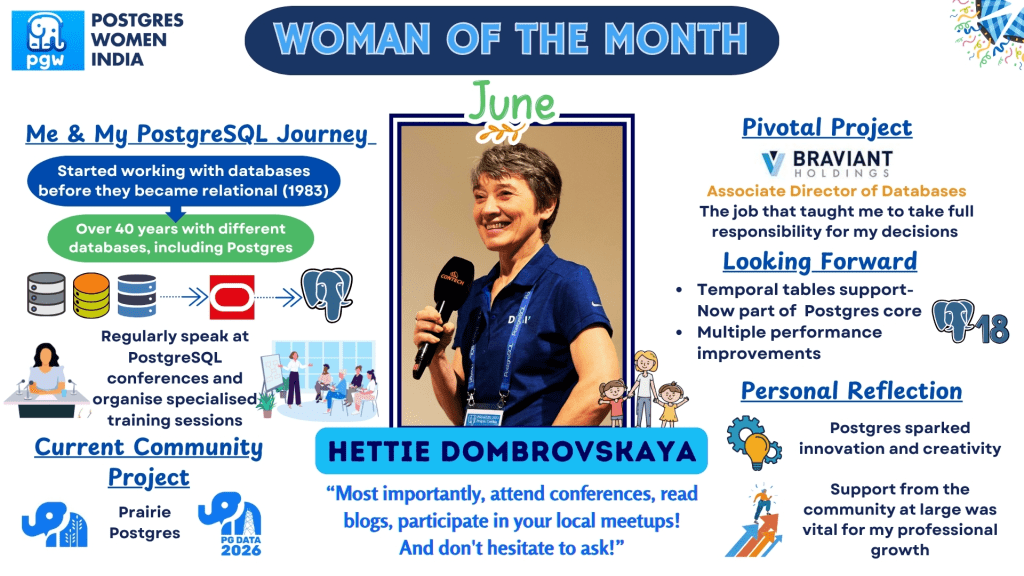
What I Have To Do With India?!

I know, I know – they featured multiple Postgres Women from Europe and the USA, and they were interviewing me for the past two weeks, but it still feels funny!

I genuinely love the graphics, though!

If anybody is interested in the full article, it is here. Enjoy 🙂

Chicago Is Ready To Resist

Chicago Sun-Times:

Mayor Brandon Johnson urged Chicagoans to “rise up in this moment” against President Donald Trump’s mass deportation effort, even as he acknowledged Wednesday that the deployment of the military to help carry out immigration raids in Los Angeles could happen here.

Johnson refused to say precisely what he would do if mass demonstrations in Chicago — perhaps as soon as Saturday’s “No Kings Day of Defiance” protests — provoke an L.A.-style federal response.

The mayor would only say that he is concerned enough to have spoken directly with Gov. JB Pritzker and Cook County Board President Toni Preckwinkle about the possibility that Trump might activate the Illinois National Guard to protect U.S. Immigration and Customs Enforcement agents making arrests.

“This is a necessary fight for all of us to be able to push back. Whether we use the courts or whether we continue to protest and raise our voices, dissent matters in this moment,” the mayor said at his weekly City Hall news conference.

“It’s a war on our culture. It’s a war on our democracy. It’s a war on our humanity. I am counting on all of Chicago to resist in this moment because, whatever particular vulnerable group is being targeted today, another group will be next. … None of us are immune from this disease.”

Chicago Mayor Brandon Johnson, shown here at a public appearance June 4, used some of his strongest rhetoric yet Wednesday against President Donald Trump and the White House’s deportation-raid efforts. Pat Nabong/Sun-Times
Saturday’s protests have the potential to be even larger than Tuesday’s demonstrations in the Loop.

Johnson said the Chicago Police Department will preserve the right of demonstrators to peacefully assemble and protest, just as it did during the Democratic National Convention, but lawbreaking will not be tolerated.

“Our first responsibility is to ensure that we keep everyone safe. That is my No. 1 responsibility. It’s what I think about every day, all day. Our approach won’t be that much different on Saturday,” Johnson said. “The right to assemble peacefully is a constitutional right. We have to protect that. There are some actors that, unfortunately, act outside of their constitutional protection. If that were to take place, those individuals will be held responsible and accountable.”

Apparently referring to the violence and vandalism that occurred in parts of Los Angeles during anti-ICE demonstrations there, Johnson said when a “small number of protesters set things on fire, it plays into the hand of authoritarians like Donald Trump, who take advantage to ultimately suppress all protesters.

“What we have seen in Los Angeles is really not about immigration. This is not about policy. It’s about power. We have a tyrant in the White House who has a complete disregard for our Constitution and the dismissing of our democracy,” the mayor said. “This is a terrible moment in our nation’s history. … He continues to show how low he will stoop. … It is sick and demented. I didn’t know you could look worse than George Wallace.”

Johnson’s chief of staff, Cristina Pacione-Zayas, warned that the escalatory tactics the Trump administration has used in Los Angeles could happen in Chicago.

“Yesterday, the notice was given … to federal agents that they have 48 hours to stand by and be ready to deploy — that there will be five cities that are targeted. Democratic-led cities,” Pacione-Zayas said. “Chicago being one of them for sure, and that they were going to be targeting workplaces in terms of the raids.”

Pacione-Zayas added: “There will be tactical teams. There will be mini-tanks. There will be other tools that they use in which they plan to do raids, as we saw in Los Angeles. That information is actually pretty public. It has been out there and, in fact, on official channels.”

Johnson’s deputy mayor for community safety, Garien Gatewood, was among those out on the street monitoring demonstrations in the Loop on Tuesday against Trump’s immigration raids. During the protests, a motorist drove toward a group of protesters and struck one of the demonstrators.

“Nobody, obviously, expects someone to do what they did yesterday. So we’ll make improvements on that,” Gatewood said. “We already had a meeting this morning with some of our team on additional resources we’ll need in place. We’ve been in contact directly with the governor’s office about some of the support they can provide, as well.”

Johnson said he is grateful that “in the midst of this effort by the Trump administration to create chaos, that we were able to get through yesterday without mass arrests or life-altering harm” to police or demonstrators.

The mayor’s remarks signaled some of his strongest rhetoric yet denouncing the president’s stepped-up immigration raids. Johnson added that he considers it “grotesque” that Trump is using the armed forces to celebrate his 79th birthday by holding a military parade Saturday, which also is the 250th anniversary of the U.S. Army.


Today, there were way more people on the streets than it was anticipated; I had a commitment close to home and could not join them, but I already changed my escorting shift on Saturday so that I could join the rally on the Daley Plaza.


More Coverage Of February 24 Rallies

A short but very much to-the-point episode from ABC7 here.

WGN coverage:

Igor took a lot of great pictures, I especially like this one:

DSC_3598

But all of them are pretty amazing, and you can see all of them here.

I will try to write more about How I feel and what I think these days.

Tribune’s Strike

I wanted to share Igor’s Instagram post about the unprecedented Chicago Tribune News Room strike that took place on February 1. As I often remind people, there were only three days in the whole Chicago Tribune’s history when it didn’t come out of print. February 1 can be considered a “thrid and a half” time, since the newspaper came out with only five pages instead of fifty:).

TIME Magazine: Less Social Media?

To be clear, the question mark is mine, not TIME’s. This is one of many new-year-resolution-related articles called “How to reset your relationships with social media?”

I keep wondering why people want to use social media less – I feel like I am not doing enough of it because I do not have enough time. Often (and this article is not an exception), the author would emphasize “meeting with people” and “communicating in person” instead of on social media. In my case, however, the only people with whom I communicate on social media are people whom I know in real life but who either live too far from me or have challenging schedules. This way or the other, it is not easy to regularly communicate in person, and I want to know what they are up to. I often feel that my very real friends are upset when I do not pay attention to their lives. And it’s not just “them,” I would love to be informed about what’s up with them. As for professional social media, it’s even more important. Firstly, I also know many of these people in person, and secondly, in my profession, it is vitally important to stay on top of what are the new things others are doing. I always feel like I am missing out on important professional updates (until somebody pings me explicitly).

Anyway, here is the article (and I am trying to do almost all the opposite of what they suggest!)

Continue reading “TIME Magazine: Less Social Media?”

Failure is a Privilege: TIME Magazine

And one more interesting article. I can relate to many of the mentioned situations, including the consequences of failure while being a minority.

Billie Jean King, winner of 39 Grand Slam Tennis titles, said, “Losing a tennis match isn’t failure, it’s research.” Thomas Edison said he hadn’t failed, but rather “found 10,000 ways that don’t work” in his quest to invent a working lightbulb. These game-changing pioneers can extol the benefits of failure all they want. But most of us find failure unpleasant. It helps, I believe, to realize that there is a “right kind of wrong”—a type of failure that brings valuable advances in science, as well as in everyday life. Called “intelligent failures,” these are the undesired results of thoughtful forays into new territory. Intelligent failures illuminate the pathway toward success.

Failure can also be a privilege. As journalist and University of Colorado professor Adam Bradley points out in a New York Times article, “One of the greatest underrecognized privileges of whiteness might be the license it gives some to fail without fear.” Bradley explains that being a member of a minority culture often means your failures, especially if they become public, are seen as representative of an entire group. Your individual failure reflects badly on everyone else like you. John Jennings, professor of media and culture studies at the University of California, Riverside, told Bradley, “I want to get to the point where Joe Schmo Black guy is just safe, can be ordinary—even mediocre.”

Stereotyping is a natural psychological process that causes people to generalize the actions of an individual to their group. This is especially true when a group is underrepresented in a given field or role. Thus, when a person of color fails in a consequential role, people tend to overgeneralize, seeing the failure as related to their race rather than to them as an individual. Intuitively aware of this, members of minority groups feel heightened pressure to succeed, so as to avoid triggering these biases—a pressure that ironically inhibits their ability to perform well.

In fact, that inventor and acoustician James West, whose intelligent failures resulted in more than 250 patents, including one for the electret microphone, was African American makes his success that much more noteworthy. He succeeded in his field despite the entrenched racism that had him being mistaken for a janitor while employed as a scientist at Bell Labs. Imagine the pressure he must have felt to avoid reducing the chances for others like him to follow in his footsteps at Bell Labs and other elite institutions.

Women, especially women in academic science, also lack the luxury of failing unobtrusively. We are at risk of feeling pressure to succeed at all times lest we spoil other women’s opportunities. Scientist Jennifer Heemstra endorses “a culture in science and academia where people can be open about their failures without consequences.” A realist, she adds, “I’ll say that our responsibility to share our failures is proportional to the amount of power we have in the academic system.” As a tenured professor with her own lab at Emory University, Heemstra is now quite open about her failures. But she wasn’t always that way. Her most painful failure—not being voted for tenure the first time around (at a previous university)—turned out to be a gift. The failure was an interruption, forcing reflection.

“[Failing a tenure vote] was definitely the most painful failure of my life, as I felt like I had let down my family and my research group members—basically all of the people I care most about,” explained Heemstra to information-technology researcher Veronika Cheplygina, who also studies failure. “But it can also be a beautifully humbling experience as well. Seeing how all of those people stood by me in the midst of the struggle ended up seismically shifting my worldview and priorities. It gave me a new view of what academia could be and a fire to make that into a reality.”

Note that Heemstra didn’t try to slough off or ignore what she calls “a truly horrible feeling.” She acknowledged and named her feeling and let herself feel bad for a time. This is in line with findings from a 2017 study led by psychologist and researcher Noelle Nelson that focusing on your emotions, rather than thinking about the failure (which tends to generate self-justification), helps people learn and improve. Eventually, Heemstra developed a keen interest in failure that led to research into understanding how undergraduates experience failure in STEM courses and how this affects their decision to continue science careers. She and others have designed an undergraduate research curriculum to engage students in hands-on laboratory learning and give them experience with the right kind of wrong that is so central to discovery.

Similarly, embracing failure is a mainstay in queer (LGBTQIA+) theory and politics. In his seminal book The Queer Art of Failure, transgender media theorist Jack Halberstam argues that the measure and meaning of success is not defined by the individual but rather comes from communities, and that the norms of “success” lead toward a “mindless conformity.” In contrast, embracing failure allows a “free space of reinvention” from which to critique assumptions imposed by the world. Halberstam is part of a group of queer thinkers who see the experience of failure to meet society’s expectations as foundational to queer culture. Mainstays of what it means to live a “successful” life, such as biological prosperity, financial security, health, and longevity, had long been denied to queer people by discriminatory adoption laws, biases in hiring, acts of violence and prejudice, and even the HIV/AIDS epidemic. In failing to live up to heteronormative expectations, queer people must find their own ways to “succeed,” and a core and now celebrated part of this success is the recognition of having first failed.

For instance, drag performance, as an art form, celebrates the experience of queer people welcoming a lack of conformity to society’s expectations. Through its exaggerated contrast, the show makes society’s default expectations more visible. It makes us aware of heteronormative culture as a lens through which we view the world—nudging us out of our default sense, as naïve realists, that we objectively see reality. In the competition reality-television show RuPaul’s Drag Race, a group of mostly male-identified contestants adopt characters who are pastiches of femininity in hyperbolic performances of models and pageant contestants. The show celebrates liberation from expectations on a prime-time stage. And it’s wildly popular. The premiere of its 13th season on January 1, 2021, was, at the time, the show’s most watched episode, garnering 1.3 million viewers via simulcast, a number comparable to the 1.32 million viewers who tuned in to an average NBA game during the 2020–21 season.

Cultivating psychological safety is not the same thing as cultivating belonging, and many have conflated the two in recent years. Here’s how I see it: Psychological safety, which means believing it’s safe to speak up, is enormously important for feeling a sense of belonging. But belonging is more personal, while psychological safety is more collective (it is conceptualized in research studies as an emergent property of a group) and, I think, it is co-created by individuals and the groups to which they wish to belong. The more I study the research on the psychology, sociology, and economics of inequality, the more massive the undertaking of correcting these societal failures feels. At the very least, as a society, we should aspire to creating a world where everyone has an equal license to fail intelligently. That is not the case today. But I believe that we’re ever so slightly closer to that aspiration than we were even just a few years ago. Recognizing our heteronormative, white lens through which we view the world is an important first step.
Bias Against Bodies Podcasts

WBEZ’s Sasha-Ann Simmons ran the Bias Against Bodies podcast for most of 2023. Here are just three of the episodes.

Fitness

Fashions

Workplace discrimination

Igor’s Article

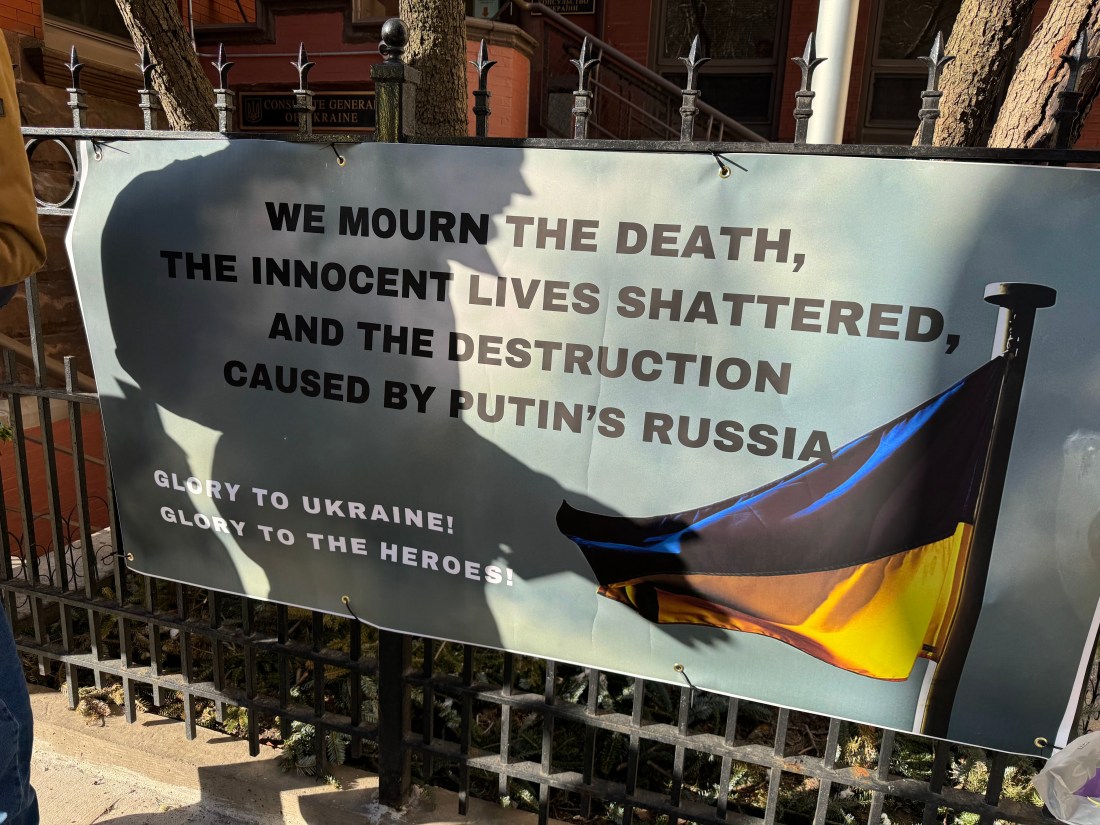
Today, one more time, a person who has known me for a long time, but does not talk to me too often, asked me “how am I” other than “lots of work.” I told him: there is a war in my life; it is here, it does not go away, and it will never go away from my life until it will be actually over.

That’s how I am, and although most news sources moved the war in Ukraine to the second tier of coverage, I didn’t move it there.

That’s why I was so happy that Igor’s article about the war in the Wednesday Journal made it to the front page of the Opinion section. I hope that enough people will see it – here is it.

Igor’s Articles

I wanted to share a couple of recent Igor’s articles

And last but not least – an article, in which he himself became a part of the story with his editor’s follow-up:

Friendships In Black & White