CSO Backstage Tour

Since last year, I purchased two tickets for a Millennium Park concert, which was considered a fundraiser, I officially became a “CSO donor” (I think, my subscription is not expensive enough to qualify). With that, I started to receive some exclusive invitations. I know that invitations to the open rehearsals are issued to all subscribers, but I believe that for a backstage tour invitation, you need a higher level. Or maybe they just started to offer them. Whatever the case, this season was the first time I started receiving these invites, and I was sad I couldn’t choose any tour time that worked for me. Finally, a couple of weeks ago, I spotted one time that could work and still had openings (it was a last-minute addition). The time loosely corresponded to my lunch break :). I immediately grabbed two tickets and told my neighbor about this opportunity.

Unfortunately, I couldn’t stay for the whole tour, because it ended up being longer than one hour (as it was advertised). But funny enough, the last and the best part of the tour – the backstage – was less important for me because I saw it as a part of the CSO for Kids Ambassador tour with Nadia, so it was OK; I just felt bad that I had to ask an usher to escort me out.

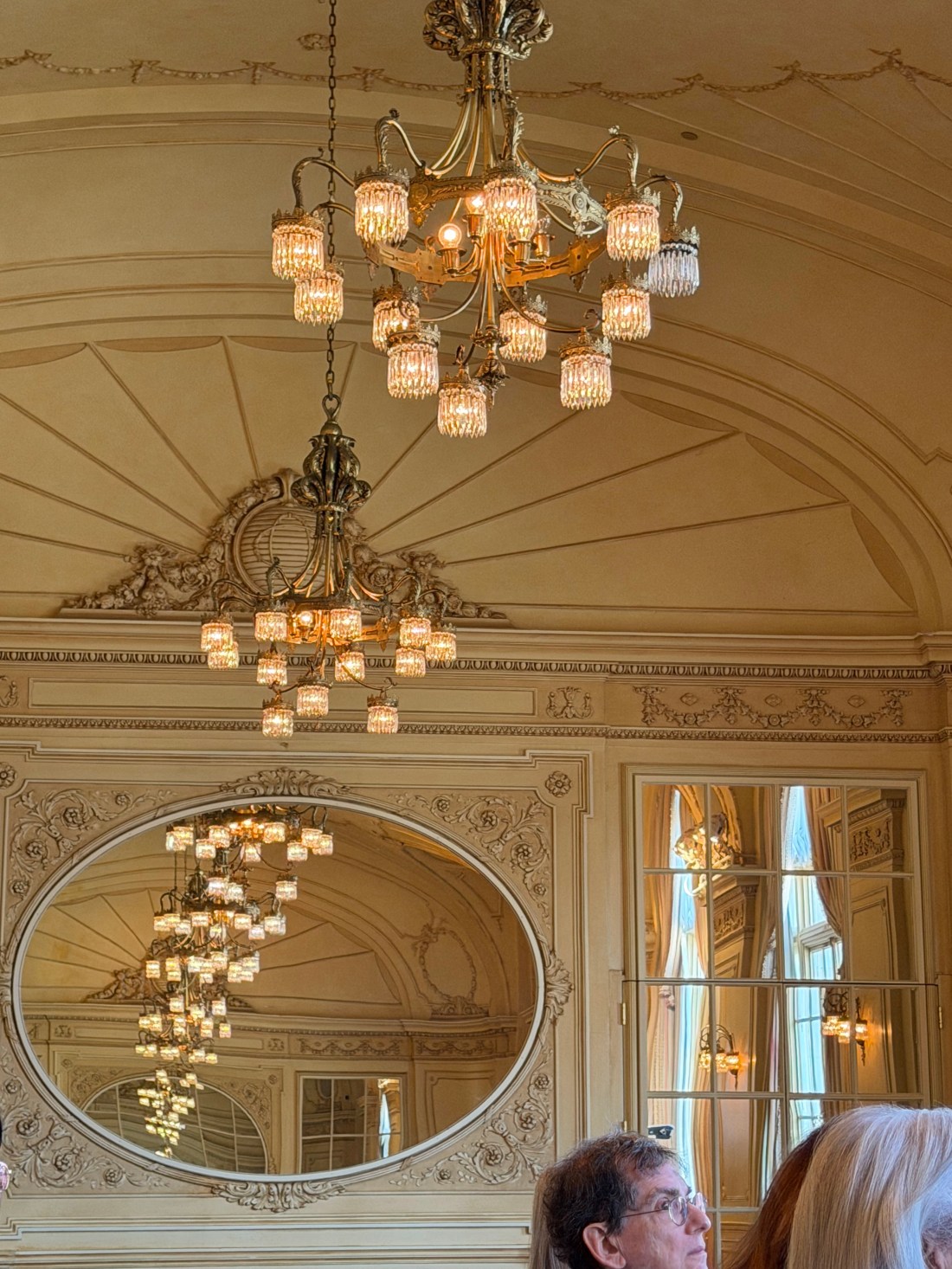
The curator who led the tour was exceptionally knowledgeable, and she told us all about the history of the building and the orchestra. I knew some pieces of it: how Theodor Tomas agreed to move to Chicago in 1890 for the promise to have a permanent orchestra (“I will move to hell for that!”). How the orchestra first performed in the Auditorium, and how Daniel Burnham volunteered to design the new orchestra’s home.

I didn’t know that Theodor Thomas specifically wanted to have a ballroom in the building for more intimate gatherings, and that it’s because of him we have Grainger Ballroom.

The Rotunda was a later addition, similar to the Arcade, and was built to house the CSO offices, the libarary and the archive
Another thing we learnde on the tour: the first female member joined the orchestra in 1940, and out of all instruments you would imagine, she played a French horn!
I didn’t know that the ceiling can be moved up and down to create a different effect, depending on who is on stage (the full orchestra, the Chamber orchestra, or a soloist)

Backstage:

The harpsichord (I remember seeing Melody Lord playing it)

As I said, I didn’t take a lot of pictures backstage because I took them on a previous tour. My friend messaged me later that it was a very special experience, and she loved it. She was able to sty till the end, and I had to run back to work!

I Knew It!

Honestly, when I saw this piece. in WBEZ newsletter, that’s what I wanted to scream: I knew it! I knew that Makela would love our Art Institute! And I love the concept of “music pairing.”

The story.

Continue reading “I Knew It!”

Mäkelä Conducts Sibelius

On Thursday, I was at the CSO again, and it was another exceptional program. I am still in the process of familiarising myself with our new future Musical Director, but I am getting to know his style more and more.

During the first part of the Thursday concert, Mäkelä was conducting Sibelius’ Lemminkäinen, and the program book was full of the Helsinki pictures, so I overloaded my neighbor with extra information about the Sibelius Monument, Kelevala, kantele, Larin Paraske, and Akseli Gallen-Kallela (his Lemminkäinen’s Mother was in the program book). In short, lots of unsolicited information :). I think she barely survived :).

Mäkelä was fantastic (and also, as I said, I am slowly “growing into him.” I can’t find a recording of Mäkelä conducting Lemminkäinen, so here is the only one I found. I am sure I will have more opportunities to listen to Mäkelä conducting in the years to come, and hopefully I will be able to share more videos.

A Thomas Club Dinner

I rarely post pictures of food these days; for a change, these are the pcictures of the dinner my neighbor and I had before the Thursday concert. She turned 75 earlier this month, and we wanted to have a nice dinner together. The Thomas Club on the 9th floor of the CSO building is always a good idea, and there we went.

In addition to the occasion itself, there were two things I wanted to mention. First, I could never imagine the stuffed shells being an exquisit dish, but here they were! Unbelivably delicios! And second – just a thought – why all of sudden a tiramisu has bunny ears:)? Let it stay a mystery!

The CSO Concert

The CSO Concert on Thursday was one of the best I ever attended! It started with the composition “To See the Sky: an exegesis for orchestra,” by Joel Thompson.

Composer Joel Thompson credits the inspiration for his orchestral work To See the Sky to a single line from the song “Thunderclouds,” written by jazz vocalist Cécile McLorin Salvant: “Sometimes you have to look into a well to see the sky.” 

To See the Sky, which had its world premiere in March 2024 by the New York Philharmonic, under Jaap van Zweden, is Thompson’s longest orchestral work to date. “It gives an indication of his future music,” said Patrick Summers, artistic and music director of the Houston Grand Opera, where Thompson is composer-in-residence through 2027. “With no hyperbole, To See the Sky is music of extraordinary beauty and deep content. To hear an orchestra of such dazzling quality as the New York Philharmonic bring Joel’s imagination to full life was a very moving thrill.”

Commissioned by the American Composers Forum, Atlanta Symphony Orchestra, Aspen Music Festival and Bravo! Vail Music Festival, To See the Sky will be performed by the Chicago Symphony Orchestra, under Jaap van Zweden, in concerts Feb. 12-15

Thompson has said of his work: “The movements outline a non-linear journey toward healing.” “He has achieved this in every possible way,” said Summers in a video interview posted by Houston Grand Opera. “The listener’s emotional journey of To See the Sky is more than simply satisfying; it is cathartic and self-realization. Quite an achievement. 

“Primary among his many gifts is an ability to juxtapose several musical styles simultaneously, forming a melodic and colorful musical narrative that anyone can understand, but which also challenges virtuoso musicians like these,” Summers said. “To See the Sky was 20 minutes in length, and the musical material could easily have been twice that. One wanted it to last longer. Large-scale structures like opera are clearly in his DNA, based on a work like this. 

The composer himself was in the audience and came up on stage!

And next was an absolutely stunning performance of Himari, a fourteen-year-old prodigy, and I don’t know what to say, because no words can describe her! Fortunately, I just found on YouTube the Max Bruch concert she was performing on Thursday, an

I completely agree with one of the comments on YouTube: There are violin prodigies then there is Himari.

I can’t believe I was there, in the first row, experiencing her magic!

Art Institute And CSO

On Thursday, I had a very packed after-work schedule. First, I went to the Art Institute to finally see the Strange Realities exhibit. Usually, I am among the first to see a new exhibit, but this time, I have something going on each Thursday, and I didn’t have time to make a separate trip to the Loop on any weekend.

Upon entering the exhibit, I realized that symbolism as an art movement had completely dropped from my radar many years ago. In high school, we studied symbolism in literature, including Alexander Blok and Andrei Bely. We “obligatory loved” Balmont, Annensky, and other poets of the “Silver Century” of Russian poetry. I just tried to find (unsuccessfully) a blog post where I wrote about how an “intelligent person” in Soviet Russia was supposed to admire certain poets and writers, who were not explicitly banned, but were not praised by the official propaganda; loving symbolists was one of those “requirements.”

Now I realized that for many years, it was not obligatory anymore, and this artistic movement dropped from my sight, and it took me a while to realize: yea, I know what it is all about!

Kupka: The Fools
Ensor: The Entry of Christ into Brussels
Hans Thoma: The Dream
Felicent Rops: The Greates Love of Don Juan
Alfred Kubin: Judith with the Head of Holofernes
Grasset: Morthin Addict

I think I will go see this exhibit again; I didn’t have enough time because I also wanted to catch up on the Elizabeth Catlett exhibit (I saw it as a “second one” when we were at the Art Institute with Boris in August, and it was not enough).

Next stop was the CSO. A week before, they advertised the pickup dinners at the Rotunda. I think it was in response to the disappearance of the affordable “before the show” dining options, which I also complained about. So I tried it, and the answer is no :). I would rather stop at Lea!

As for the concert, it was absolutely amazing! It was an all-Berlioz program with Klaus Makela conducting, and now I have finally started to like him. I won’t say I disliked him when I heard him conducting for the first couple of times, but he is so different from Riccardo Muti that it was a difficult switch! This time, I sat with my mouth open throughout the whole concert 🙂

Oh, and the violist Antoine Tamestit was absolutely outstanding!!! Loved every moment of his performance in the Harold in Italy.

Two More CSO Concerts

We had a subscription for a series of three family matinees at the CSO, and due to the scheduling conflicts, we had to miss two of them. May 3 was not easier, but we all made an effort, even though Anna had to drive to the Loop and drop Nadia just in front of the Orchestra Hall, and had to leave immediately after the post-concert activities.

I was disappointed with a very low attendance, and I can’t even attribute it to anything except for general not-so-great people’s mood. it’s a pity because the concert was absolutely wonderful. Thomas WIlkings was absolutely magical – the way he spoke with the kids from the stage, how he introduced each piece, how he talked about building a community… As a CSO for Kids Ambassador, I (with the rest of the family) was invited to lunch in the Grainger Ballroom. that was a little bit overkill, because only two other families joined us, but as I said, the concert attendance was not great, so that was expected. I still think it’s a great idea to pre-order lunch for before or after the concert, and I hope that things will be better organized for the next season.

Then, there were the usual between-the-concerts activities, including “Mini Maestros” and the “instrument petting zoo,” which both Nadia and Kira thoroughly enjoyed. A new activity was creating some music with the large sticky notes:

The musicians actually played these two measures :).

***

On Sunday, I took my mom to another concert conducted by our Music Director Designate Klaus Makela (Brahms Piano Concerto No.2 and Dvorak’s 7th Symphony). That’s the second time I listen to him conducting; I didn’t hear him before his was appointed the CSO music director, so now I am just starting to get a “taste” of him. Both works are beautiful, and Brahms sounded very unusual, though in a good way.

Makela is so different from both Muti and Borenboim, the two Musical Directors I’ve experienced at the CSO that it will probably take me a while to take his style in.

Showing Chicago To My Guest

One of the conference attendees (and my good friend) stayed at my house for the whole event and the weekend after, which was great for both of us, and we were each other’s moral support :). It was her second visit to Chicago, and this time, not only did I show her places in the city she hadn’t seen before, but also, I walked with her around Rogers Park and showed all the best local spots, because she and her family will stay with me in August.

An L-train turning
A bridge going up
Lunch at the Art Institute Member’s Lounge
Continue reading “Showing Chicago To My Guest”

Two CSO Concerts

Just to note that I had some life during the past two weeks, not just conferences, papers, submissions, and millions of other things.

The first one was on April 13, a joint CSO/Joffrey performance. The first part was just CSO, but both pieces were extra special. The first was Chevalier de Saint-George’s First Symphony (and I am all into him since I learned about his existence, which, I hate to admit, happened fairly recently). The second one was Hayden’s Farewell Symphony, which, again, I knew nothing about, and I just thought that all Haydn’s symphonies are the same. The musicians didn’t have the candles on their music stands as they technically should for this piece, but they were still walking away until the last two violins were left. Below is not the CSO performance, but just to show what it looks like:

Then, after the intermission, we had the Joffrey on stage! In fact, they were warming up during the intermission, and everyone in the audience started taking photos 🙂

I especially loved the last piece, Le Bouef sur le Toit, by Darius Milhaud. Of course, below is just the music, without the ballet, and trust me, that was something worth seeing!

The second concert was Mahler’s Seventh on April 17. My neighbor, with whom we usually go, didn’t know what it was going to be, and it was a surprise for her that we would be sitting for an hour and a half with no intermission. But then she was absolutely taken away by the music :). Some works sound especially good when you listen from up close, because you feel like you are surrounded by music, and Mahler’s Seventh is one of them.

Shostakovich’s 11th

It was definitely not the first time I heard Shostakovich’s 11th Symphony, but I guess it has been a while. Or it’s just how it feels these days. Usually, I leave the CSO uplifted, with the general feeling that “life is not so bad,” but the 11th Symphony left me feeling hopeless, especially the finale. Too many cultural references, plus too many parallels with today’s situations (more than one). After the last accord, when the audience exploded with applause, I felt almost insulted by this sound: how could anybody applause after hearing that?!

There was one interesting episode at DevOps Day. I met one person at the beginning of the day (he was a partner of one of the speakers). He approached me later in the day, asking my opinion about some abstract situation (and he told me that he was constructing this situation based on the previous responder’s feedback). After several clarifying questions, I finally realized which moral dilemma he was trying to solve. I told him: you do not need to ask me about the hypothetical situation; I have been in a similar situation for the past three years. And I hate myself for not doing enough years before. I hate myself for not doing enough now, for having my spoon being too small to scoop the water out before the people drown. And I feel guilty for “living a life” and worrying about a million non-critical things while some seriously evil things are happening all over the world…

At the end of our conversation, that person thanked me for sharing my opinion and said that he was sure I would have something to say. I asked him why he was so sure, and he said that he listened to my talk and knew I had opinions.

I don’t know why I feel this conversation is related to Shostakovich’s 11th, but somehow, in my mind, it is!