Maid: A Book Review

This is not the real review, just the short note, since I want to mention this book to my friends who are following what I read.

Another book I finished last week, was Maid by Stephanie Land.You might want to say that “that’s what Barbara Ehrenreich wrote about in “Nickled and Dimed,” except for (as she herself said in the foreword) that’s FOR REAL. Stephanie is not role-playing. it’s not a game, it’s survival.

Working hard is not enough. Working multiple jobs is not enough. Trying your best is not enough

My takeaway from this book is: people who are struggling, need help. They need help from organizations, funds, and people. From individuals. Otherwise, survival mode will stay forever.

Laziness Does Not Exists: A Book Review

I especially liked the first half of the book. I’d say I would give 5 stars to the first four chapters and four stars for the rest. I felt like the second half was partially repeating the first, and at the same time, it felt less convincing and slightly off-topic. But what I just said does not diminish the fact that this book is AWESOME! For me, it was also extremely timely – just when I felt completely burned down.
Interestingly, I knew most of the things this book is talking about many years ago. I knew that even when we have an 8-hour workday, the actual time we can produce the intellectual results is not more than four hours a day. I knew that switching from time to time your attention to something which is not “work” helps the thinking process. I knew that when you work too much and too hard, your body becomes less immune and more prone to all sorts of illnesses.
I knew it all, but after I joined my current company, where I really wanted to do all the things I wanted, and it was too much of these things, I started to think that if it is not “somebody” which makes me work more, but I, then “it does not count.” I do not know whether anybody can make any sense out of the last sentence :), but at least I know what I meant to say :))

Another thought which resonated with me a lot was about “me” and “everybody else.” Devon Price says that most of the people he interviewed for this book would agree that “people in general” are not lazy, but they would say: but I am REALLY lazy. For me, it was “nobody has to work overtime, and it is unproductive anyway,” but “I” CAN work long hours, because “I” have a very special attitude, and since I WANT it, not like somebody MAKES me, I will be productive. Maybe now that timing was right, but I took it in this time. Even before I finished the book, I resolved to make changes to the way I work now, monitor how many hours I spend working, and not allow my direct reports and people around me to work long hours. It is unproductive and sometimes dangerous.

And the final takeaway from this book was about stopping “saving” people. Once again, I knew for a while that I rush into “saving” people way too often. Recently, I started to distinguish between people who need just a little push or simply encouragement and people who need me to listen to their complaints about everything that goes wrong with their lives. It’s nothing wrong with complaining; I just started to realize that there are people who are not looking for ways to improve their situation but need to complain just for the sake of complaining.

To summarize, by the time I turned the last page, I had a whole bunch of resolutions, and I also liked the author’s personality and writing style a lot!

Reading Sophia Tolstaya Diaries

Some time ago, my friend posted several blog posts about Sophia Tolstaya, Leo Tolstoy’s wife’s Diaries. These posts prompted me to start reading.

It is a massive book; the diaries cover all her marital life, and at first, I wondered why I even started reading it and whether it is worth finishing. I never hesitate to drop the book if it does not feel engaging; that’s why my booklists end up being relatively short.

I had a completely different impression about Tolstoy and Sophia Tolstaya and their family life than my friend did. At some point, I thought that “I already got it,” and there is no reason to keep reading over and over about similar activities day by day, about the visitors, etc. But to my surprise, I found myself drawn to that book, and the more into the book, the more I got interested.

Continue reading “Reading Sophia Tolstaya Diaries”

The Book Is Official!

I will write more on one of the subsequent days, but I really want to share my news, which one of my former co-workers called “the next most important news of the day after inauguration.”

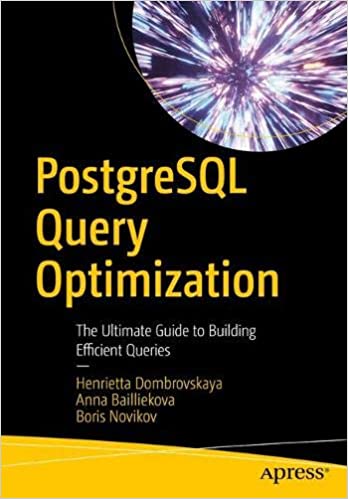
Last week, our book became official, we are on Amazon, and we will be published at the end of April.

Here is it: Amazon.

I made an official announcement a today’s meetup of Chicago PostgreSQL User Group. Also, we officially announced the open source database postgres_air, which we developed to illustrate the concepts from the book. But it ended up to be more than that, and we decided to give it to the community as our contribution.

I am happy in all possible ways 🙂

Here is the recording, if somebody wants to hear a lot of me :). Tomorrow, there will be LinkedIn blog posts, and I will upload the video there as well, but not everybody follows me on LinkedIn 🙂

2020 Reading

When Goodreads sent me my 2020 report, to my surprise and astonishment, I found only two books there! 

I know that I didn’t record everything I read, but it was definitely more than two!

When I checked my books on Goodreads, I found that because most of the time, I’ve recorded my reading way later than I read the books, I almost never put the date when I finished reading, and thereby Goodreads omitted them. 

I had to go back to my list of books and fill in the approximate dates when I finished them. It ended up being twenty-five books. It does not sound like a lot, but I do not record the books I read in Russian, and I do not record the books I do like. Full discloser: most of the time, if I do not like a book twenty percent into it, I just drop it. 

The last two books which I finished last year were Wildwood Creek and Redlined. The first didn’t quite meet my expectations. The beginning of the story was auspicious and expected a lot, but then it somehow ended abruptly, in a hurry, with some threads abandoned. At least, that’s how I feel. 

Igor recommended the “Redlined,” and I liked it a lot! I like the whole real-life plot: after both parents passed away, their children found their dairies, where they described the same events each from their perspective. Also, the first-generation immigrant family, and also – Chicago’s West Side transformations. Maybe, this book is not so meaningful for those who do not live in Chicago, but I enjoyed it a lot!

I am now finishing the Promised Land, and also listening and reading a couple of Russian books. They will be my first reads of 2021. 

Listening to “A Promised Land”

I started doing audiobooks instead of real books first because it became difficult for me to read and because I could listen on the go. After all the eye surgeries of this year, I can read the regular books again. However, I already got hooked on the convenience of listening, so more often, I listen. 

As for this particular book, Obama’s “Promised Land,” there is an extra incentive for listening: Barack himself narrates the book. 

Thirty hours of listening to the voice we do not hear that often anymore! Small suppressed laughs here and there. And the ability to travel back in time and relive all these amazing years again! 

I remember it so well – exactly how he describes it in the book! I remember this feeling: now it’s the time! I remember how everybody was saying: it’s too soon, and at the same time the feeling was mounting: now IS the time!

I remember everybody in the City of Chicago building where I was doing my consulting work saying: he is our future president. Before anything happened, before Springfield. I remember Anna happily telling the story of her encounter with Barak on Melissa Bean’s campaign trail: you are still above us, but we appreciate the gesture! She was so happy that she made Barak laugh.

And I remember this cold February night, the night before the announcement. I remember her calling her coach: can I be excused from practice tomorrow? There is somebody who can drive me to Springfield! And I remember the silver bells in her voice: Thank you, coach! 

Continue reading “Listening to “A Promised Land””

Strangers In Their Own Land – a Book Review

I listened to the book Strangers In Their Own Land a couple of weeks before the Elections. And that was very appropriate reading for that time! The book description from Goodreads says:

In Strangers in Their Own Land, the renowned sociologist Arlie Russell Hochschild embarks on a thought-provoking journey from her liberal hometown of Berkeley, California, deep into Louisiana bayou country – a stronghold of the conservative right. As she gets to know people who strongly oppose many of the ideas she famously champions, Russell Hochschild nevertheless finds common ground and quickly warms to the people she meets – among them a Tea Party activist whose town has been swallowed by a sinkhole caused by a drilling accident – people whose concerns are actually ones that all Americans share: the desire for community, the embrace of family, and hopes for their children.

Strangers in Their Own Land goes beyond the commonplace liberal idea that these are people who have been duped into voting against their own interests. Instead, Russell Hochschild finds lives ripped apart by stagnant wages, a loss of home, an elusive American dream – and political choices and views that make sense in the context of their lives. Russell Hochschild draws on her expert knowledge of the sociology of emotion to help us understand what it feels like to live in “red” America. Along the way she finds answers to one of the crucial questions of contemporary American politics: why do the people who would seem to benefit most from “liberal” government intervention abhor the very idea? 

The idea of this book resonates deeply with me. I am often faced with questions from outsiders, especially from people who live in other countries, how people in their right minds can support Trump? I always say that it’s not like these people are cruel and inhumane; it’s just the see different sides of Trump’s policy, and that there may be reasons why they find these policies appealing, and why they find government interventions bad; and it’s not like they are stupid. 

I really liked this book for the conversation’s calm tone, for the author’s willingness to listen and understand. You can’t change people’s mind stating that they are idiots; if you want to convince people to your views, or at least plant a seed of doubt, you should clearly understand where they are coming from and converse with them on their territory.

Once again, some of the people’s stories in this book reminded me of my grandparents’ generation point of view. They might seem to be on the opposite pole of the political spectrum, but I remember this pride of always providing for themselves, always doing their best at work, never being late. Interestingly, somehow they never considered any government assistance, like pensions, the housing they were “given”, things like free education as “assistance.” And probably rightly so, because all these things would never compensate for what the government effectively took away from them in the form of reduced pay, budget redistribution, etc. In any case, I was surprised to hear my grandfather (and to some extent, my mother) in these voices from the American South. 

While America Aged: a Book Review

While America Aged: How Pension Debts Ruined General Motors, Stopped the NYC Subways, Bankrupted San Diego, and Loom as the Next Financial Crisis is a relatively short book with a long title. At first, it felt boring, and I wondered why I am reading it in the world, but it ended up being very enlightening. 

One thing that puzzles me is the difference in the pension systems between the US and the rest of the first world. I knew that many big American corporations had pensions in the past, but by the time I entered the US workforce, they were eliminated everywhere except the governments. I learned how pensions in big corporations, like GM, were first established and how they played their role in attracting workers in the absence of Social Security. Later, the pension design flaws led to the financial crisis. 

When the US car manufacturers were in a severe crisis ten years ago, people would say that American cars cost more than Japanese cars because American workers “cost more.” What never occurred to me was a notion that it’s not that American workers were paid more, but that American car manufacturers had to invest huge sums of money in the workers’ pensions. At the same time, Japanese companies do not need to do so because they have government retirement programs. 

Some parts of the book made me think about the Russian pension system. In Russia, the retirement age for women is fifty-five, and for men – sixty, which is so early that I can’t even wrap my head around it. 

When a couple of years ago, the Russian government announced that they would increase the retirement age, everybody started screaming. What is worth noting, though, is the fact that in Russia, people file for retirement when they reach the age of fifty-five or sixty respectively, and they continue working, receiving both the salary and the retirement benefits. And when I try to explain that that’s wrong, they say that “pensions are so small, you can’t survive on a pension alone, you need to work. I do not understand how it does not occur to anybody that pensions can’t be bigger if people only work for half of their lives. 

When I express my opinion that pensions are designed to provide income for those who can’t work any longer, that it is something like insurance, people are telling me: no, we are entitled to receive a pension after we reached a certain age. 

I just gave up on understanding :). But the funny thing is that in this book, when some municipal employees were receiving both their salaries and pensions, it is described as something outrageous, like the lowest possible morale :). When the workers were given extra shifts or better positions during their last year before retirement, the schemas were described as fraudulent, but that precisely what everybody was doing back in the USSR. 

Very interesting reading, I am telling you 🙂
Invisible Women: a Book Review

One more time, I am so behind in the book reviews that I can hardly remember what the last book I reviewed was. But consulting my Audible library, here are the three books I wanted to write about. 

The first on the list is Invisible Women Data Bias in a World Designed for Men A person who recommended it said that it’s a horror book. I thought that maybe it’s a horror for them, but I could hardly imagine that there can be something in the book about women’s unfair treatment that I do not know. And boy, how wrong I was!

When I checked the reviews, I saw that many readers shared the same sentiment, saying that they could not even think about the depth of prejudgement and that there are so many defaults they never thought of. 

I can relate to all these sentiments since I felt the same way. This book is about the data gaps which are present in nearly every research in virtually any field. Each chapter of this book is dedicated to one of the areas in which research routinely exclude or under-represent women: medical trails, interior design, government… The book introduces a “default male,” and I never realized how deeply this default male concept is enrooted in almost all assumptions I make. An eye-opening moment was when I realized that when I write or say “a user,” I picture a male! And that’s me, a fierce advocate of women’s equality in technology! 

If you want to know the depth of your own “default to male” presumption, I highly recommend this book! 

All The Books I Read And Did Not Review

I am trying to write this post for more than three weeks, and the list of books I’ve listened to or read is growing and growing, and I already lost hope to write even a paragraph about each. But since people are keeping asking me about what I am reading, and since I read a lot of really good books, I will try at least to compile a list with some notes.

This list covers the past four or five months, and includes only the books I liked.

First, I finally read all of the “Call the Midwife” trilogy. I can’t tell why it took me so long, I wanted to read it forever. Loved it to the last word:). I never had an opportunity to take a close look at the life of the impoverished population of London. I guess, I had no idea about what was happening between the times of Charles Dickens and nowadays. I could not help but noticing, how much the healthcare for the poor was developed in the UK even in the middle of the previous century, something which the US underprivileged population can’t even dream about.

Too Much And Never Enough – that was a classical example of “everybody is reading it, and I should, too.” It’s not like I didn’t like the book, but I guess I expected more of it after all the buzz.

The Book of Lost Friends – a beautiful book. The two threads of the story stand a hundred years apart, but even the “modern” part, which takes place in 1987 looks horrific from the nowadays point of view. Unfortunately, many schools in the underserved neighborhoods even these days have the same lack of resources and same limited expectations from their students. But I hope that school boards like the one described in this book, no longer exist!

Childhood, interrupted. Raising kids during pandemic – a short but charming essay by Sanjay Gupta, very personal and sincere.

When you finish saving the world – this book is available from Audible Originals, and does not exist on paper. The rating on Goodreads is somewhat low, but I really enjoyed the story, all three parts.

The things we cannot say – I mentioned this book in one of the recent posts, and I still hope to write more than a paragraph about it; it raised a storm in my mind. Same to the book Truths I Never Told You – these two books are painfully related in my heart.

As I said, I am only mentioning the books which I rally liked. I should probably mention the books which I started and didn’t like and didn’t finish, but it’s just not interesting to write about them 🙂