2025. Part 2

Civic activities

Here, there are more negative than positive results. My biggest regret of 2025 is that I didn’t do enough during the election campaign. To be precise, I did zero canvassing and a very moderate amount of convincing people of what the right thing to do is. I knew it was wrong, but I kept telling myself that organizing Prairie Postgres is more important at that moment, and that I can’t do everything, and… I didn’t speak up enough, which I also regret. I post very little, if anything, political on LinkedIn, where I am most visible, and the list continues. I will never do it again!

I’ve done a little bit better at supporting DEI, regardless of the political climate, but I wasn’t consistent enough, so one of my goals for this year is to always keep this support on my radar.

Even with simple things like attending the rallies, I did way less than I did in previous years. Once again, my excuse was that I was twice as busy as before because of Prairie Postgres and my activities in the professional community. Still, I should always remember that if the country’s civic values are at risk, the interests of my professional community are at risk as well. I want to make an intentional effort to attend rallies when I really care about the cause. I know that society’s well-being depends on each individual’s actions, so I have no excuse. I know that each person matters. Earlier in 2025, I tried to become more involved in local initiatives, but I had to drop these activities because they looked like a very insignificant outcome for the time spent. I will try to get involved again in a couple of years, when I retire.

Cultural activities and reading

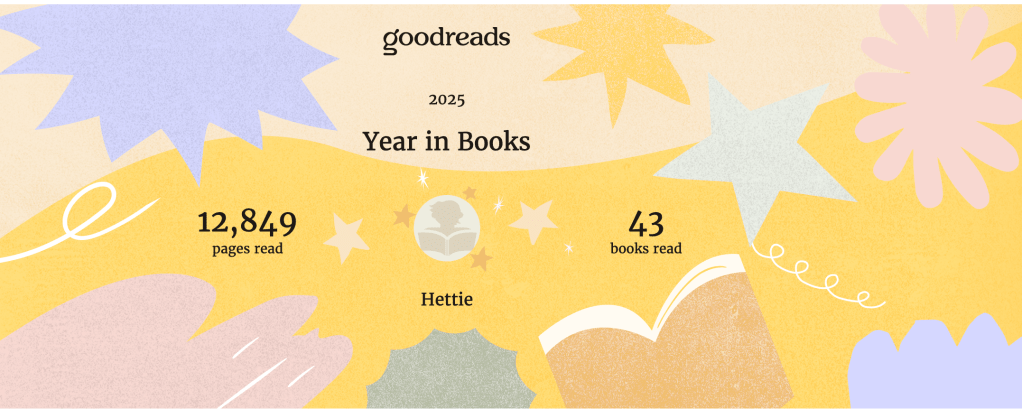
According to Goodreads, I read fewer books in 2025 than in 2024, but I believe that’s because I didn’t record books that ended up being a waste of time, and there were more of those in 2025. The majority of books were audiobooks, and that’s something I want to address. I switched to audiobooks because it is easier to listen while I am doing something else, and also because of my vision problems. Now that my vision is better, I am looking to find ways to read e-books again. Today, I realized I have a new option: I started taking the L more often, and when on the L, I can find a place to sit, but there isn’t enough space to open my computer, especially since I switched from Mac Air back to Mac Pro. This is the time when I can read e-books.

As for the other cultural activities, I attended many exhibits, concerts, operas, and different theatrical performances, but I didn’t keep track of them, and that’s something I want to do next year. I am still hungry for more cultural activities and want to see more performances than I have time to see, and oftentimes I feel disappointed because I do not like the show. Next year, I want to get more organized with all these activities, keep track of them, and what I like and what I don’t, so I can figure out how much I really want to see and what exactly.

To be continued
Books – 2025

Here is my year in books according to Goodreads.

I read more books than that, but unfortunately, a large percentage of the ones I read didn’t give me anything, and I regretted spending time on them. The most disappointing part was that I didn’t like any of the books from our book club at work. However, I am happy to report that I learned to drop the books I didn’t like without any guilt. Here are the last several books I read at the end of the year:

The Tipping Point. The full title of this book is The Tipping Point: How Little Things Can Make a Big Difference. Published 25 years ago, it’s considered a classic, and I think it’s a must-read for anyone who wants to understand how ideas are spread in society, and what can be done to promote progressive ideas or desired behavior. I didn’t read this book before, but I saw an advertisement about the next book, Revenge of the Tipping Point, and figured I needed to read the original one first.

Revenge is even more interesting; it explores social engineering, its faults, and offers a new perspective on the COVID pandemic and opioid crisis, among many other topics.

What we can know – A dystopia, the most interesting part of which is, in my opinion, how much the digital trace of our lives will reveal about the true us to our distant descendants.

Careless People – an explosive book, which I am glad I read. I am not disagreeing with those who say that the book is extremely subjective, and I can see the point of those who say that the author was not as naive as she presents herself, but still, I believe it. And somehow, it does not surprise me.

Books

Some (not all the books) I listened to and read recently.

The Tree of Knowledge – I liked it when I just started reading it; it looked like an interesting

The Dream Machine I LOVED this book! So many things we now take for granted, and you do not think that at some point, somebody came up with this idea! Things like “there shall be memory” :). Starting from the very first ideas, how a computer should be built, the concepts of processor and memory, the concept of a program as a set of commands, binary representation… I knew some bits and pieces of that history, but only some. Absolutely fascinating reading.

A Thousand Ships by Natalie Haynes. I liked it less than all the other books by the same author. I felt like she tried to talk about too many characters in one book, and it ended up being more shallow than some of her other books.

After the Spike – great book! The first book on the subject of (de)population and declining birth rates that I have ever come across, which discusses the real causes of the problem, rather than merely suggesting that “women should be paid more and daycare should be affordable.” Love how the authors talk about the “opportunity cost” and what we all can do about it.

The Rope Walker. I learned who Jaan Kross is when I visited Tallinn last January, and saw his sculpture on one of the Old Town streets. I wanted to find out who this person is, and I learned that he lived in Estonia all his life, including the years of Soviet and German occupation. And during all this time, he has been writing historical novels. He was very popular, and for some reason, he was never prosecuted, and his books were regularly published. At the same time, he continued to be deeply respected by everyone in the country.

Naturally, I wanted to read his books, and I discovered that his most popular trilogy had been translated into English. It took me a while to finish it, because I rarely have time to sit and read, and there is no audio version, but I loved it!

Honestly, I do not know how in the world Jaan Kross got away with writing this kind of book under Soviet occupation, but I guess they took it literally like he was talking about Germans 🙂

Regardless of political context, it’s a great book! I may be biased, because I love Tallinn, and I know not every street, but almost every building mentioned. When you read this book, you are completely immersed in the life of Medieval Tallinn; I felt like I could hear every sound, and smell every smell… I am on book three now!

Original Sin

I heard about this book, Original Sin: President Biden’s Decline, Its Cover-Up, and His Disastrous Choice to Run Again, on the Apple News podcast about a month ago, and I knew right away that I needed it! I listened to it non-stop until I was done. I see that it gets mediocre reviews; some say that the authors should have criticized more, some that they shouldn’t have touched this topic. But I am convinced it’s the right book at the right time.

When I started listening to it, I was shocked by how much was hidden from the general public, and wondered how in the world the people close to the President could set up such a massive cover-up. But then, listening further, I relived all the hesitations again, all of the many unknowns, and as horrifying as it is, I felt that I could understand. It’s a very depressing book, but an absolute must-read. We must learn the historical lessons and take in all the excruciating consequences of the 2024 election disaster.

An Event with Ron Wynden

I am ashamed to say that I didn’t know anything about the book “It Takes Chutzpah” until I saw the advertisement for the library event. And I should be even more ashamed that I didn’t know who Senator Wyden was.

The only reason I made a note about this event was the mention of Governor Pritzker being a part of this conversation. I checked out what this book was about, asserting the topic and the fact that the Governor thought it’s worth reading prompted me to get a book and mark my calendar.

I put aside the book I was listening to at that time, and started to listen to the Senator Wyden ‘s book. When I learned which initiatives and legistlations he championed, I became really ashamed, and thought that my knowledge of the Senators is tilted towards the Midwest :).

I came to the library about 30 minutes before the event start, and there was a line (these events are not ticketed).

When they let us in, I hurried up to get the good seat. What I should have done was to get a copy of that book in the hallway by the auditorium, but it didn’t occur to me that they could bo sold out – which happened to be the case! I didn’t need the paper book for myself, but since I already read it, I thought that I wanted Igor to have it, especially when I could get a signed copy.

The event was livestreamed, and if you have 40 minutes to spare, I think it’s totally worth it.

As for the books, a person right before me in the line, got the last copy! For me and everyone behind in in the line, they offered an option to sign an insert which they will paste into the book when it will arrive, so I hope to have one which I signed for Igor in a week or so.

Also, you know how I always ruin the photos having my eyes closed?! This time, when they took a photo of me with the Senator, I was OK, but his eyes were closed!!! No luck!

Books

Hardly Ever Otherwise – the second book by Maria Mateos I read, and I liked it even more than Sweet Daruisha, which I read earlier. It is exceptionally well written, and I couldn’t put the book aside until I was done (to be fair, I put it aside right after I started for a while because I had something due back to the library, the book club reading, etc., but then I picked it up again and read non-stop). It’s not an easy reading, but nevertheless.

Small Great Things. The Goodreads reviews are mixed, from one to five stars. I gave it four and read several reviews, and I understand why the opinion differs drastically. There is one review that a reader rewrote several times, giving it five stars first and then gradually changing it to two. I think it’s very much worth reading, especially these days, to remind us about the dark sides of human nature, which are unleashed (again( by the current Administration’s actions).

The Trail of Mrs. Rhinelander. Not from the first page, but I got hooked pretty soon into reading this book and couldn’t put it down. Once again, I understand the mixed reviews, but I liked it. One of these stories in which you learn a lot of unexpected things about the very recent past and what were social norms in a very recent past (barely a hundred years ago).

2020: One City, Seven People. The stories of seven new-yorkers during the pandemic and after. OK, but judging by the book description, I expected more.

The Black Utopians – same as the previous book, I expected much more for the description. I wish the book would be better structured, more organized, and more engaging.

Russian Lies #2

The second documentary of the ‘Russian Lies” series, this one is focused on Russian Literature. And once again, I can repeat word for word the same things I said in the comments on the first documentary: none of this was ever hidden or not accessible. Ever.

We all studied Pushkin, Lermontov, Tolstoy, and Dostoevsky at school. We all read (or at least were supposed to) the books in which the never-ending war on Caucuses was a centerpiece. And brave Russian officers fighting with violent Chechens were the heroes. And we never ever questioned that assumption. Pushin’s private letters were always available in the “Complete Works.” It fact, many of them were frequently cited during the Russian Literature lessons. There was no secret of how he felt about the expansion of Russian territories from Peter the Great onward.

We knew that Russian literature didn’t exist until the 18th century. The was a Tale of Igor’s Campaign at the end of the 12th century, and then pretty much nothing (with few exceptions) until the beginning of the 18th century. But as I already mentioned, the language of the “Tale” is not Russian; it’s an old Slavic language that later evolved into three separate East Slavic languages. The language of Shakespeare is archaic English, but nevertheless, it’s English, while the language of the Tale is not Russian.

A side note. It’s a stunningly beautiful piece of literature. I was so taken away by it when I first read it (I was not older than ten) that I started to learn it by heart. I read all the scientific comments and learned what each word meant (not what it sounded like). As a result, I hated all “officially recognized” poetic translations because I could spot inaccuracies immediately. I still can recite big chunks of it.

Back to the main topic. We didn’t study any literature except for Russian. The exception was my English school; if I remained there until graduation, I would have two semesters of English literature and two of American literature. However, I moved to a specialized mathematical school. I know that regular schools had a “foreign literature” semester in the 9th or 10th grade, so the students there had at least limited exposure. As for us, we were unlucky to have a very good literature teacher. It’s not a typo; she knew Russian literature very well, and we worshiped her. On Saturday afternoons after school, she read forbidden literature to us (not completely forbidden, but let’s say, not approved, such as Bulgakov, Leonid Andreev, or Akhmatova). We believed every word she said, and she was saying that Russian literature is the greatest (she had never read any foreign literature in its original language) and that there was not enough time in the curriculum for us to learn what she wanted us to learn, so to hell with any foreign literature.

This baggage was very difficult to get rid of; somehow, the modern “progressive” writers didn’t charm me that much; somehow, I was able to detect the imperial mindset more or less right away, but many of my friends didn’t.

OK, enough commenting – please watch the documentary.

Books

Just a short list of what I recently read so that I won’t postpone it for three months again.

The Song of Achilles. This was our workplace book club reading, and I loved this book! Maybe it partially helped that I read it while I was in Greece, but I think I would love it regardless.

She-Wolves: The Untold History of Women on Wall Street. This book was recommended by a co-worker. OK. Not bad, but less exciting than I thought it would be

Skin and Bones. Very good! I didn’t expect it to be so captivating—I kept listening whenever I had a minute to spare. I can’t recall which recommendation list it came from, but I am so glad I read it!

Joffrey Ballet: Atonement

Going to see a ballet the night before my departure was a little bit tight, even if I wasn’t as busy as I ended up, but having all I had this week, it was a crazy idea. I think that if I wasn’t going with my neighbor, I would just stay at home and pack, but I didn’t want to let her down. And OMG, how glad I am that I went! The batter is brilliant! The more Joffrey performances I attend, the more I like them!

I didn’t know that this ballet was based on a novel; I only learned about it from the program notes. I still had the right days to read it, so I got an audiobook and listened nonstop, even when I usually listened to the news. I listened to it almost to the end by Thursday evening so I could follow the plot (and I shared it with my neighbor because otherwise, it would be almost impossible to figure out what was going on on stage).

The epilogue was quite unexpected, and I was eager to find out how the book ended. It turned out that the book ends… well, unexpectedly, but I am not going to put any spoilers here. I loved it! Some comments on Goodreads say that Part One is too slow and not engaging, but I can’t imagine it to be different. I loved the novel, the ballet, and the endings of both.

More Books

Sweet Darusya

Followed a friend’s recommendation. It was difficult in the beginning because although I do not speak Ukrainian and even more so Hutsulian, I could still feel that the English translation lost a lot of language flavor, and I was frustrated not being able to grasp it. Still, I kept reading because since I first visited Bukovina in 1976, I had fallen in love with its people. Despite all Soviet propaganda, it was impossible not to see the level of oppression Hutsuls had experienced, and it was absolutely clear that their existence within the Soviet Union was not a happy ending to their struggles. I fell in love with the local legends. For many years, Oleksa Dovbush was my hero, and when other romanticized korsars and musketeers, I dreamed about opryshkes. I know what is drymba and what is kiptar, and how does Hutsul embroidery look.

After the initial “no, it doesn’t sound right!” I got all absorbed in the story: powerful, horrifying, and so beautifully written. I am not 100% sure whether those readers who knew nothing about the history of this region would love the book as much as I loved it, but I highly recommend it.

Divine Might: Goddesses in Greek Myth

It seems hardly possible to tell something new about Greek mythology, but Natalie Haynes succeeded in this endeavor. Focusing on female figures in Greek Myths, she conducted extensive research and presented the readers with many little-known facts. She also encourages the readers to think beyond what they learned in schools about the Greek Gods, and analyze the myths from today’s point of view on gender (in)equality

Eile Weisel: Night. Dawn. Day.

For some reason, Goodreads does not show the other two books of this trilogy, Dawn and Day. I believe they are often combined into a “Trilogy,” but I can’t find it either. I listened to the audiobooks, starting with Dawn and ending with Night. All three are not easy to listen to. They all talk about the long-term personality damage that does not end after a prisoner is liberated from the concentration camp, which I think is really important to understand. I just looked over the reviews of this book, and I see that most readers limit their reviews to one or two sentences, and that’s how I feel: it’s very difficult to write anything except for “horror” and “must-read”.