Just watched it at the Siskel Center – the theater was packed, and a significant part of the audience was not Russian-speaking. The English subtitles were OK – some nuances were definitely missing, but still quite accurate. They should have run the subtitles in the end, when they play a recording of “Broad and vast is our mighty country” – it’s not like every English speaker knows this song, and I think it’s important that during the time of a tightening oppressive regime they play “where man is gloriously free.”
The documentary is unimaginably depressing. Not only because of what exactly it shows, not only because the audience physically feels the pressure of the Russian propaganda machine, but also because of how Pasha chooses to be blind even after he left Russia: everything was fine before February 2022, and then all of a sudden…
As always, I didn’t read any reviews before watching, and now I see some interviews with Pasha, and I am oging to try to watch at least some of them (I have no idea when I find time, but…)
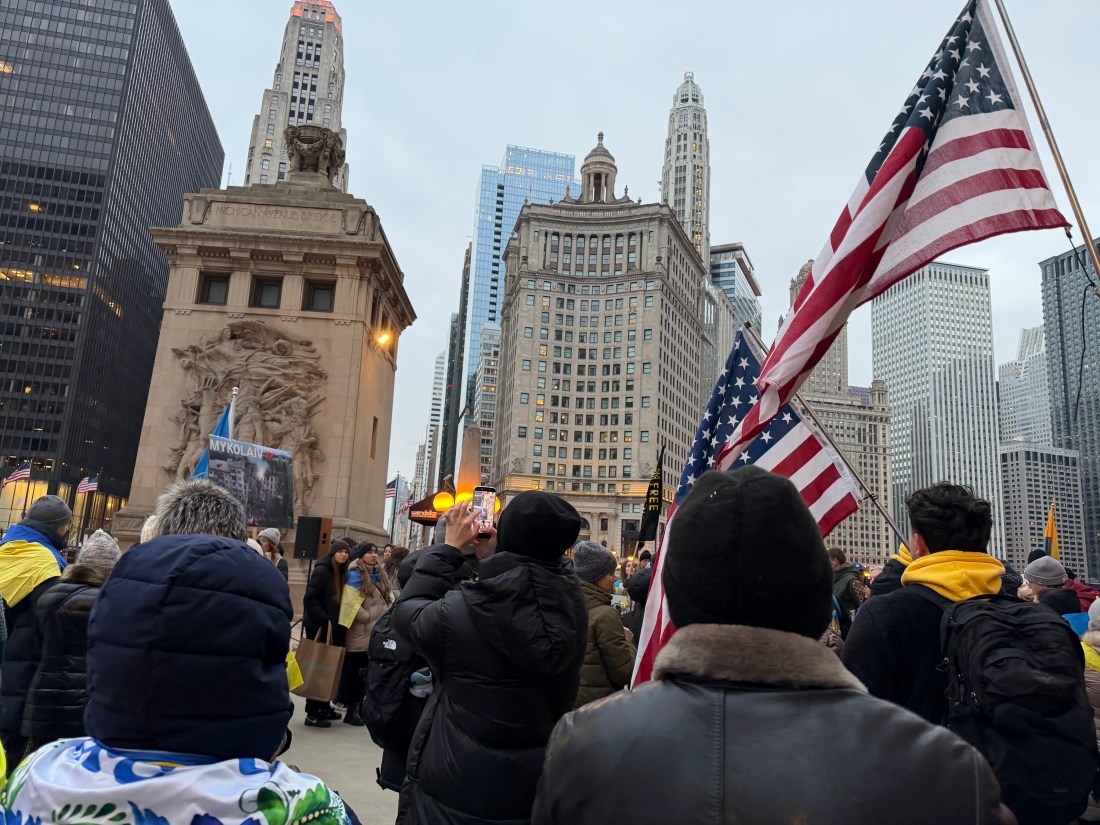
This weekend, my best friend Lena from Ann Arbor came for her annual “Orchid Show visit.” Now, this visit has another, somber meaning. Although the show runs from the beginning of February to the end of March, we try to plan Lena’s visit so we can attend the rally in support of Ukraine, marking the dark anniversary of the full-scale invasion.
Igor was there before us, in a better position and with a better camera, so the pictures are mostly his. Also, I will come back to this post to fill in the names of the speakers, because I am not 100% sure of most of them.
One thing I noticed is that over these four years, everyone learned to say “Slava Ukraine!” without an accent. And the Lithuanian Consul General gave the entire introductory part in Ukrainian, which caused uproar from the crowd. As always, I was happy to see Dick Durbin, a great supporter of Ukraine (and I learned that his ancestors were from Lithuania!)
Pre-rally: Senator Durbin talking to the Iranian activistsPre-rally
The rally started with the USA and Ukrainian Anthems.
Senator Durbin took the stage and told the crowd that there is support for Ukraine on both sides of the aisle, and that he will keep fighting.
Mariya Dmytriv-KapeniakDick Durbin
‘The only fight we can’t win is the one we do not fight!”Consul General of Lithuania Reginmantas Jablonskas
It was cold, but we stayed there for an hour and a half, and the whole time I was thinking about our visit to Vilnius in March 2022 and how there were Ukrainian refugees everywhere. We could not imagine back then how long the full-scale war would last, and we hoped for a quick victory for Ukraine. I know that we need to focus on our fight at home, because our victory at home will benefit the rest of the world, but I still feel that I am not doing enough to support Ukraine. Not talking enough about the war, and letting people to forget.
Last week, Boris asked me whether people around me know how often Kyiv is shelled. I told him: oh, I know! And he asked, “What about the others around you?” Again, I understand that out atmost focus is here and now, but still…
Even though I stayed with locals, it’s impossible to draw any conclusions and/or form any opinion about the country after a three-day stay. Still, there are a couple of things I wanted to mention.
Armenia is a relatively poor country, still, the level of mutual trust is surprising and runs counter to my idea that you need a society of splendor to achieve it. One can say that the priest was comfortable leaving his belongings in a wide-open temple just because there was nobody around who could take advantage of the situation. But in the building where my friends live, the front door has no lock and no buzzer. Moreover, they only lock their apartment at night or when everyone is out, just like I do.
Another thing that I noticed was the way people talk to stranges. It was not our regular over-cheerful/annoying American talkativeness, but very calm and respectful willingness to support a conversation, whether it’s a smalltalk, or a meaningful discussion. No pressure to buy anything at the souvenir shop. Only the cab drivers at the airport, looking for clients, were annoying, but cab drivers are always and everywhere cab drivers. By contrast, during the actual rides, cab drivers were remarkably silent.
Calm, peace, and respect – these words defined my stay in Armenia.
As Igor commented: Ukrainians know how to get people together on a very short notice: the Sunday rally , though last-minute announced, got a decent crowd and press coverage.
It was the first time when I understood the timeline of the October 6 events, and saw the footage filmed by the hostages and those who managed to escape. Although the exhibit is put together exceptionally well, and leave a deep emotional impression, I left it with mixed feelings.
I didn’t post anything about this visit for several days, hoping to figure out what didn’t feel right, but still can’t pinpoint it. I hate to sound critical of the exhibit organizers, because they’ve done tremendous work, but I also can’t brush off the unease I felt afterward. Most likely, it was related to the testimonies at the end. It was actually a one testimony of a survivor, and I honestly think it was too much both for him and people listening. Or maybe not.
My mom’s caregiver and her husband are Ukrainian refugees. They ended up in Chicago because their son and his family had been living here for a long time before. They just never thought they would move here themselves, and probably wouldn’t for many years if it hadn’t been a war.
However, before they moved to the US, they spent several months (almost a year) in Tampere. I recall how I felt when I first came to Finland after the war had started. The war was in the air; the posters calling to donate to the Ukrainian refugees-supporting funds were all over the place, and half of the conversations I overheard on the public transportation were about refugees.
Remembering all that, I can understand why my mom’s caregiver is so thankful to the family that hosted them in Finland. Since the first time they learned that my husband lives in Finland and I go there often, they have wanted me to meet their former host family, and this time it finally worked, since I was going to Tampere!
When the husband visited me before my departure to drop off the gifts, he asked me whether I could do him a favor and ask these people whether they are scared about possible Russian attacks (in light of recent events). I told him that I believed Finland had been “always ready” since 1918, but promised to ask.
So when we met, I asked. They told me that many people in Finland were very much afraid, to the point that some people they knew couldn’t fall asleep without sedatives, but they were fine because they were sure everything was in God’s hands. They told me that they even started building a new house, which should have proved that they indeed believed they would be fine. And yes, they confirmed, it was always like this since 1918, “we just do not talk about it.”
I have nothing to add to this conversation. I believe in Finland, in her people and her Armed Forces, but why in the world does it have to be “always ready”?


 Hettie's Reflections