About “Leaving It For Later” And When Not

When somebody has a newborn baby, is working day and night to meet a deadline, or is in another challenging situation, their house might become a mess, or they can forget something important that they would never forget to do under other circumstances. This is all perfectly understandable.

What does it have to do with me? It’s not like I have always been a model of cleanliness, nor are my current standards of having things in order model ones. However, I have this thing where the sight of a mess is aesthetically displeasing to me, to the extent that most times I can’t do anything else when there are things on the floor or dirty dishes in the sink. I tidy things up right away just because it makes me feel better.

Still, the two weeks before I went to Helsinki were really exhausting. I felt like I was doing something all the time, and most of what I was doing was past due. And several times, I caught myself leaving a mess behind. For example, under normal circumstances, I would not leave the house with a pile of things on the floor or dishes not put away in the dishwasher, but I have had it several times that I had to leave immediately so that I am not late.

And each time I realized how quickly the entropy builds! You miss putting things away just twice, and now all of a sudden, you need an extra 30 minutes to get everything back to order.

It was a timely reminder for me why I am going out of my way to do all this small chores right away. Also, similar thinking appies to non-household chores. For example, when several months ago I lost one week worth of updates of my finanicial excel, I was furious, because just three days before I recorded almost two weeks of my Amazon transactions and a week worth of Visa transactions. I was very proud of myself when I was done, and it was all gone. Back then, it was a reminder to be sure I save my work in addiiton to the autosave mode, especialy after working offline, but also, I was questioning my habit of recording Amazon transactions once a week (I know why I do this, and there is a good reason, but still).

The reason I was thinking about it all the other day was that I ws in Helsinki, and wanted to spend as much time with Boris as I could when we are physically in the same location. However, I felt that it was important not to fall behind on recording my expenses, especially since I am using a diffterent CC when abroad. Same with several seemingly small things, like scheduling next A/C tune-up or filling in medical paperwork for the upcoming procedure.

I think I ended up balancing it right, still spending most time together but not feeling bad about coming home and needing to stay up later the first night I am back.

Do You Have To Struggle To Succeed?

This blog post, authored by someone I know professionally and personally, provoked many thoughts in me. While I completely agree with the idea that life shapes us and that the ability to overcome challenges builds character, I can’t fully agree with the statement that without necessity there is no drive and without struggle there is no “self.”

In fact, I repeatedly come across research showing that children from more privileged, more financially secure families have a greater chance of excelling academically and later in the workplace. That’s because their parents can provide them with opportunities for development, support their natural curiosity, and expose them to a variety of experiences. Granted, it’s not enough to have the means to support your children’s development; parents should have the right focus and right priorities. However, when money is tight, you are indeed focused on survival, and have no cycles to even think about children’s extracurricular activities, even if there are options of signing them up for free.

Financial stability is not the same as stagnation. Yes, a person might be aimless, have no goals in life, and pursue no interests when they “have everything.” But I strongly believe it’s not because they “have everything,” but because their curiosity was not encouraged and they were not challenged to reach out to the stars.

My children attended YMCA summer camps for several summers. These camps cost a fortune, especially multiplied by three. During our first summer in the US, I applied for financial assistance, and we were given 50% off. It was still way more than I could afford, and I borrowed money from people who cared about me and wanted to support me. I paid off my debt in six months. Next year, I will be better off and able to afford the camp without going into debt. Regardless of whether it was a struggle, my children benefited greatly from this opportunity.

I do not think life should be a struggle. Suffering does not make us better. Challenges do. And one more thought: when people ask me what the secret of my success is, and where I find the energy to do everything I am doing, I am always saying: I do only things I want to do, and never the things that I do not want but “have to do.” Although I often say that I had to teach my kids to be independent, walk and bike to their activities, cook and wash their clothes “because I didn’t have a choice,” this was still a choice :). The necessity was coming from wanting to do something else :), both for my kids and me.

Tax Returns Reflections

I know that the title sounds weird, to put it mildly, but let me explain.

Financially, I had very different periods in my life, both very high and very low, both while living in Russia and in the USA. I frequently think about how much it has changed in my life, and what things money can or can’t buy. When I was sitting at the Lyric Opera watching Così fan Tutte, I remembered how I was watching this opera for the first time, many years ago, at the same Lyric Opera House, but from somewhere very high above. It was the same opera, with a similarly funny and cynical Despina, but I could barely see what was going on onstage, while this time I could see the singer’s facial expressions. And even this upper balcony ticket was not an ordinary thing back then.

So what about tax returns? After two turbulent tax seasons, when, due to some planning mistakes, I ended up owing taxes, I ended the 2025 tax year with a sizable surplus, largely due to my total donations amount. And it’s not only about me having more to give, but also about me knowing what can be tax-deductible.

During my first two or three years in the US, I was able to take the kids to the Field Museum or Aquarium only once or twice a year. And if I had bought a family membership back then, it would have paid off in two visits, but I never had enough money “right now” to make the purchase.

Moreover, what I didn’t know back then, and even later, was that all these memberships were tax-deductible, so there are even more savings which I never tried to utilize.

The same goes for different benefit events. Not only are you paying for a fancy dinner at the fundraiser, but you can also claim a tax deduction, and I take advantage of these opportunities very often. For the past two weeks, I was contemplating “to go – not to go” for the Night Ministry Gala. I usually go, but this year, since it’s the 50th anniversary, the event will be held in Gerardy (the same place as our corporate Christmas party), and it costs three times as much as usual. After looking at the price tag for the third time, I was about to say no when I realized this ticket would be tax-deductible, which switched me to the “why not”? Still thinking 🙂

Also, the advantage of “buying in bulk.” It’s not only about buying larger packages of food, which makes each unit cheaper, but it also applies to cultural events and entertainment. Subscription tickets are significantly cheaper than single tickets, but the one-time subscription price is out of reach for many, if not most, people. I remember what it took me when I bought a CSO subscription for the first time – the cheapest tickets in the house, the last row of the gallery!

I guess the moral of the story is that it’s great that many Chicago museums have free days, many have free access for SNAP recipients, and that anyone can borrow a free family museum pass for a week at the Chicago Public Library. But it’s definitely not enough.

***

I do not want to repeat the same thing again, namely that the workload is unimaginable, but it is still the case. I had a very difficult problem at work, and I couldn’t figure it out all day yesterday. The problem was urgent, but even if it wasn’t, I won’t be able to stop thinking about it or trying to resolve it. I finally figured it out today, along with two other problems (but these ones were way easier).

When I was able to figure it out, there was nobody around who could share my joy, and no one wanted to listen to the details. I ended up calling Boris, although it was rather late for him, but at least he understood the level of my happiness – he knew how much I was annoyed by this problem.

There is no pleasure in the world that could be compared with a techinical puzzle being solved, I am convinced! At least, that’s true for me :). The most potent drug 🙂

About “Change Anything” Book

I read this book right after I read the “Stolen Focus. ” I would never pick it up on my own because I believe I am capable of making any changes in my life I want, but it was highly recommended by one of my peers, and after reading other people praising this book on his blog, I thought that it might be useful to read as something I could recommend to others. In fact, I know that my abilities of “change anything” is completely non-transferable, and I was hoping to find some working strategies.

On the surface, this book should work, though I didn’t start recommending it. The book starts with describing the “willpower trap.” Citing the famous marshmallow study, the authors say:

Unfortunately, to this day most people draw the wrong conclusion from this study. They fall into what might best be called “the willpower trap.” They assume that the only reason (among many possible reasons) certain kids were better at delaying gratification than others was that nature had endowed them with more willpower.

Patterson, Kerry; Grenny, Joseph; Maxfield, David; McMillan, Ron; Switzler, Al. Change Anything: The New Science of Personal Success (p. 15). (Function). Kindle Edition.

However, their research lab proved that, in reality, these kids had skills, and when they taught other kids these skills, the level of success was significantly higher. Changing your personal behavior and learning specific skills are important, but only a small part. Equally, if not more important, are the changes to your social circle (hanging out with a different crowd) and changes to your physical environment.

I think I will soon have a chance to speak with a person who succeeded using these strategies, and I am very interested in hearing a real-life story.

The authors then detail six sources of influence which are standing on the way of people trying to make changes in their lives, such as breaking away from bad habits. These sources of influence are:

  • personal motivation
  • personal ability.
  • social motivation
  • social ability
  • structural motivation
  • structural ability

Each of them can work against you or with you, helping you achieve your goals. In the rest of the book, the authors detail the changes a person can make in each of these six directions and the specific skills that can be developed. Not only do they describe some success stories, but they also lay out the paths each person had to take and the specific changes people adopted in each case to reach their goals.

About The Radio And Being In Direct Reach

I just think that people in the US can’t really understand the concerns of the European nations regarding potential Russian aggression. Yes, there was a Cold War. Yes, there was “duck and cover,” building bomb shelters, and such. But the US never experienced an actual Russian aggression, so all these scares were and still are very abstract.

I thought about that when Boris showed me his recent purchase last week. It was more like a joke for him, but the backstory is worth mentioning.

This is a Philips radio, which also has a large flashlight and a built-in siren. It can be charged from a wall outlet or a USB port, but it also has a built-in solar battery and, as a last resort, a rotating handle that you can turn to generate some electricity by hand. And in addition, it can be used to charge other devices via USB.

Overall, it can be viewed as a perfect “rescue me if I am lost in the woods while hiking” device, except for one small thing. The first time this radio appeared in a store was when the Finnish government was seriously preparing for potential Russian aggression and asked all citizens to have a three-day food and water supply, and to note the location of their nearest bomb shelter.

Half of Europe experienced direct Russian aggression over the last hundred years. Many cities were shelled and partially or almost completely ruined. Many countries lost big chunks of their territory. It’s very real and very close. It’s in people’s memories. And I don’t know how to get it into my countrymen’s heads that it’s not OK.

Stolen Focus: A Short Review

I really liked the first half of Stolen Focus. I liked how the author described his initial frustration with his nephew’s inability to focus on real life and his own declining ability to focus, and how he originally attributed this to a lack of willpower (like most of us do). Then, he shifts from the idea that restoring focus depends on individuals to the understanding that there are certain societal forces and techniques used by social media and other online platforms that reward this behavior. After meeting and talking to people who claimed they could successfully break from these dependencies, he seems to be back to his original thought, and I like how he shows his thought process, going back and forth.

What I liked most was the concept of “cruel optimism”, which can be described as “you can overcome negative influence if you deploy certain techniques, and anyone can do this if they try.” I am guilty of doing a similar thing for many years, telling people that “if I could do it, they could do it as well.” It took me many years to learn to stop giving advice and explaining to people what and how they should do. I still fall into this behavior from time to time, but at least I recognize it and try to stop 🙂

The second half was less interesting because it mostly repeated well-known facts about the environment and general recommendations on how to minimize its impact, as well as rather generic self-help recommendations, so in the end, I was more disappointed than excited about this book, but I will definitely use the “cruel optimism” concept in my future discussions.

Firsthand Democracy

Yesterday, I was at the WTTW studio for a kickoff broadcast and stream event for FIRSTHAND: DEMOCRACY. The event description said:

We’ll preview the documentaries, hold a panel discussion about democracy in Chicago and Illinois, and field questions from local residents. Brandis Friedman, Chicago Tonight Alexandra and John Nichols Chief Correspondent and Anchor, will host this live studio audience event. 

Reading this description, I was under the impression that we would see the documentary, which didn’t happen – we saw only small excerpts of it. However, some of the people featured in the documentary were present either on the panel or in the audience and shared their thoughts.

WTTW will run this initiative for the whole year, documenting how individuals and local organizations are responding proactively in their own communities. FIRSTHAND: DEMOCRACYwill present documentary films, investigative reporting, and a series of public events and conversations focused on civic participation, accountability, and the role of everyday people in democratic life.

To be honest, I feel very sad as the 250 annivesary of the signing of the Declaration of Independence is approaching. I was anticipating this year, this date, for at least twenty years! I was imagining how awesome it will be to be here, and celebrate with the rest of the country. And now Trump ruined it all, and I am contemplating being out of the country on July 4.

This is probably a coward tactic, and probably the right thing to do is to be here and not let Tump ruin this day. It’s our day, not his. But I am unsure how I will feel. Yesterday’s event participants talked about the strategies one can deploy while talking with someone with opposed political views. They were giving really good advices about listening, finding out what drives this person’s views, what are their values, where they are coming from. It’s true that many people just do not have enough information, or do not have time or mental capacity to research information, or their information sources are very homogeneous, and as soon as thye are exposed to a variety of informaiton, their views might start shifting.

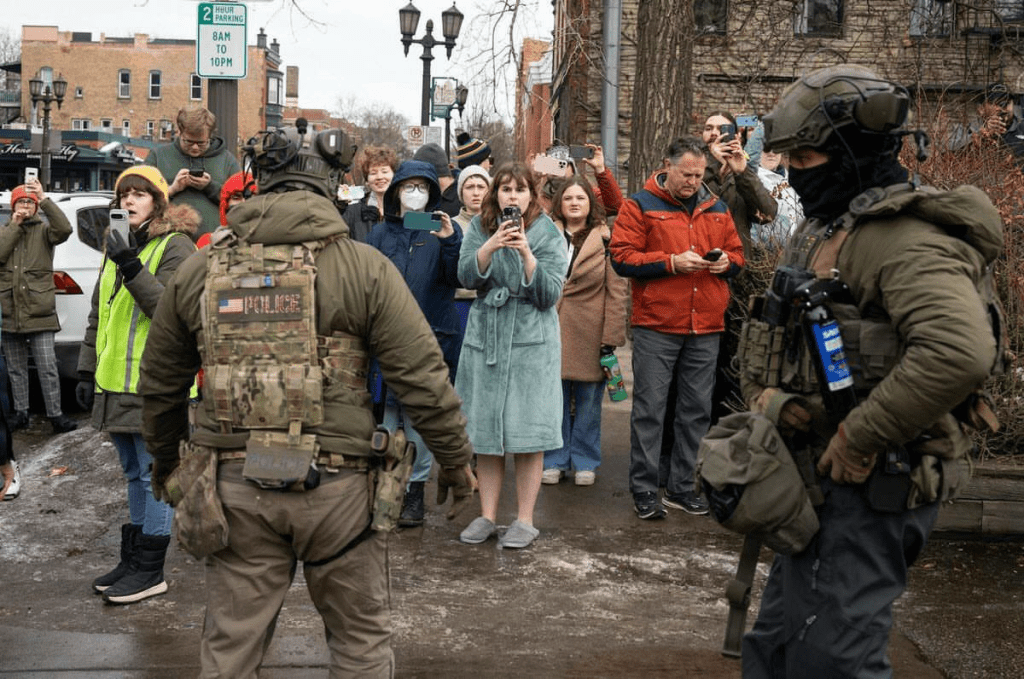
All is true. However, today, I wen to search for the photo which people reference as a “Rockwell Kent St-Paul photo,” and ran into the whole series of MN photos again. And started to cry again. I wll never get over it. The announcement that ICE is leaving Minnesota came out yesterday, confirmed and approved. Not just the 700 presiously announced, but basically everyone – the whole operation is shutting down. But I will never get over over it. I will never get over the fact that it had to be blood to make it happen. Death is irreversable.

The photo everyone is talking about

What I Want To Do In 2026

Boris and I spent a lot of time talking about how I should reorganize my life, at least for the next two years. Most of this time was me complaining about the things I feel are important but don’t have time to do.  I know that I am horrible with establishing priorities, and I didn’t make a lot of progress in prioritizing things for 2026.

My most important resolution for 2026 is to keep trying to plan my life better. So far, my progress is rather modest, but here are some things I want to do differently in 2026:

  • Boris and I agreed to try to have him visit Chicago less frequently but for longer periods of time. This might partially address the problem with him having huge difficulties with jetlag, but I am also mindful of the fact that when he is in Chicago, he can’t do many of the things he does in Helsinki, and I feel for him, because that’s exactly how I feel in Helsinki: I can’t do a lot of things I like doing in Chicago. So we will see whether this will work.
  • I thought about all the situations in 2025 when I had scheduling conflicts and/or had to change things multiple times because it was “too tight,” and now I am thinking about them even more in advance than I did last year. For example, I am planning to bake all my international cookies before Thanksgiving. Also, I already planned the dates when Lena can visit me in Chicago in the summer, and when I can visit her in Ann Arbor. I am planning the time when my granddaughters can visit me. All of this is in the calendar, so I won’t accidentally schedule anything on top of it.
  • I still need to figure out how to be more present in my friends’ lives, but at least I am prioritizing this.

I know that, for most people, my life looks too scheduled, even as it is now, and many have told me that living such an “overplanned life” is not fun. But I know I will be much happier if I can do more things from my “I want to do it” list, and I would rather have a rigorous schedule than not have time to do something.

We’ll see how it goes 🙂

And The Last Thing About 2025

One area where I felt I failed entirely is people relationships. I feel acutely that I didn’t do enough to keep my relationships and to reach out to people.  I neglected many of my friends, and I deeply regret it, because I need them, and I feel how much I miss them.

I was constantly in situations where I did not have an extra five minutes to message “how are you doing,” and I did not know what to do about it.

I am unhappy with pretty much everything in this area, and my most important goal for 2026 is to figure out how to change it.