On family history, parenting, education, social issues and more


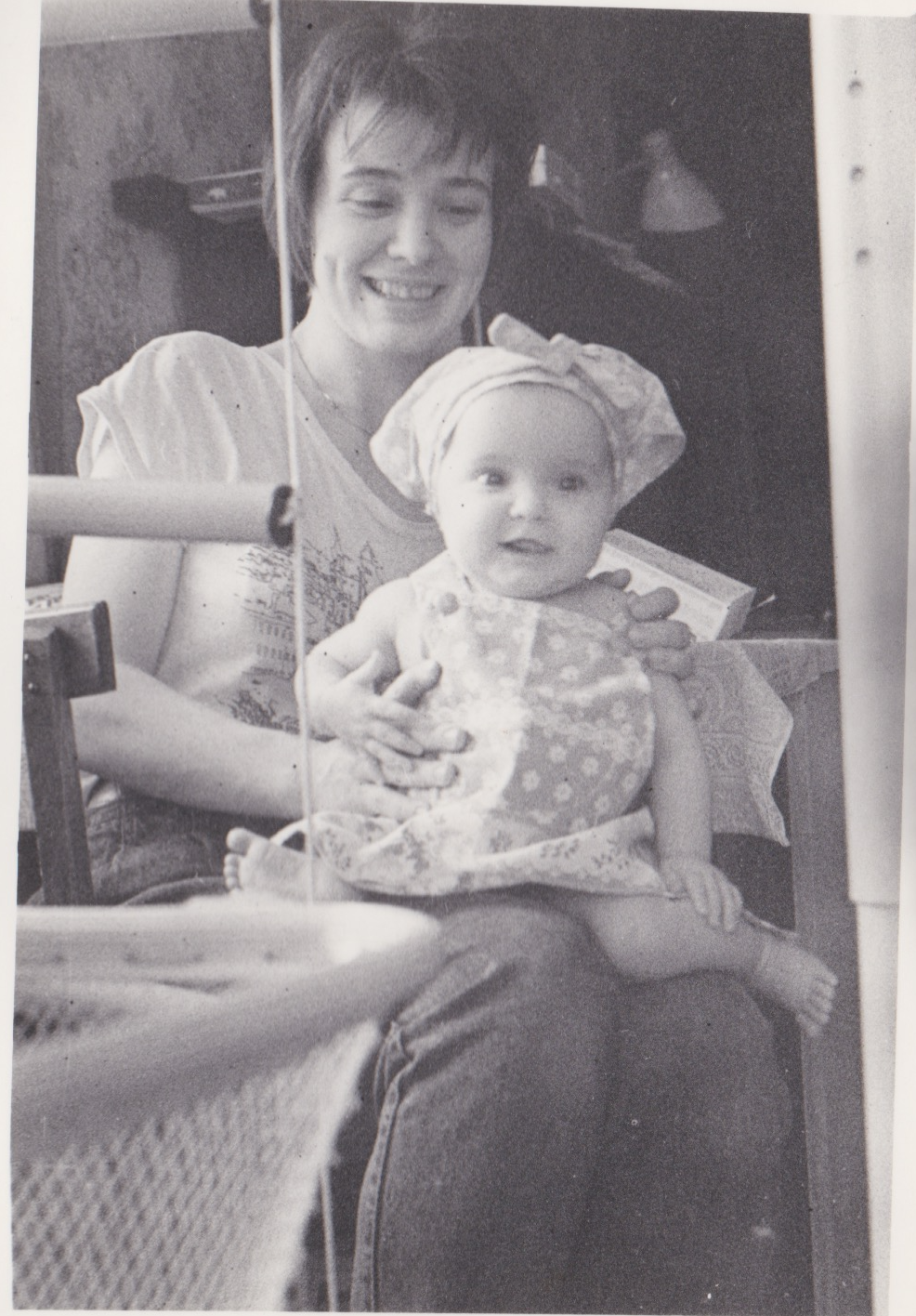
Another thing which has happened that spring was my atopic pregnancy, which was just short of ending tragically. I refused to go to the hospital even after I’ve collapsed on the kitchen floor, and my mom called 03. Fortunately, the doctor told me: we will take one more call, and then I’ll come back. By the time they were back, I was ready:).
There was a reason I refused to go: nobody except me has ever taken care of Vlad and Anna. Except for Boris for a couple of hours here and there. I remember half-lying down on my mother’s bed (no idea, why on her’s, not mine) and dictating each and the single thing about the babies: sleep times, meal times, amount of food, naps, clothes for inside and outdoors. I remember that Boris managed to come before I was taken to the hospital, although I do not understand how he could get there on time.
I didn’t know what was going on with me, except that I could not move and could not breathe. When the doctor in the hospital has told me I have an atopic pregnancy, I didn’t believe her. I was taken to the operating room right away, and I remember that the surgeon asked me whether I want another tube to be removed as well. It’s hard to believe, but just a week before that Boris and I were talking about that option, and he said that he does not like the idea of doing something non-revertable. So I said no.
After the surgery, I’ve stayed in the hospital for five more days; eight patients in the room, atopic pregnancies, abortions, ovarian cancer – you name it, ages from nineteen to seventy-five. Two hours a day for visitors.
I had no breast milk the first day, and I thought it’s gone for good, but the next day it has reappeared. I’ve started to pump, just for the sake of keeping it coming, and it was then that I saw it was yellowish-grey and half transparent. To the” breastfeeding only” fanatics: I am absolutely sure my babies were better off with the US baby formula (that’s when it became handy, the Christmas gift from a Jewish charity!). After five days, my stitches were removed, and I was allowed to go home the next morning. I left the same night.
I was not allowed to lift any significant weight after the surgery, so I had to crowdsource my childcare. All of my friends who could come, for half a day, or for just an hour, were coming when they could. When nobody was around, I was moving on my knees and lifting the babies from that position.
Still, the warmer weather was approaching, at least theoretically, and life was turning for the better. By June, I’ve returned back to work at the University. This didn’t change much in my life since the year was 1992, and the people, whos’ salaries were financed by the government, didn’t get paid for months.
But fortunately, there was another perk. A relict from the Soviet times, when the local Unions were another branch of government – a summer boarding house.
I need to step back and explain what was so special about this last fact. I haven’t met with this perception in the States, but I might have a wrong referential group. In the Soviet Union and later in Russia there was no concept of suburbs in the American sense. We lived in the cities with relatively high pollution level. Granted there were magnitude fewer cars on the streets, but their engines were producing a lot of pollution. Besides, there were plants and factories, and there were not enough parks.
Any good mother had to provide a way for her children to “get some fresh air” during summer. This meant ideally to find a dacha somewhere in the countryside, where the children could stay with rotating parents/grandparents or send her children to the pioneer camp. The camp was for the children who were already in grade school, meaning they should have been seven or older. The younger children could be sent to a dacha with their daycare, but by my time, very few of them had dachas.
Besides each mother would have to resolve a dilemma, which way she would be the worst mother: if she would send her child to the daycare dacha, where she should suffer without her mother, or if she would have her stay in a polluted city and attend a “daycare on duty.” Many daycare facilities would close for summer without providing any alternatives. So you would be labeled a bad mother in any case :).
The University boarding house was a relict from the Soviet Union epoch and a present from heaven for me. It was opened all year long, but the summer sessions were in particular demand.
The University of Saint-Petersburg STEM campus was located outside of the city, in the countryside, or rather in the middle of nowhere. That was an idea of academician Alexandrov to build a university campus “as they do on the West.” There were many things wrong with this idea in the Soviet Union times, but a side effect was this boarding house right there, clean air, very little of civilization, and almost across the street of my work.
The price for the 3-weeks stay was pretty symbolic, especially counting the fact that we were getting meals three times a day, and most of the time they were eatable. I did buy extra fruits and other stuff for the kids, but that was fine. In the boarding house, I had more space than in my apartment, I barely ever had to cook and wash the dishes. I slept for 7 hours straight and was having a real vacation. Whatever work had to be done, was done primarily when Vlad and Anna were asleep.
This post will have no pictures. I didn’t take any pictures in this museum, mostly because we were short on time. We wanted to visit this museum very much – we’ve read a lot about the Dutch Resistance. Even when we were visiting other museums in Amsterdam, such as Stedelijk, there were multiple mentions of how people, artists, and curators, in particular, felt compelled to aid the Resistance, and how vital the Resistance was for cultural and national preservation.
The location of the Resistance Museum is not a very central one, so it required some planning, especially because the conference had started already, but we made it. By that time, after being in Amsterdam for a couple of days, we’ve already realized how useful their museum audioguides are. They are way more convenient than the ones we have in the States, at least here in Chicago.
When we visited Brussels several years ago, we ended up being very disappointed in the Magritte Museum – there were not that many of his paintings there (then-recent Art Institute exhibit had more!) and we could not read any of his letters and diaries, which were on display in abundance. We were a little bit concerned that something like this will happen in the Resistance Museum, but the audioguides helped a lot!
That’s another reason I didn’t take any pictures inside this museum – obviously, all explanations are in Dutch, and the exhibit is mostly useless without them. I’ve learned a lot about how life in the Netherlands was unfolding during WWII. It turned out I didn’t know a lot, including brutal hunger towards the end of the war.
That won’t be the first time that I am realizing how little did I know about WWII before I came to the US. My knowledge about the events of WWII was very obscure. The way World War II history was taught at school would give you the impression that even though there was something else going on, the most significant part of it was the Great Patriotic War. When I first rented a set of DVDs about WWII in our local library was the first time I’ve realized that WWII was a WORLD war and that so many countries have participated. It was a shock for me that the USSR was mentioned on less than half of these DVDs.
Since that time the more I travel the world, the more I learn about different countries’ history, this realization becomes deeper. In this sense, the Resistance Museum was a great history lesson, and also an outstanding ethical experience. The museum is organized in such a way, that the visitors are presented with the questions the war-time Dutch citizen had to answer: should I cooperate or disobey? Should I fly or stay? Should I hide or should I protest? I could not even imagine one could build the whole museum based on these ethical choices.
And one more thought. I agree with my friend, who was saying that the visit to this museum and her subsequent research made her realize that the Soviet Union was the only country under German occupation which did not have a resistance movement. The “partisans” were organized and controlled by the communist party, or the communist party would acquire a leadership over a spontaneously organized group. Also, the focus of the “partisans” activity was on blowing bridges and military echelons, not on saving people, as it was with the Resistance in other countries. Sadly, I have to admit, that by the time the war broke out, the idea of resisting any authorities was wiped entirely off people’s minds and was not considered even a remote possibility.
As I’ve mentioned earlier, winter 1991-92 was especially bad economically. And as a consequence, people were the most unkind. Several months later, when a situation has become a little bit better, people were much more inclined to let me skip the line and started to express more kindness towards the babies.
One thing I still can’t understand was the fact that for some reason, my twins were drawing lots of male attraction in my direction. Once I was taking the bedding to the laundry service. I’ve left the baby carriage outside for just a couple of minutes to bring my bundles in (it was a norm in Russia at that time, nobody thought that something terrible could happen to the babies in the course of a couple of minutes, and who in the right mind would want extra babies in their lives?!). When I’ve emerged out of the laundry service, I saw a guy standing by the baby carriage marveling at my babies. They were tiny at that time, bundled tight in the blankets, one with pink polka dots, another – with dark green. This was an indication of the gender of a tiny person inside each of the bundles.
The guy moved his gaze away from the babies and looked at me. “Twins!” – He exclaimed – “a boy and a girl! How you are doing this?! Any chance you are taking orders?” “No,” – I’ve replied – “It’s a matter of inspiration!”
There were multiple other occasions, especially by late spring-early summer, when Vlad and Anna very not just tiny bundles anymore. Men would stop by me when I was sitting on the bench at the playground and say: “Such beautiful babies! Any chance they need a father?” This was especially surprising since by late spring when I was almost done with breastfeeding, I was far from being a pretty sight. I weighed 49 kilograms (about 109 lb) while being 164 centimeters tall (5 feet 3.5 inches). My clothes were hanging on me like on the coat hanger, my face was covered with sores due to the lack of vitamins, and my teeth became so fragile, that I was missing several pieces, so I can’t even say that my smile was pretty.
Continue reading “Winter-Spring 1992. About Good People”In July 1969, I was six years old and living in the Soviet Union, and you may wonder who it the world I could remember just anything about Americans landing on the Moon. But in fact, I do remember!
That summer I was staying in the children sanatorium in Karelia, I was getting colds with the alarming frequency throughout the whole year, so my pediatrician prescribed to me some fresh air and sand beach (I hated being there, by the way, but that’s a separate story).
So one sunny day after the required nap we were gathered in the largest room in the building, and the director of the sanatorium told us grimly, that “Americans landed on the Moon.” I do not really know why I remember this episode so vividly, after all, I was not especially into space theme at that time. But for some reason, I remember even the dress I was wearing on that day and resentment in the voice of the director and the somber expression on her face.
Before I proceed with my story, I wanted to reply in more details to the comments on the previous post. “The nineties” was a very prolonged period, each several months the economic situation would change drastically. The time I was talking about in the previous post was from late fall 91 to spring 92, maybe a little bit more than that. Again, I am not going to consult the Wiki, to check the exact dates of all the legislation which were coming out these days. I am trying to recall as precise as possible how I felt back then.
In September, when I just came back from the hospital with Anna and Vlad it was not that bad yet. You could actually buy at least some things in the stores, and I remember that Boris was occasionally bringing me some groceries which he would manage to “get,” waving off my attempts of financial independence. This was one of the very few periods of our togetherness when I was OK with that.
I was eating a lot. I felt sick for the last couple of weeks of my pregnancy each time I was trying to eat something more than an apple, my body was not really processing anything. When I’ve checked into the hospital, the nurses were commenting “you are so thin!”, which sounded hilarious applied to my eight-months-pregnant with twins body, but they were right.
After Vlad and Anna were born, I started eating :). And there was actually stuff to eat. I remember making myself endless omelets with vegetables, cheese sandwiches, lots of black tea with whole milk, which was a traditional Russian breast milk production booster.
I believe things started to change for the worse in October, and then I barely had any protein till the end of the year. The hyperinflation was in full swing, and I had nothing except government subsidy for new mothers. The weirdest thing I remember about these times was my thinking about how in the world I could live on this little money till next month. I was thinking to myself: well, that’s what the government is giving for new mothers, if they came up with this sum of money, there should be a way to survive on it. It sounds completely ridiculous now, but I remember that back then these thoughts would provide some sort of comfort to me.
Continue reading “Winter 1991 – 1992”Anna asked me to write about shock therapy, but first I need to say a couple of words about the economic situation in the Soviet Union: not how did it look objectively, not how did it look for the rest of the world, but how the ordinary people, who’ve been inside this system, perceived the economic situation.
The ruling word was “deficit,” and in Russian, in those days it meant not the fact of deficiency of certain goods, but deficient goods themselves. “Deficit” meant anything, which you were unable to find in the store, anything, you had to “get,” either staying in a long line, if you were lucky to be at the place and at the time, where and when “a deficit” has been distributed. Or perhaps you knew somebody who worked in retail, and they could help you to “get a deficit.” There were also “holiday distributions” at the workplaces, or in the worst case scenario, you could find “a speculator” who would sell to you “a deficit” for a sky-rocketing price.
You might ask – who could afford this sky-rocketing price? The answer is that most of the people could. Not every day, not for everything, but if you really-really needed something, you would come up with the money, most of the time.
The salaries were approved somewhere far away from your place of work, and in a majority of cases were not individualized, meaning that a junior engineer will have the same 120 rubles monthly, and maybe 130 or even 135 rubles monthly, if they would work for the Department of Defense. All prices, from bread to beef, to bananas, to underwear, to chairs were fixed across the country, so everybody knew what did the “ice-cream for 19 kopeks” mean, you could use a price instead of a brand.
Most of the people would use their “retail connections” or “speculators” from time to time, for example when they would needed new winter boots or a coat for their toddler. And the vast majority of people would complain about this situation. Most of “intelligentsia” would lament: I wish it would be legal being able to get something for a higher price. It’s much better than not having these goods at all! Why “they” won’t let these people sell what they have.
Continue reading “Switching To The New Economic Model (1991)”My move to America won’t be possible without Pam – the CEO of the company, which hired me for my first job in the US. She was an outstanding personality and quite a controversial character, but one thing for sure: it’s only because of her that my move to America has happened.
Granted she was considering the interests of her business first, and for sure I was initially paid on the lower margin of the acceptable pay rate for a position, but she took on herself a responsibility of bringing me over.
In was not only about the money (although if you think about it, with myself and my three children, there were four visas and four airplane tickets to pay for, and as I’ve mentioned earlier, I had no money at all, so all these costs were upfront).
But what is more important, she’d taken on herself a responsibility of being in charge of me and my kids – remember, how my other two potential employers didn’t want to take any responsibility of bringing over a single mother with three children?
Pam did. Not without some risk, but being a divorced mother of two small children herself, she understood a thing or two about me.
If you recall my conversation with John R. before my departure, you remember that he was reassuring me, that I do not need to take any extra money along, because “I am going to America to make money.” It didn’t occur to him, that a person is being paid at the END of a pay period, while you need to pay your rent at the BEGINNING of the month, not mentioning a deposit, and once again, three hundred dollars was all I had.
Moreover, in my first company employees were paid monthly, and with me starting on October 23 I had to pay a deposit and nine days of rent, then receive only 1/4 of my monthly check, and pay November rent… And I also had to pay my other expenses till my November check would come.
My company, personified by Pam lent all this money to me. But that was just the beginning of my financial troubles.
One of the decisive factors which prompted my fearless departure to America was the assumption that G. and his family will help me in many ways, including childcare. I will leave for the future a more detailed explanation of what exactly happened, but as a result of it only a month after my arrival I had to move out, pay a fine for lease breaking, find a new apartment, pay one more deposit, find a daycare for my children, and transfer them to a new school. At that time, I was not practicing yoga and has been quite hysterical.
Before I start, let me tell you a couple of words about how my children have reacted to the news that we are going to go to America. First of all, they were very excited to tell everybody around, and the funny thing is that nobody believed them! They would be at the playground, and would tell other parents: we are going to America for two years!!! And other parents would be yea, sure… And then I come and say that it’s true!
When Anna and I were talking recently about these weeks before our departure, she told me that she remembers there was one thing she was sad about, but she can’t remember what exactly it was. But I remembered! The Fall play in their daycare was in rehearsal at that time; it was a modern version of the Russian folk tale “Репка” (“The Turnip”). Both of them were playing leading parts: Anna was playing a role of Granddaughter, and Vlad was playing a Dog. And they had to miss their artistic triumph!
We were flying the KLM airlines. It was a strange flight; I do not think they even offer this kind of flight anymore: we would arrive at Copenhagen in the afternoon, spend a night in a hotel, and leave to Chicago in the morning. The hotel room and airport transfer were both paid by KLM. We did have some time to walk around the city, and I even remember that we went to see the Mermaid, but my mind was not there, and I could not fully enjoy the sights.
We had to eat somewhere, and I’ve asked at the hotel reception, where is the nearest place we can eat, and how much would it cost. I had to exchange some dollars to Denmark kronas, and I knew I wouldn’t need them after that evening. Money was scarce, I only had three hundred dollars, so I could not afford to waste any.
They directed us to the nearest McDonalds, which was a safe choice for kids, but also it was a luxury for us these days, and I could not stop thinking that I didn’t plan to spend that much money before we even come to America.
Fortunately, the hotel stay included breakfast, and we went down pretty early in the morning to be sure we eat before our bus comes. And we could hardly find any food my kids were familiar with. Neither they nor I were used to being served ice-cold milk, and they refused to drink it this way. I remember pleading them to eat some corn flakes with this cold milk, and I forgot what we ended up with, but I believe all of us had finally eaten something.
One thing which warmed my heart was that when we stepped on board of the airplane flying to Chicago, a flight attendant had given Anna and Vlad small Lego sets to build lego airplanes, and coloring books and some crayons. And that was so unusual for us! Real legos were extremely expensive in Russia, I would buy some Polish substitutes, which were also expensive, so they would only get medium-size sets for New Year or their birthdays. Having children be treated as special guests was a completely new concept to me, and I felt right away, that this new world is going to be a place of kindness.
During the long flight, the kids behaved well, didn’t make much noise, asked a flight attendant for some orange juice in English, and tried to connect with other children on the plane. So all was good. I stepped out of the airplane, holding my passport with my working vise (the kids didn’t have their separate passports then), and a note with the name of the company secretary, and their phone and address.
A border control officer took my papers and asked: do you know where you are going to go? I said: no, but somebody is picking me up. The officer said: what if nobody will meet you, what you are going to do? He’d sent me to the room with the wooden barriers, where other people were sitting and waiting, and he told me to sit and wait with them.
Imagine being after nine hours-long flight, with two five-year-olds, not even being able to tell them how much longer we need to wait, and why, and what we are waiting for in the first place. We ended up sitting there for about an hour: I and my five-year-old twins, with no food, no water, no toys, no books. They were doing great, being quite patient. And then an officer appeared at the doors and called on me. He handed me my passport and said: you can go! What? Can I go? No questions, no interrogation, no nothing? Yes, you can go.
We exited back to the baggage claim area. It was empty. No people, no luggage. And then we saw our boxes mounted on one cart, and a tall thin man standing by it – it was Val, and that was the first time we met him. I remember the kids walked towards him and clenched to his hands, and he was so surprised with that, that he just started walking, leaving me behind with the luggage:).
Those were our first steps on American soil.
So, I’ve got a job offer and started to get ready. At that time, getting a work visa was not at all that crazy as nowadays. My phone interviews had happened in mid-June 1996, and at mid-August, I’ve got a package in the mail. The two months in between felt weird since I was not telling anybody; only Boris and my Mom knew, and neither was happy about this development.
The package arrived, and I checked the hours of operation of the US Consulate in Saint Petersburg and went there. As far as I remember, I didn’t even need to make an appointment at that time, I could just show up, get in the line, and get in. And as far as I recall, I didn’t get any visa forms before I came to the Consulate. Now it seems unbelievable, but I actually filled in all the forms by hand and proceeded to the window to talk to the officer. She looked through my papers, asked me something about databases and then said, that the package is incomplete, that they need “articles of incorporation” and “recent tax returns”. Needless to say, these words meant nothing to me, so I had to memorize them to make sure I will be able to cite them in my email.
Another month passed, and a new package had arrived. And I went to the Consulate again, and this time, my work visa was granted.
In the next month and a half, lots of things were happening, and I can’t recall the whole sequence of events. Finding a flight. Airlines other than Aeroflot just started to make their presence in Russia. It was a total shock to me, that the ticket prices where different for different airlines, and that they could depend on the date the flight is scheduled for. It was news that we were allowed to buy a one-way ticket (it was forbidden with Aeroflot). Then there was all this business of “paying by corporate card” – in the Saint Petersburg office of KLM they recorded the credit card number in the notebook, and told me that they will pass into their New York office, and “will let me know when it comes through”. And remember, I knew nothing about the credit cards at that time!
The date was finally settled, and it was October 22. I was still running around, meeting with people, “seeing each other last time”. I remember my friend asking me: do you even believe it yourself, you are going to America, or you are watching a movie about yourself? I was definitely watching a movie. I was telling everybody that I will return in two years, that I will just save enough money to buy my own apartment. Some of the people were skeptical saying: “Everybody says they will come back, but nobody comes!”I would dismiss these comments – what did they know about me?! Still, one part of me was thinking: I will never come back, I am going away, so that I will never see my Mom anymore, and I will never have to deal with Boris anymore. I will find some nice man over there and will have a family as other people have.
I had no money. Almost none. I was always keeping a poker face about that, but by this time, I was without a rouble in my wallet by the end of the month regularly. I was barely making ends meet, but would rather die, than tell anybody. I’ve sold my desktop computer, because I had to have at least some money with me, and after repaying some minor debts I was left with 300 dollars to start my new life. I was asking John how much money I will need to get along for the first month. With all the idealism of Columbia alumnae, coming from a family with old money, he would reply: Why do you need to take any money with you? You are going to work in America! You are going to make money, not to spend money! – So, will 300 do for the start? – Sure!
Igor was not coming with me. I did not know how to figure out from a distance, whether he will be able to go to school in America, where should I start, whom should I ask. And it never occurred to me that I could ask my new employer! I would never think to do such a thing in Russia, and I had no idea it could be different in the rest of the world. So I left Igor behind, “until I figure things out”.
It was decided that the company will rent an apartment for me in the same building where G. lived with his family. The office manager (and HR, and everything else) from my new company was writing me about the train schedule, about G’s wife, who was supposed to take care of my kids, and I could not figure out what the problem was. The CEO had sent me a very long and detailed email to the effect that I have no idea, how much daycare costs in America, and indeed, I had no idea to such an extent, that I was not getting a message. Both she and John were saying: it’s very expensive! The best thing you can do is to take your mother with you so that she could take care of the kids. But that was the whole point of the idea – to get away from everybody!
The date of departure was approaching. I didn’t have any luggage, so I’ve packed our stuff into five cardboard boxes. I didn’t even take any winter boots for the kids – they are growing, and we will buy better ones in America! I didn’t have money for a cab, and one of Boris’s postgrads agreed to drive us to the airport (very few people owned cars in Russia at that time). I remember all my last good-byes, and remember the same feeling that I am not sure whether I will see everybody again, whether I will ever come back…
my experiences with data, coding, reading and other life musings...
Foto, travel, St.Petersburg, Stokholm, Tallin
Data Platforms, Built on Trust, PostgreSQL, AI-Ready Architecture, and Enterprise Trust
Jeremy Schneider
A journey of curiosity and unfinished thoughts
Shaken, not stirred
Information about SQL (PostgreSQL & SQL Server) from the Asylum.
Chasing Wellness
Curiosity to Infinity
SQL help, examples, tips
Musician and Network Engineer
Living life to the fullest
Life in Copenhagen, Denmark, after moving during Covid-19.
Spontaneous Blogger! Doze on Sunday @7 PM IST
a written collection of souvenirs
ramblings of a crazy lady living with MS
Every Family has a story to tell..........Welcome to mine
Travelling without Limits