Baby Clothes in the Times of My Motherhood

In August, when my girls were visiting me here, Anna and I started talking about baby clothes when they all were babies. I funny thing is that there was a very little difference between the times when I was a baby and Igor’s times. Things just started to change at Vlad’s and Anna’s time, but a little bit too late for us – I still got a full share of caring for the babies without civilization’s advantages.
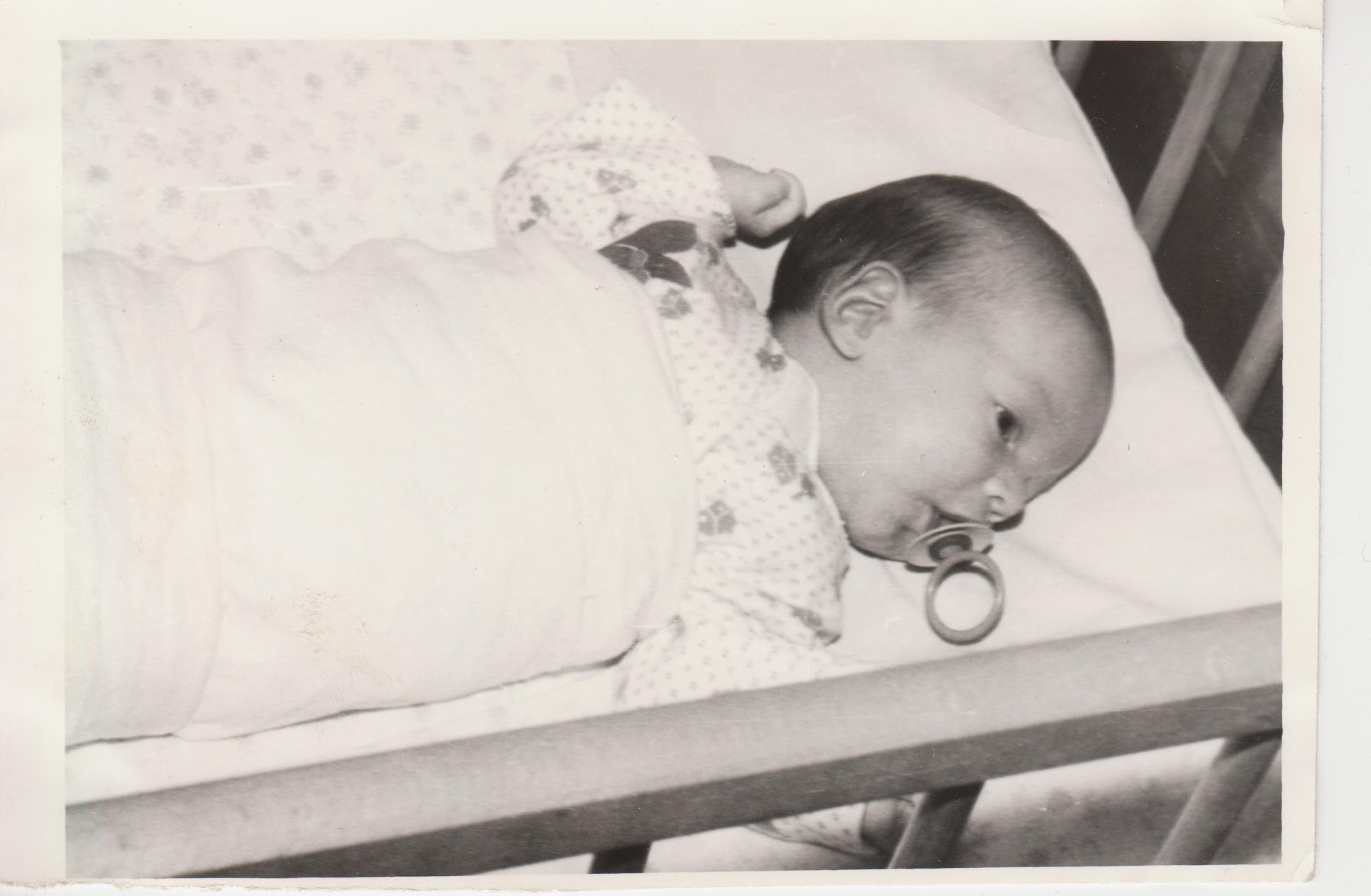
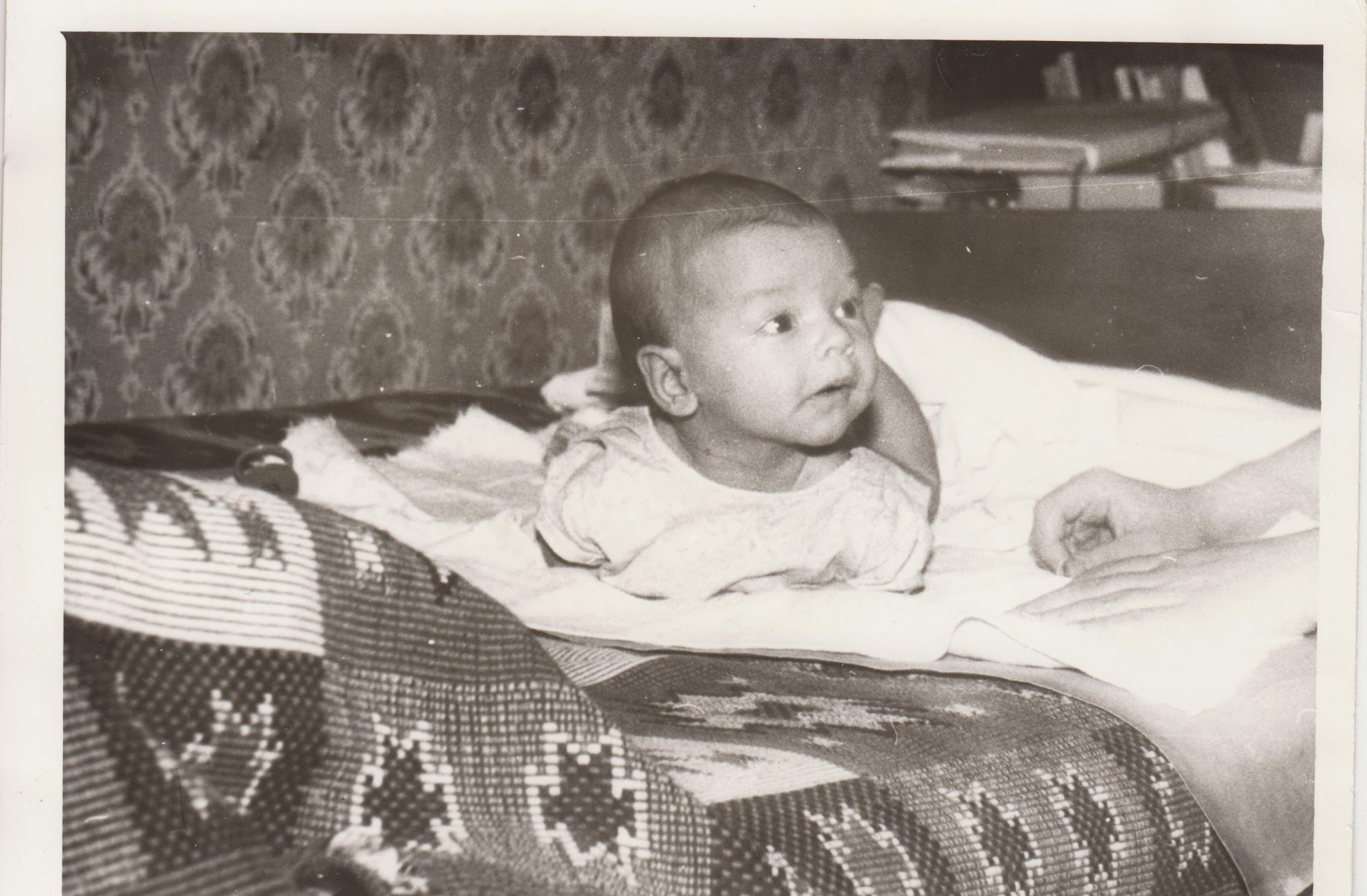
When I finished my story, Anna said that I should write a blog post about it because she never understood my challenges before. To illustrate my story, I pulled up a couple of Igor’s pictures when he was 1-2 months old; however, you’ll mostly have to use your imagination :).

There were two tops; both didn’t have any buttons or snaps or fasteners – nothing to hold them together. Such tops were called raspashonks – which can be translated as “no fastener.” The one going under was made of chintz (cotton, but not the stretchy kind). It had short sleeves and was put on a baby with the opening on the back. The upper one had long sleeves and was made of thin flannel, and it was put on a baby with the opening on the front. Both were short, just to the baby’s waist.

Diapers were made of gauze. Most of the time, three layers were sewn together in a triangle. You would fold this triangle twice and put it over the baby’s bottom, between the thighs and over the hips. If you are wondering whether there was anything water-proof, the answer is no. Even when the first leak-proof covers started to appear, pediatricians disapproved of them. They were saying babies develop a rush because of them.

Over a diaper, you would swaddle the baby’s body’s bottom in a small rectangle chintz swaddler (pelenka). Then you could put a small rectangular piece of plastic under the baby’s butt, and then you would swaddle her with a flannel pelenka. For night sleep, you would swaddle in the baby’s arms as well.

I believe this gives a good idea about the volume of washing – cleaning required, and why I was never rushing to change the diaper the moment, it was wet. Oh yes, and multiply by two, and by the absence of a washing machine!

January 1, 1996

One more year, one more set of pictures taken on January 1, at the family gathering on Aunt Kima’s birthday. Once again, I do not remember who took the pictures. I am sure there were tons of pictures of everybody, but I only have pictures where my children are present.

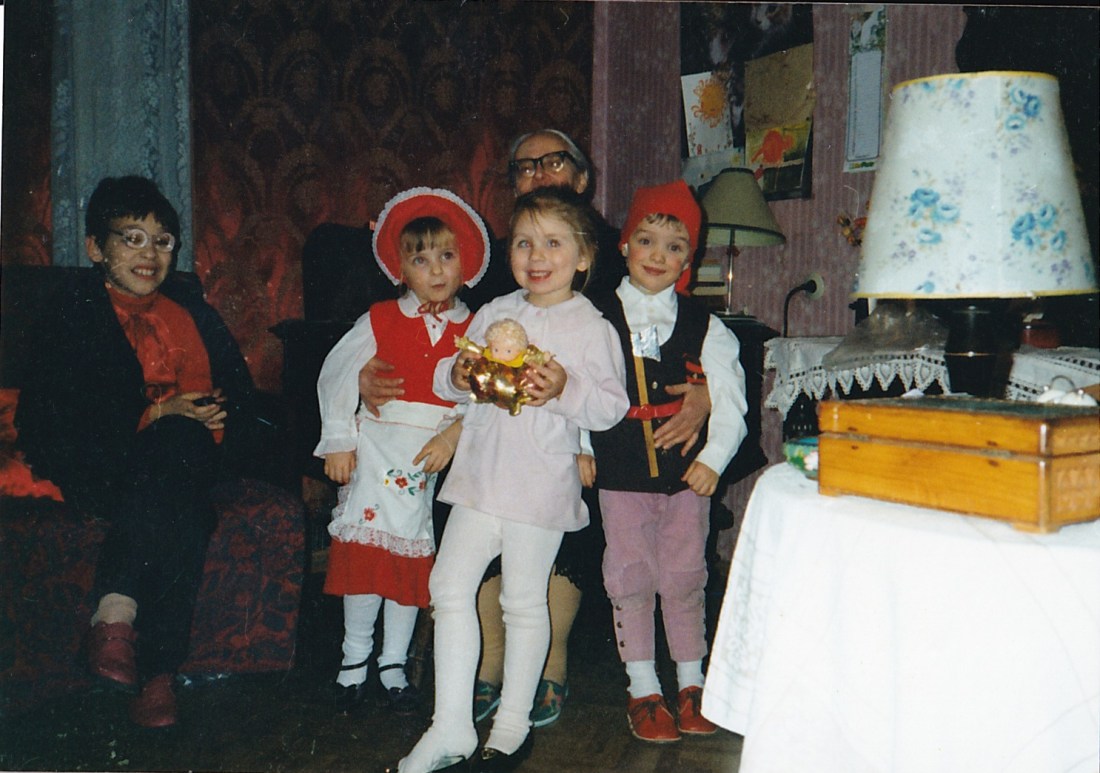
They are dressed in the same costumes as on the photo with a children’s musical cast. Igor is a Vampire, Vlad is a Dwarf, and Anna is a Little Red Riding Hood. I am recycling my High School Graduation dress with all accessories.

Igor, Slava, Petya, Vlad
Aunt Kima with Anna, Iya and Vlad, with Igor on the left
Me with Ann on my lap and my second cousin Ania with her daughter Iya
Continue reading “January 1, 1996”

Saying Goodbye to 1995

The year 1996 was fast approaching, my last year in Russia, although I didn’t know about it back then. To be precise, the first call from Vin.NET International happened in December 1995, but they didn’t offer a job for me then, and I didn’t think there will be any followups. So I didn’t know what the New Year had for me and celebrated it’s coming.

New Year was always a big deal. As I already explained, the New Year festivities were reinstated in the early 1930s to compensate for banned Christmas and Sviatki – the week between Christmas and New Year. Since Orthodox Christmas was celebrated two weeks later than the Catholic one, on January 7, all the festivities would start right before the New Year Eve and would continue for a week or more. The “Old New Year” was celebrated on January 13, and the school winter break started on December 30 and lasted until January 10.

The New Year concerts and parties at schools were usually held on one of the last days before the winter break, and between January 2 and January 10, there were lots of events. Most of the Children’s theaters were running their New Year specials, and also, there were tons of “yolkas.” Yolka means a fir tree or a Christmas tree, but according to an old Russian tradition, Yolka also meant a party, mostly for children, with some New year-themed performance, games around a New Year Tree, and at the end, everybody gets presents. Presents were usually bags of assorted candies and chocolates and maybe a pack of waffles and a mandarin orange.

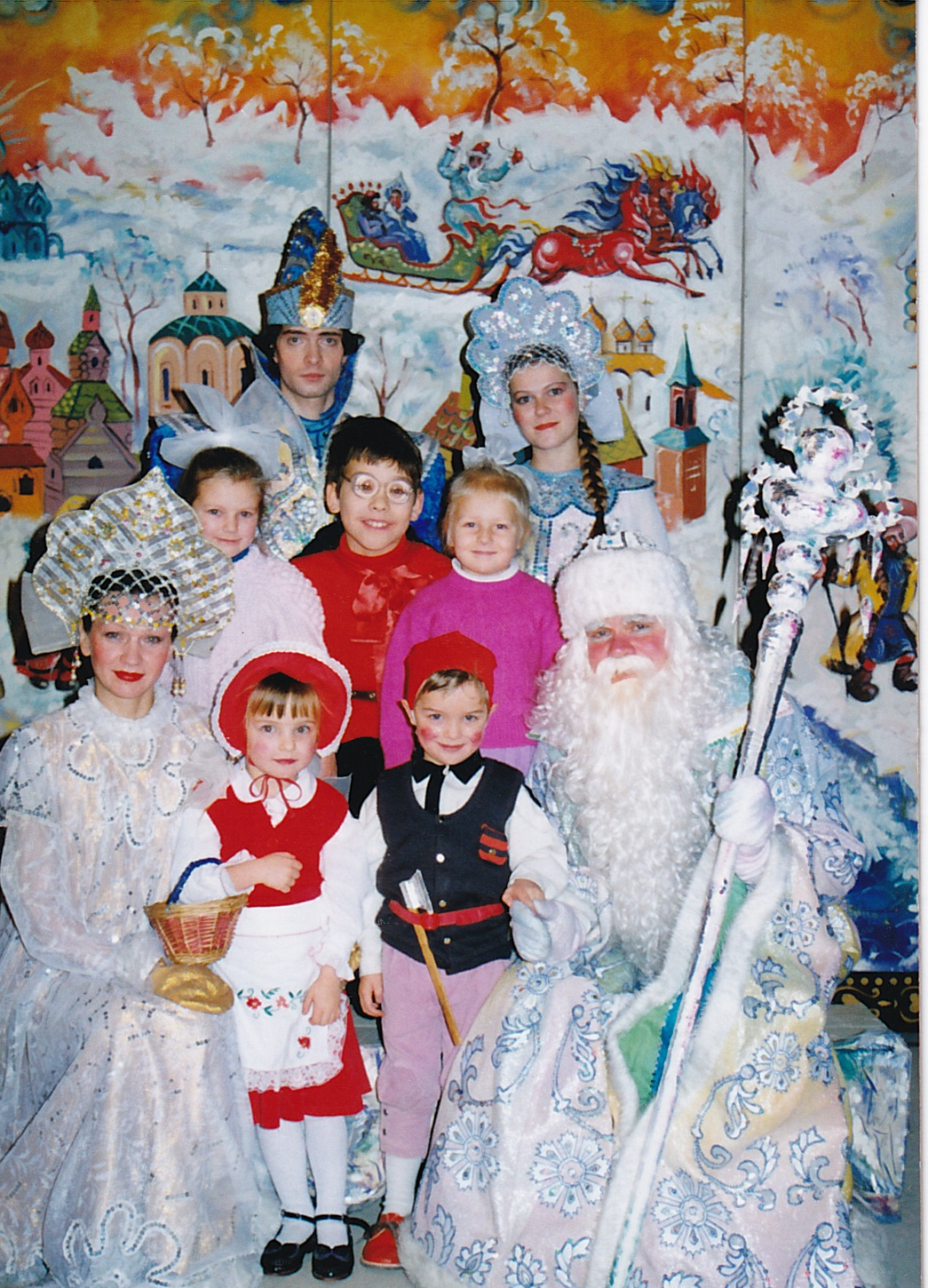
The first picture, however, was taken at Vlad’s and Anna’s detskiy sad. They had. New Year party and I took Igor to watch it with me. After the party was over, a photographer suggested that he take additional pictures of the children, whose parents would be interested in purchasing more. That’s where this picture came from.

The next one was taken in the Children’s Theater, which we frequently patronized. It was called “Skazka” – a fairy tale. They put on some New Year show, and we went there with two other families. Families meant mothers and children because it was very uncommon for fathers to participate in such activities. A mother was considered to be enough 🙂

I already mentioned, kids (and sometimes adults) dressed up for New Year parties, and Igor, Vlad, and Anna are in their costumes (I have better pictures of costumes, which I will include in the next post). After the show, everybody could take pictures with the cast.

There is a Prince (Tsarevich) and a Princess (Tsarevna) on the back. Next row: a girl who’s name I can’t remember, to my shame, then Igor dressed as a Vampire, and then our friend Ania, who participated in so many activities with us. Finally in the first row: Snow girl (Snegurochka), a granddaughter of Grandfather Frost, Anna dressed as a Little Red Riding Hood, Vlad dressed as a Dwarf and Grandfather Frost himself, is his blue and white coat.

We had more pictures with the cast, but for some reason only this one survived, and I am glad I have it!

My historical posts are being published in random order. Please refer to the page Hettie’s timeline to find where exactly each post belongs and what was before and after.
The Rest of 1995

When I think about my life before we relocated to America, I mostly think about the last year before we left, precisely the period I am describing now. I want to describe our “life in general” during this period, rather than specific events.

Vlad and Anna attended detskiy sad – the preschool-daycare ran by the Department of Educations for only a nominal cost, which was a huge relief to my budget. They were lucky to have great teachers, and I invested my time and effort to be in good relationships with all of them, always showing them how much I appreciated their hard work. They were paid little, and their salaries were often late, as with almost everybody at that time.

In Igor’s boarding school, the building remodeling was finally over. He stayed there from Monday morning till Friday afternoon, which was also a relief for monetary and time budgets. I was a research associate at the University, which still paid close to nothing. Besides, after many thoughts and hesitations, I applied for government child disability payments for Igor. That was a small but reliable additional income, in addition to Igor having room and board for five days a week in his boarding schools. Still, more than half of my income had to come from some side gigs, which I was always searching for. I never requested child support from Igor’s father for several reasons. When we divorced, my earnings were higher than his, and I didn’t feel it fair to ask for more. I have to mention that the way the child support amount was calculated in Russia, it didn’t take into account mother’s income, it was plain 25 or 30 percent of the father’s income (I forgot the exact number, I think it was 25% for one child, 30% for two and 50% for three or more). Second, I felt that because it was my initiative to divorce him, I could not make it worse. And lastly, I told him that the only thing I want from him was to visit Igor often and never ask for money if he will keep in touch with his son. He ended up visiting way less than I would hope for, but that was my intention.

Continue reading “The Rest of 1995”

Pictures From September 1995

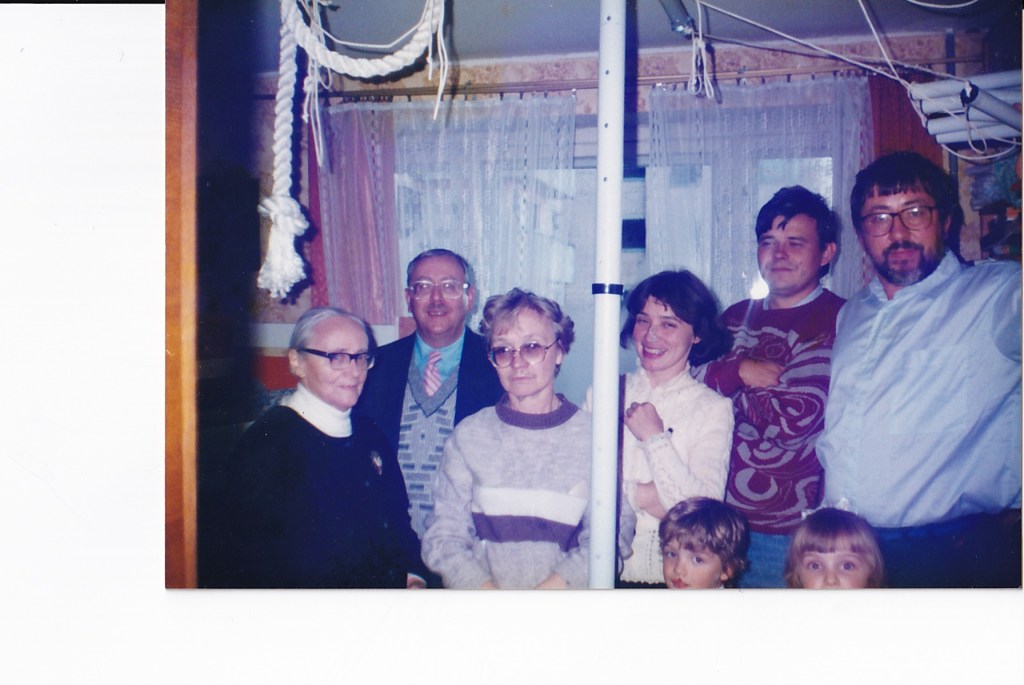
I promised several people, including my children, that I would post more pictures. I am always trying to combine pictures with stories, but I can’t say much about these, except that it was a family gathering in our house. Judging by the guest list and the fact that this picture was taken in fall 1995, it must be Igor’s tenth birthday.

We lived in extremely crowded conditions. This one room of fewer than 200 sq ft was the place for everything. All four of us slept there. All our belongings were stored there, all the desks, including mine for working from home, all the toys, the piano – everything was packed in this one room. Our beds and the desks were folding, the jungle gym, which you can see on that picture could be lifted up.

From left to right: Aunt Kima, her son Dodik, my Mom, me, Igor Sr (Igor’s father), Sasha – my cousin’s husband.

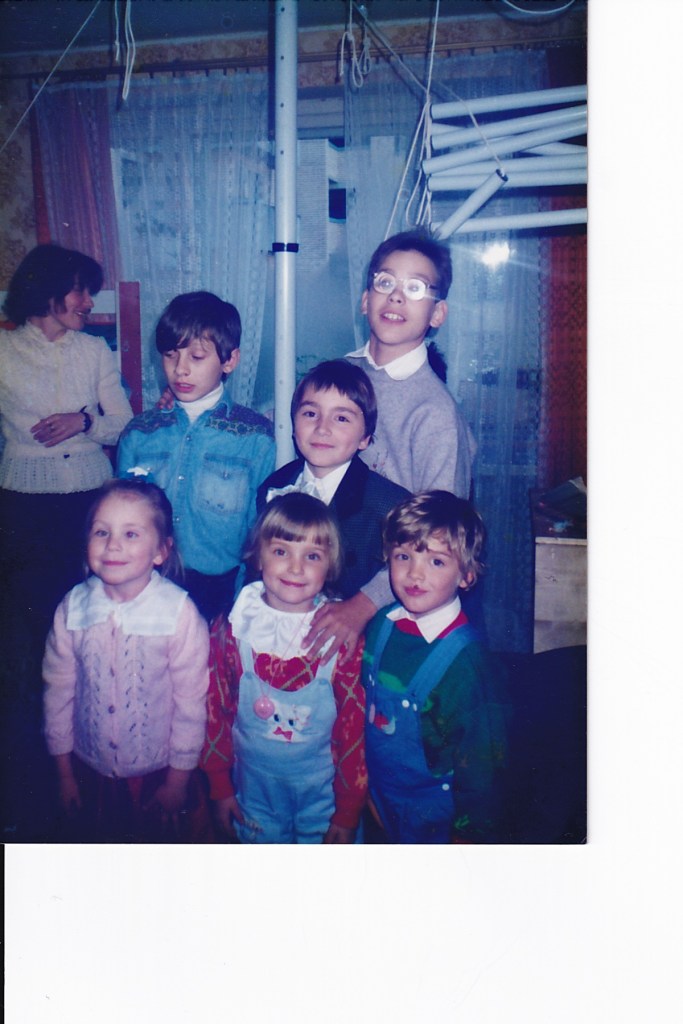
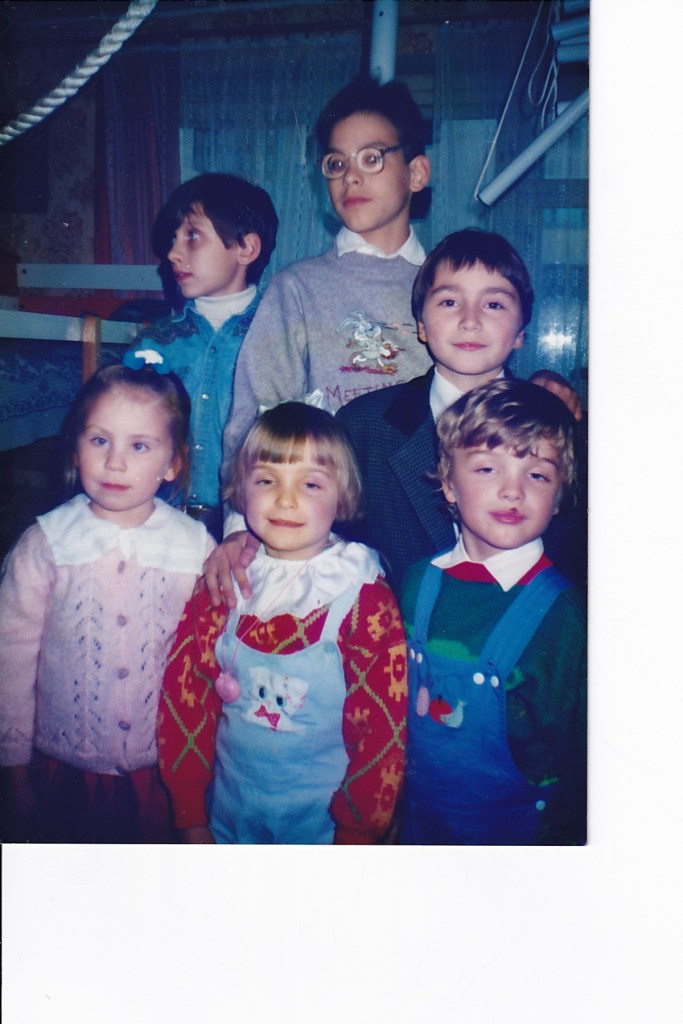
The next two pictures look almost identical, but I could not choose one, so I decided to post both. On the first one, you can see me in the far left corner. The older kids from left to right: my late nephew Petia (my cousin Ania’s older son), my half-brother Slava (my father’s son) and Igor. The smaller kids from left to right: my niece Iya, Anna and Vlad. (Vlad has a cold sore on his lip).

Everybody is dressed warmly because all the houses had (and still have) a centralized heating system, which was usually turned on only in October, so September would end up being one of the coldest months.

My historical posts are being published in random order. Please refer to the page Hettie’s timeline to find where exactly each post belongs and what was before and after.
Smolny in 1995, Part 2. How I Didn’t Meet Putin

Boris’ part in this Smolny project was installing the software Dr. Conrad was trying to sell. And my part was, as usual, writing the user’s manual. In this case, it was more like a persuasive essay. I had to present a use case and show how this software will make the life of the City clerks easier.

I remember how I was inventing the names and ages of people and their addresses. But the most memorable were the letters I was scanning. Scanning was a very new thing then, at least in Russia, even the copying machines were rare. And I was given a whole bunch of real people’s paper letters to Smolny. And I read them while scanning. I can’t recall any particular case or any particular problem from these letters, but the overall impression was desperate. You could hear people crying, searching for words that would be convincing enough, pleading for help, from necessary surgery to pensions being delayed, to broken heating pipes. I could not help but think how the City clerks can read such letters and put them aside. I knew that all these letters were not processed yet, and some of them were dated two-three months before the day I was reading them.

Continue reading “Smolny in 1995, Part 2. How I Didn’t Meet Putin”

Smolny in 1995

The last gig I wrote about was the project in Bank Saint-Petersburg, which earned me money for our trip to Poland. 

Later in 1995, my employment situation continued to be the same as I described in the above post. I was a full-time researcher at the university, working in the Operations Research Laboratory, and Boris was my boss, which was wrong on all possible accounts. The university jobs were still paying very little for both of us, but the way we thought about it back then, it was unimaginable to leave a university position. It was academia; we were researches, and even if we aren’t paid anything, we could not drop these badges of honor. 

And still, we needed money. Maybe, some people can be happy being poor together with their loved ones, but it was never our case. We were on a hunting trail all the time. 

The next gig came one more time from Dr. Conrad, and that was my last encounter with him. The gig was huge – working with the city government. Dr. Conrad, as usual, wanted to sell something to somebody. That time, this “something” was a document flow system that would allow all the city government departments to process the letters from the public more efficiently. My job would be to interview the city government employees from all departments, analyze their needs, the existing processes bottleneck, and produce a report explaining why the proposed system was the best possible solution. Then I had to make a presentation to the whole bunch of officials. 

Continue reading “Smolny in 1995”

A Girl With a Monkey

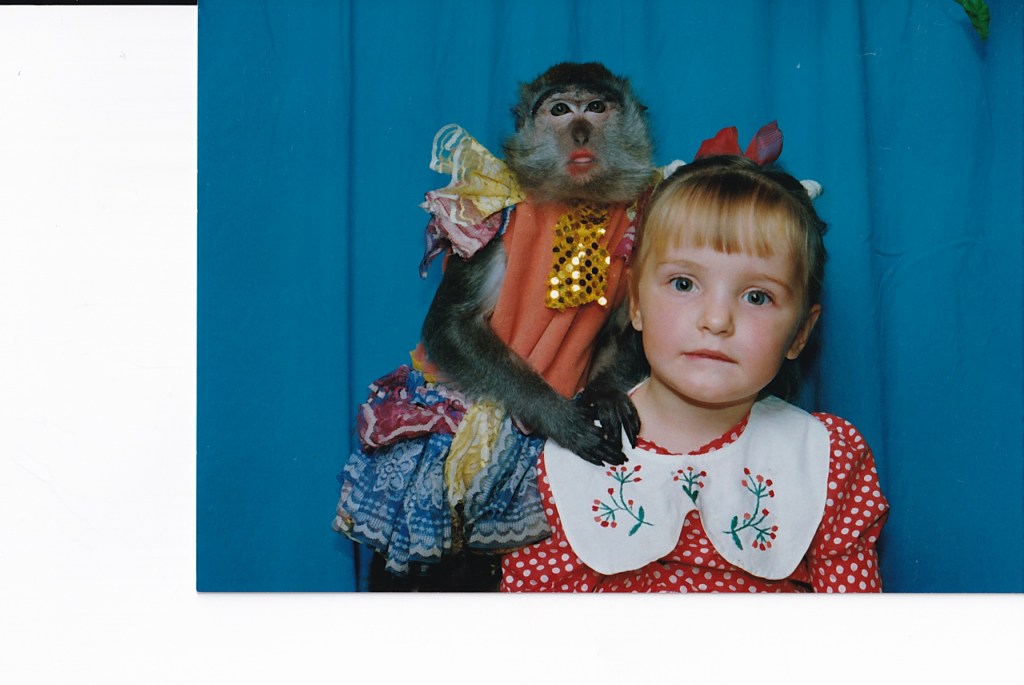
I’ve scanned lots of photographs from 1995, and now I can continue with our family story. Here I want to show just one picture to illustrate “how things were” back then.

I am coming to daycare to pick up Vlad and Anna, and their teacher tells me that there was a photographer with a monkey (?!) and that he took a picture of Anna with a monkey – see below.

I do not even know why and how, and why anybody would find this idea appealing. Anyway, I didn’t know anything about that. Anna said she wanted a picture with the monkey, but then she got scared, which is also visible on the picture, and then she didn’t want to back out of that!

My historical posts are being published in random order. Please refer to the page Hettie’s timeline to find where exactly each post belongs and what was before and after.

The Fall of 1995. Anna’s Ballet Classes

Since now Anna is wondering where her older daughter got the idea of wanting to be a ballerina, I have to remind her about her ballet classes.

Here is the story. My cousin Anna is a musician, and one of her side jobs in 1996 was playing piano for ballet classes in one of the nearby schools. For my life, I can’t remember whether the lady who ran these classes was affiliated with the school, had an independent “circle,” or whatever. But she ran these ballet classes for children of different ages, and the youngest dancers were six. As an exception, she would admit children who were five and a half and were exceptionally gifted.

Let me tell you that there was some rationale behind that age limitation.

For smaller children, coordination of the movements of different parts of their bodies is challenging. Anna just turned four, and she wanted to be a ballerina :). I was trying to teach her that when asked, she has to tell that she was five and a half, but I didn’t hold much hope. My cousin suggested that we will pretend we were a little bit late and that I should push Anna into the audition room when all the children already start to repeat to movements. Then, my cousin was hoping the instructor will already like Anna and will be more willing to make an exception. She showed Anna the moves which she most likely would have to repeat during the audition, and Anna was practicing on her own, tirelessly. It was unbelievable.

Continue reading “The Fall of 1995. Anna’s Ballet Classes”

June 1995. Our Trip to Poland. Part 4

The last part of our travel to Poland I wanted to write about was a voyage to the Copernicus Museum. I didn’t feel that doing nothing except for going to the beach was the best idea of vocation. When we stayed in the University boarding house, I organized different excursions, museum visits, etc. We did some of that in Gdansk, but I wanted to do more. 

I learned that boats are departing from the pier a couple of times a day, which would take us to the Copernicus Museum and decided that we should go. Funny enough, now I barely remember anything about the museum itself. Partially, because the boat was late, so we arrived later than planned and then, we had to hurry back for our return journey. 

The reason for the late arrival was a storm. The waves were rocking the boat, and almost everybody got sea-sick. In our family, Anna was notorious for never getting sea-sick, and the rest of us was the opposite. I remember Anna cheerfully running around the boat while most of the passengers were miserable. 

The reason I want to tell you about this trip is different. We happened to book the tickets for the cruise, which took on board a large group of families where one of the children had Down syndrome. On the way onward, I could not take my eyes off these families.

We ere not living in the Soviet Union anymore, but the way people perceived things was still very much from the Soviet era. And in the Soviet Union, you were not supposed to have a special needs child. People with disabilities, especially with mental or emotional ones, were non-existent. Invisible. There could be nothing worse happen to a mother than having a child with a disability. If we came across such a child on the street or at the playground, we would try to walk away as fast as possible. 

Women, who gave birth to children with Down syndrome, were expected to leave them in the hospital, “in care of the state.” That was the norm. 

A year earlier, my friend gave birth to a child with Down syndrome, and she was fighting fiercely for her right to keep the girl. But even those who supported her would say that she needs to leave her daughter “in care of medical professionals” for at least six months (there were other complications in addition to Down syndrome) and keep visiting her, and “maybe later” take her home. Her daughter died several days after, because of other complications, and my friend was inconsolable. 

But I was to reiterate that the expected behavior was to leave a child with a known disability in the hospital. Nobody would criticize the mother; on the contrary, people would understand and not even mention that she ever had that child. 

We felt for all mothers, who had “to carry their cross” and pitied them a lot. If you had a child with a disability, whom you chose to keep, you would only take her to the playground when there are no other children. You would never go out with her. 

And here, on board of a boat, I saw two dozen families who adored their children with Down syndrome. You might ask – where is the inclusion, why a separate group of special-needs kids, but that was a huge step forward that these kids were even going out. 

I looked at the mothers. I watched a mother cooing over her three or four months old the same way as if that child would be an average healthy baby. I saw her smile and could not take my sight away from her face. That was one of the biggest revelations in my life – she loved him!

I saw bigger kids, smiling, talking to their siblings, and each other. They had nice stylish haircuts and fashionable clothes. I noticed for the first time that each of them had their unique facial expression. I should be ashamed of myself because it all was news for me at that time, but I wanted to write honestly about my feelings because that can explain how bad things ere in the Soviet Union and for many years after it’s collapse.

Twenty-five years later, I can still close my eyes and see their faces and hear their voices.

The biggest takeaway from that cruise was: things can be different!