TIME Magazine: A Breathing Break

I know that, and I have known about it since the time I realized how regular yoga classes helped me to become a different person and to control my mood much better (not like I always use this technique, but still! However, that’s the first time I read about using it in the work environment, and not to alleviate an individual person’s mood, but to globally improve the workplace.

Link to the article.

When we talk about effective business strategies, breathing is probably not a concept that crosses our minds. These conversations more often than not gravitate toward the conventional markers of success—market share, competitive advantage, profit margins, and growth trajectories. We picture meticulously crafted plans that map out the path to achieving corporate goals, driven by data analytics, market research, and financial projections.

But what if we took a radically different approach, one where we measured our success on prioritizing our employees well-being, rather than solely focusing on the company’s output? What if we prioritized one simple thing that we all have access to and can deploy at any time: the power of our breath.

It may seem “airy-fairy” or far leaning into the new age movement, but incorporating well-being and mental health into business strategies is starting to gain ground as a transformative trend. It turns out that a happy and healthy workforce is not just a moral imperative—it is a competitive advantage.

In an age where the business landscape is quickly evolving, the modern market demands more than just traditional tactics; it calls for a holistic approach that integrates the human element at its core, especially with the rise of AI. We’ve seen that the next generation of talent is demanding more from their employee experience, one where how they feel at work matters just as much as how they are compensated. And the truth is that companies that actively support their employees’ mental and emotional health are also seeing improvements in productivity, morale, and retention.

In reports from Gallup’s December 2023 poll, nearly half of U.S. adults, upwards of 45%, reported frequently feeling stress, and this is undoubtedly magnified in the workplace. Many organizations think they have a people problem when, in fact, they have a leadership opportunity. A critical component of effective leadership is identifying whether you are operating from a state of fear, or a state of love. When we are stressed our decisions and behaviors are driven from an unconscious emotional operating system and we contribute to a culture of fear-based incentivizing.

The science of stress can be broken down like this: when someone faces a stressful situation, the amygdala—a part of the brain involved in processing emotions—sends a distress signal to the hypothalamus. Upon receiving the distress signal, the hypothalamus activates the sympathetic nervous system by sending signals through autonomic nerves to the adrenal glands. These glands then release the hormone epinephrine (adrenaline) into the bloodstream. As epinephrine spreads throughout the body, several physiological changes occur. The heart starts beating faster, increasing blood flow to the muscles, heart, and other vital organs, while restricting the blood cells in our forebrain. Pulse rate and blood pressure rise, and breathing becomes quicker.

With our blood now flowing to our limbs in order to help us, quite literally, flee the situation, our cognitive processing, things like rational and logical decision-making, is impaired. We are now operating from a conditioned state of survival, but the challenge is that in the modern-day world, we’re not very good at distinguishing threats from non-threats. And if our limbic system (whose function is to process and regulate our emotions, memories, instincts, and moods) isn’t attuned to know the difference in what we perceive as threats, our decision-making abilities can quickly become compromised. For example, when receiving a distressing e-mail, your body will activate the same stress response that it would if you were evading a saber-toothed tiger back in primitive times. So the experience of dealing with the e-mail includes restricted blood flow to the conscious mind and a reduced conscious awareness of the correlating physiological responses. In essence: you forget to breathe. And this greatly reduces anyone’s capacity to make an intelligent decision or regulate their behavioral or emotional responses in a productive way.

Studies have demonstrated that various emotions correlate with distinct breathing patterns, and by altering our breath, we can influence our emotional state. For instance, when experiencing joy, our breathing tends to be steady, deep, and slow. Conversely, feelings of anxiety or anger often lead to irregular, rapid, and shallow breaths. By consciously adopting the breathing rhythms linked to specific emotions, we can effectively induce and experience those emotions ourselves.

In other words, if the order is reversed and the physiological state is consciously changed, it can have an immediate effect on the psychological state. The quickest way to do this is by employing conscious breathing. One can use the breath to reset their own system, and it can also be employed with a team to release stress and get everyone energetically connected. This can be especially helpful before a team strategy meeting, creative planning, or even at the start of each day since everyone comes in with their own stressors from their individual lives.

One such breath is an “Emotional Clearing Breath,” which can be used to change your energy and calm the nervous system down. First, a negative feeling that needs clearing should be identified. Focus on a recent event or encounter that resulted in a negative reaction. Try to get to the root of what triggered the reaction—not the act itself but what the event activated within. This will be a core emotion like feeling unworthy, unseen, unlovable, unvalued, inadequate, insignificant, helpless, or rejected.

Next, engage in diaphragmatic breathing. Use the inhale breath to fill the belly like a balloon, deepening the breath into the lungs, then empty the lungs and slightly contract the belly to release the air on the exhale. Continue to take big, deep breaths in through the nose while restricting the throat, resulting in an oceanic-sounding breath. Then exhale the air out of the mouth, keeping the restriction of the throat and maintaining the oceanic sound—as if fogging up a mirror with the breath. Once in a rhythm, repeat this inhale-exhale cycle of breath for four rounds and then take a few moments to come back to a natural pattern of breathing. Anchor into the present moment and notice the peacefulness that occurs.

What often stands in the way of our growth is our attachment to outcomes, rather than our attention to our feelings. Breath is the simplest and most effective tool that allows us to respond rather than react and override negative feelings and beliefs. Strategies that emphasize human connection, a collective purpose, and emotional intelligence are proving to be just as crucial as those centered on fiscal prudence. When we include these softer dimensions, we are not abandoning rigor or profitability. Instead, we are enhancing our capacity to connect with customers, inspire employees, and build resilient organizations that thrive in the long term.

Let’s get back to the basics and reconnect with our breath as we recognize that the most successful strategies are those that balance the head with the heart, numbers with narratives, and profits with principles. These multidimensional strategies are not just a response to a changing world—they are the blueprint for building businesses that are resilient, sustainable, and truly impactful. In doing so, we will pave the way for a more inclusive, innovative, and humane approach to business that meets the needs of our time.
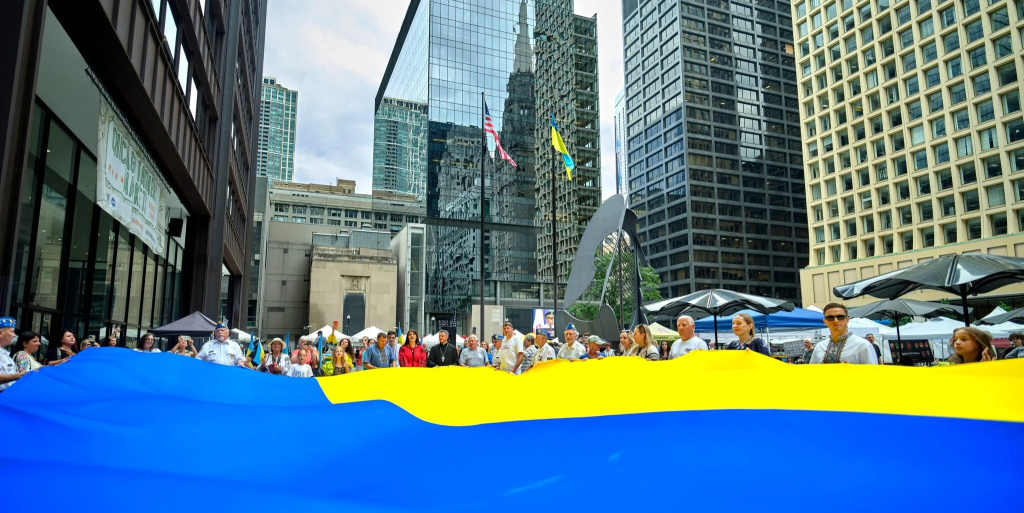
Ukraine Month In Chicago

August is officially a Ukraine Month in Chicago, and I only learned about it on August 1, and only because I went to the Daley Plaza Marked and saw the ceremony of the official proclamation of Ukraine Month:

Igor said he learned about this even at the last minute, but I didn’t know anything at all. It was very heart-warming to hear the words of solidarity and support for Ukraine, especially now when people’s attention is mostly focused on elections, and the war seems far away and irrelevant to way too many people…

Official news feed for the event.

You Can’t Plan Anything With This Weather

It’s a very hot week! Boris tried to choose a week with less chance of a heat wave when we planned his coming, but it ended up being a week with several extremely hot and humid days.

I had three good-seat tickets for a “Broadway Rocks!” concert at Millennium Park, and Boris and I agreed we could go (the tickets were originally for my French friend and her daughter, who were going to visit me but had to cancel). Retrospectively, I should have returned these tickets and gone to the indoor Bruckner concert on Friday, but it was hard to tell in advance: even when you know the weather forecast, it’s hard to say how it will feel.

It was definitely too hot, and also the music was not what I was hoping for (and not Boris’ thing) so it was almost a disaster. My neighbor to whom I gave the third ticket said she enjoyed it, but maybe she was just polite. I felt like I ruined the evening for all of us, but I finally agreed with Boris that it was impossible to tell in advance.

For this visit, I tried to minimize the outings and just come home after work – partially because of the weather and partially because I felt like we were not doing it enough – just two of us being together, not on a mission.

On the other hand, we had one unexpectedly positive experience: going swimming in the evening. I never went to Fargo Beach to swim before (technically speaking, it is not allowed 🤷🏻‍♀️), but it is a three-minute walk from our building, and – well, it’s the same lake, and it’s getting deep pretty fast.

Morning Biking

The days are becoming shorter, and I see the sunrise only by the time I reach Montrose Harbor.

Before Sunrise

Tandem Disaster

We (Boris, Anna, and I) have been talking about getting a tandem bike for Boris and I for a while. According to Anna, the major challenge with all regular tandems would be that they all are built with the presumption that the bigger person is sitting in the front seat.

We knew that if we were going to get a tandem, there war going to be a custom build, but we still wanted to try on some “regular” tandem, just to have an idea. One of Anna’s friends owns a tandem, and she arranged us to try it out.

It ended up being a total disaster. I was scared to death because I didn’t feel I could maintain the balance with a bigger weight behind me. Apparently it is different from when I have a shopping bag in the rear!

I tried several times, and I was unable to go for more than five feet. Anna said, she would try to be i n the front instead of me, and she managed to make a circle that way

Still, with this particular one, Boris could not pedal, because his knees were touching the handle bars.

I still want to try and to come up with some solution which would work for us, but looks like it has to be a totally crazy design.

Mom’s Walking Sticks

During my mom’s last doctor’s visit (we switched to the new primary care doctor) I mentioned that she refuses to use her cane when walking, and as a result, she falls often. The doctor suggested trying Nordic sticks instead: “Canes are for old people,” he said, winking, – “for those who can’t walk. and we are going to exercise, like active people.” I purchased the sticks, and on Saturday, we had a “test drive”.

I was surprised with how fast my mom got it. I noticed that she is not operating with her left hand the same way as with her right (and I asked her whether she keeps doing her hand exercises and reminded her to keep doing them. Also, I will need to check on whether she is using the sticks on her morning walks. But still, I was ready for her “I can’t do it,” but she did.

Thingers crossed!

Milwaukee Air And Water Show

Boris arrived on Friday night, and on Sunday morning, we were on our way to visit Anna and her Family in Milwaukee. That weekend was an Air and Water Show weekend, the same show that came to Chicago a couple weeks later.

My last two attempts to watch it in Chicago were not very enjoyable because you could hardly see things from the northern beaches, and getting closer takes time, and you end up in a huge crowd. In Milwaukee, it turned to be a way better!

Continue reading “Milwaukee Air And Water Show”

More On Breaking Stereotypes And Old Patterns

Last weekend, when we talked with Lena about breaking the eating habits, she touched upon breaking away from other things we were taught froman early age. She told me: since I do not remember how early in my life, my grandmother used to tell me that when I have a family, I should attend to my husband’s needs first, then to kid’s needs, and then to my own. And I can second her – that was a universal idea.

In addition, even though we had the same access to higher education and theoretically the same access to jobs, all of us – all female I knew – regarded their love life being more important than professional career, more than anything, Marriage was definitely the first priority since our early teens, and none of us could ever possibly imagine a happy life without marriage. At the same time, most of us thought that a woman should follow her husband whever life moves him, and that sacrificing all our personal desires, for “what he needs” was in our books of “being a noble person.” We despised those women who “chose their comfort over sharing their husband’s hardships.” That’s why my extremely gifted friend, who for some reason, didn’t consider herself a “marriage material,” got married right before graduation and moved with her husband to Baikonur (where her first child died in birth). That’s why we had a had time understanding what was so heroic in the decision of the Decembrists’ wives to follow their husbands to Siberia.

Actually, I think that we just spend too much time on our personal life and relationships (and who woud’ve thought I would say that!). That was another thing we talked about with Lena, and she seconds me. The funniest part is that my current high professional status is in a strange way a result of me being focused on love and relationships too much in my earlier life – this triggered a long sequence of events which resulted in me being where I am.

Life is the strangest thing. And I am not free from stereotypes, although I try :). My kids are better 🙂

Widow Clicquot Movie

I went to watch it at the Siskel Center with my mom on Wednesday. I’d say it was a success in terms of that my mom didn’t complain about “how she couldn’t understand anything.’ What was even more impressive is that after I sent to her a short description of the movie, she googled it and read more information, and was very well prepared. And she was able to read the closing remarks about the later years of Widow Clicquot, so we had a meaningful discussion on our way back home. I am always glad when I can find something stimulating for her, and get some fresh reactions.

I expected a little bit more from that movie; I liked it, but I didn’t “love-love” it. Now, I am waiting for a premier of “Sisi”- it should start in a week, but the Siskel Center still didn’t announce the showtimes.

Eating Habits And Health

I had this WBEZ piece in my list of opened tabs for a very long time. As much as it sounded reasonable, I internally disagreed with its message. When Lena visited last weekend, we ended up talking a lot about changing eating habits, and I decided to go back to that piece and the research it referred to.

To be precise, I agree with the opening statement that there is no “one best diet.” Also, I understand that the new immigrants might feel lonely in many ways, including missing familiar foods. However, many traditional foods of most cultures, including American traditional food, are objectively not the healthiest.

There are many historical and economic reasons for eating habits to be formed a certain way, but it does not mean we should keep following them out of the force of habit. The conditions of life have changed; most of our lives have changed compared to how people lived a hundred years ago, not even talking about the earlier times. Maybe something is wrong with me, but I don’t understand the “food nostalgia” many people born in Russia mention, like missing the condensed sweetened milk or some types of ice cream or sodas. I am not saying I am rejecting my heritage food entirely. There are tons of great foods that I not only use but also frequently advertise, such as multiple vegetable soups or buckwheat, but definitely not the fried fish or soups for which you would sautee the vegetables before adding them to the broth.

I often hear these ideas about “it’s better to eat what you are used to eat,” and i discgree with it categorically. When I chatted with Lena during the weekend, she told me how difficult it was for her to break the eating habits that were engraved in her brain by her mother and her grandmother and how long it took her to learn to listen to her body and to eat only when she wants and what her body really wants. And now, it makes some sense, I am coming back to the statement that was made on this WBEZ show – there is, indeed, no “one size fits all” in what, when, and how we eat. The same as one shouldn’t blindly follow “what everybody says is healthy” patterns, they probably should not follow “traditional” means “better pattern.

All of this was to say that I am really happy and proud of Lena for breaking her old habits and making positive changes in her lifestyle. Now, she does not say that “she does not like strength training,” and I am sure that very soon, she will be faster than me on her bike!