On family history, parenting, education, social issues and more
Author: Hettie D.
My name is Henrietta (Hettie) Dombrovskaya. I was born in Saint-Petersburg, Russian (actually, back then – Leningrad, USSR) in 1963, and immigrated to the United States in 1996.
I love Saint Petersburg, the city I was born and raised in, and I think it’s one of the most beautiful places in the world. Similarly (but differently) I love Chicago, and can’t imagine myself moving somewhere else in the observable future.
I have three children, Igor, Vlad and Anna, all adults living on their own, and one (so far) granddaughter Nadia. I also believe that my children are the best thing that happened in my life.
As for my professional life, I am working in the field of Information Technologies. When I was twenty, I’ve declared that the databases are the coolest thing invented and that I want to do them for the rest of my life. Thirty plus years later, I still believe it’s true, and still, believe that the databases are the best. These two statements together imply that I think a person can have it all, and indeed, I think so! Keep reading my journals to find out how I did it.
Last weekend, I ended up doing three different outings with my mom. I already wrote about two of them: the Aquarium Member’s Night and the visit to the Christkindle market. The third event – the CSO concert – was on Sunday.
I am glad that this season, there are some Sunday matinee orchestra concerts- last season, they only had piano concerts on Sundays (and that’s the only time I can take my mom to the concerts).
Philippe Jordan was a conductor. It was the first time I heard him, and now, that I read about him, I am wondering how this was even possible!
The program included the original score of Mussorgsky’s Saint John’s Night on the Bare Mountain, Szymanowski’s Violin Concerto No 2, and Stravinski’s The Rite of Spring – all pieces very emotional and powerful.
After the concert, we attended the Subscriber’s appreciation coffee with musicians. That time, this event hosted the CSO librarian and one of the violas, and we learned quite a bit of interesting things! The librarian explained how they order notes for the whole orchestra for each new piece (it differed whether the music is in the public domain or is still copyrighted) and how they often need to make their own copies of the pages if there is no rest at the end of the page or at the beginning of the next page, and why the music publishers do not pay attention to that (saving paper). Somebody asked about using iPads and the pedal page turner, and both the librarian and the musician replied that it might be good for practicing but that the iPad is difficult to share on the music strand, and anyway, they will always perform in a traditional way.
Remembering the concert we attended in Helsinki in the Church in the Rock, where most of musicians were using iPads with pedal page turner, I am wondering how long will it take until it become a common practice 🙂
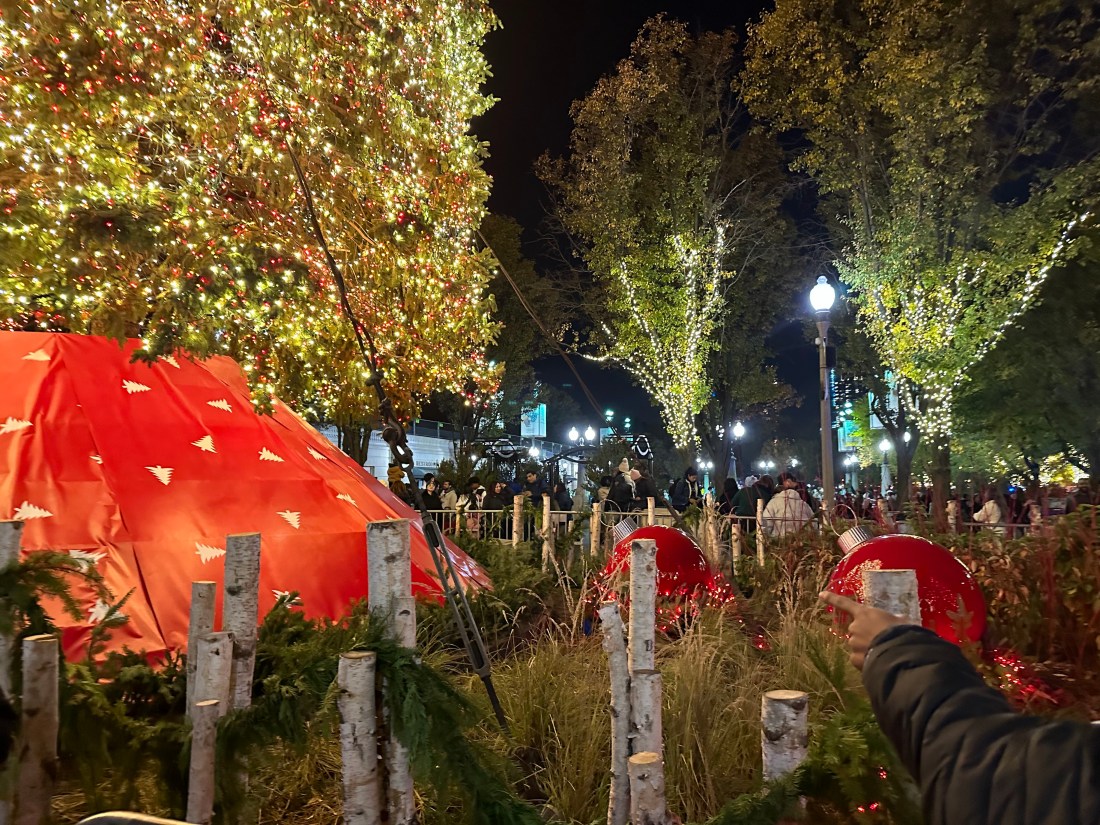
Everything opened as it should, on the schedule, and I decided that if I wanted to do at least some of the Christmas things, the only time I could do them was last Saturday. I am still not sure whether it was a good idea because I also decided to take Mom with me (and we met with Igor in the Loop), and the crowds were ginormous! Also, the Magnificient Mile Light Festival was happening at the same time. I wisely decided not to go there, but even without it, there were lines everywhere, crowds so massive that it was difficult to walk, and we ended up spending more time in the lines than otherwise.
It’s not winter yet, but for me, starting from the lower 40s, biking is challenging because my hands are getting unbearably cold. Same with my feet – that’s why I do not escort from November to March. Some time ago, I mentioned that to my one-level-up manager, and he suggested I try BarMitts – he said that that’s how he solved a similar problem.
I decided to give it a try, and it worked! I am not sure this would work when the temperature would drop to the 20s, and I still need gloves, but now i can bike when the temperature is in the 30s!
What they did this yea was the best. They didn’t have a sit-down dinner with fishes staring at you from all sides. They didn’t have speeches in the Oceanarium theater and they didn’t have performances. Instead, they just let people come and enjoy the museum without big crowds. It was amazing how close you could get to everything! I loved it!
Mom forgot that she had been to the Aquarium before, and she forgot what corals are, but she liked everything she saw, which was the most important thing.
I am inserting my Instagram posts just so that I won’t need to save videos one more time 🙂
I am really happy we made it, even though it was a very long Uber ride home (it was Friday night, and everybody was out, and both Columbus Drive and Lake Shore Drive were jammed)
For the second time, I ordered a Thanksgiving turkey from the CSA. I am unsure whether it was a good idea to order a size Large… but there is no way back now 🙂
I am reading Ann Appelbaum’s Gulag, and it will be a while until I finish it, but I can tell even now that this is an amazing work that stands out among all other books I read on that subject. However, I am not going to write about this book today. This blog is about something else.
***
When I was a teenager, I thought I knew enough about the “unspeakable” part of the history of the USSR. Having almost all of my family suffered different forms of oppression starting from the 1930s and ongoing, I was more knowledgeable than most of my peers, even among the Leningrad intelligentsia. It turned out that I knew close to nothing.
For example, I didn’t know anything about Holodomor. Yes, they didn’t teach about it at school, but neither did they teach us about labor camps. My relatives and my friends’ relatives told me about the arrests and interrogations, and I read real people’s diaries, which were never published. I nobody, nobody ever mentioned anything about kulaks1 being sent to the same camps!
Now I am asking myself why people of similar upbringing (Boris seconds my recollections) and I believed that “everything started” in 1936? Or at 1935 at the earliest?
Many books and movies present a picture like this: life is peaceful and beautiful, and that’s a nice and peaceful summer evening, and nobody expects anything, and all of a sudden, here is a “black raven,” and the father is getting arrested, and children are sent to the orphanage, and everybody’s life is ruined. Why?
There was no peaceful life, and everything was already wrong; why was it OK? Did they only care when the Great Terror started to grab people of their kind?
Why did none of my peers know that orphans were sent to the concentration camp, that kulak’s families were sent to the camps? Why did their relatives never tell them? Is it that they “didn’t know” about that before they were arrested, and then these tiny facts became “less important” when measured against their own misfortunes?
Maybe some of them didn’t know. But not all of them.
My grandfather was always portrayed as an “honest Chekist2” by my family members. Yet, his professional career started in the early 1920s when he was in Turkestan3, “fighting with Basmachi4.” That’s when he got his first stars. Did he not know? I doubt it.
Yesterday morning, I thought about what I believed I read in his file (the part of it which I own). I was frightened when I thought I didn’t remember where it was, but I finally found it.
The writing below is a draft of the “Characteristic” written by a famous Soviet movie producer, Ermler, as a testimony about my grandfather’s moral character.
That was a part of the rehabilitation effort, which resulted in acknowledging his innocence. Here is what “the master of Soviet propaganda” writes:
The resistance of our enemies was tremendous, and Chekists, like Dombrovsky, were on the front line of this struggle. They bravely fought with our enemies, smashed them, and built a new society.
My conversations with Dombrovsky were of great help to me since he often gave me good advice and helped me to correct my course. For example, I produced my movie “The Farmers” under his influence. He was very insistent in his demands to produce a film about the struggle with kulaks. He explained to me that this was one of the most important issues and that revealing the animal nature of kulaks to the public.
So he knew. And moreover, he was a part of it.
***
In the middle of the 1990s, when new parts of this forbidden history started to emerge here and there, my grandfather’s name started to appear in the press more and more often, mostly, however, in connection with my grandmother, who was a subject of many pieces of avantgarde poetry in the late 20s- early 30s. I remember one article (the whole newspaper page) in which the author speculated that since my grandfather was jealous because of this massive amount of love poetry and because he was a Chekist, it was he who ordered all these poets to be arrested. I told it back then, and I am repeating it now: this was 100% not true, and nobody who knew what the actual relationships between these people would ever think of any of that.
I asked my father why he didn’t protest. Why didn’t he write anything in response (in those days, objections were taken seriously.) I asked him why he would let this disgrace keep going. He replied: “You know, everybody had blood on their hands. Some up to the wrists, and some up to the elbows, that’s the only difference.” I hated his reply. I thought that he just didn’t want to get into the fight and backed out. And I promptly forgot about this conversation (as a coping mechanism.)
I recalled it recently. My father was a horrible person, and there are many things he has done that I will never forgive him. However, he was brutally honest about the past. He had no admiration for Solzhenitsyn, and he knew more about his father than he ever told me. I know that in the mid-50s, he was allowed to see his father’s file in the archive. He was not allowed to make copies or take notes, but he saw it. And he never told me anything about what he saw.
***
From multiple conversations with my greataunt, I have a pretty good idea about what people thought back then. They believed one can “bring happiness on the tips of bayonnets.” Still, I can’t understand why they were so ignorant.
My ignorance, multiplied by the ignorance of the previous generations, made the current state of Russia possible. Not only mine, but many of “us.” What’s done can’t be undone, but it’s important to acknowledge what was done. The only way to ensure this will never happen again is to understand precisely how it happened.
1 – Farmers who refused to join collective farms or were a little bit better off than others
2– A person who served in the “CheKa – “Extraordinary Commission”, the secret police.
3 – The Middle Asia Region established in the mid-19th century as a part of Russian Empie (link here).
4– The anti-Russian resistant movement in Turkestan (link here)
Recently, somebody asked me whether it is true that life in the US has “nothing in common” with life in Europe, regardless of the country. I generally agree with that, although one can say that all countries are unique. But I still stand with the statement that the first time you come to the US, especially if you do not come as a tourist, the “differenceness” strikes!
The differences are very pronounced in virtually all areas of life, but today, I wanted to talk about just one aspect, which was touched upon in the blog post that triggered the original question (is it too long a chain of references :)?)
That initial blog post described philanthropy, volunteering, and charity in general in the US and how people of different walks of life, not necessarily extremely well off, give their time and money, establish trusts, fund medical research, etc. That always prompts admiration and excitement in my European friends, who tell me there are not that many volunteering opportunities in their countries.
Although I also admire my fellow citizens’ drive for volunteering and giving in general, I often think that, at least in part, it is a natural reaction to the lack of governmental support for many causes. For example, when I am in Finland, I see practically no unhoused people on the streets. I know that that’s not because they are being arrested but because the Finnish government takes appropriate measures to ensure people do not end up on the streets.
I do not even want to start talking about healthcare; I wrote enough about it. But the situation here is similar: clinics do not need to establish special funds for treating uninsured people because uninsured people do not exist.
Let’s look at the situation with refugees. And I do not even talk about the current crisis; let’s look at how things were a year ago, with the war in Ukraine in full swing and with refugees from other war zones trying to get to safer places. In the US, the situation with accepting refugees and asylum seekers is unimaginably bad (see my post here). The asylum seekers are not allowed to work; at the same time, their cases are being postponed in court for months and years. None of them would survive if they would follow the letter of the law.
At the same time, there are multiple volunteering organizations that have over a hundred years of history of helping the asylum seeker. These organizations provide basic benefits, enroll people in community college classes, and help with housing. We, as a country, have enough resources, and I am wondering why we can’t direct them where they are needed, why there is no straight path for the asylum seekers, why they are not allowed to work – and many other “whys.”
During his speech on Veteran’s Day, President Biden said: “We are the only nation in the world built on ideas, not on the territory.” I do not think that this statement is entirely accurate, but I agree with the idea: people have been coming to the US because they have certain values and ideas on how things should work. And this has both good and bad consequences.
I love this country dearly, but there are many things I wish I could fix. I am not sure they are fixable, though, and I am sure there will be more things to fix after that :).
For years, I’ve been trying to attract college students to my meetups, and I tried all different strategies, involved external help, and organized meetings with some college officials – all in vain! On the eve of my last meetup, I saw several new names in the RSVP list, and I almost started to wonder whether it was some scam :).
And then, four of them actually showed up, and they were actual live students, and they listened and asked great questions and talked to my speaker afterward.
I asked them how they found this meetup, and they told me they were just “looking for technical events” and saw it popped up!
The moral of the story, I am afraid: “It’s not me, it’s them,” meaning that it’s not I do not advertise enough, but it’s there is not enough understanding of the importance of attending events of that kind!
Somehow, it is difficult to plan for anything after my return from Prague. Logically, I understand that there should not be any life-threatening with Anna, and if I can plan my trip to Prague, I can plan things after. But I am stuck on uncertainty. Also, there will be not even a day of vacation between now and the end of the year (excluding the state holidays), still I feel that I am going to be out of the office to such an extent that I can’t take any time of fin January.
***
On Tuesday, I was at the Beetlejuice show with my neighbor. No, I did not see a movie. Yes, I knew what it was going to be about. And I was willing to give it a try. And I didn’t like it:). And that’s fine, but … there were three young women behind us (no, not teens!). And they were screaming so loud!!!! All the time! My Apple Watch started panicking and showed me dangerous decibel levels,l so each time they started to scream, I had to cover my ears! My neighbor said that the woman behind her was kicking her chair from the back all the time!
***
I was barely home this week, and it’s already late and I didn’t write three important emails I was supposed to write last weekend.
Not sure whether this Tribune article is visible to non-subscribers, so copying it here:
Aldermen move to establish quiet zone around downtown abortion clinic By A.D. Quig Chicago Tribune • Published: Nov 13, 2023 at 3:47 pm
Following anti-abortion protests and alleged “attempts to harass and intimidate women seeking health care services” at a downtown abortion clinic, aldermen moved Monday to create a new “noise sensitive zone” in the streets surrounding the facility.
The City Council’s Public Safety Committee voted to bar protesters from using a bullhorn, loudspeaker or hitting a drum or other object “to produce a sharp percussive noise so as to interfere with the functions” of Family Planning Associates clinic.
Two aldermen voted against the proposal, citing concerns about protesters’ rights and how officials would decide whether protests crossed a line.
The ordinance from Ald. Bill Conway, 34th, follows what he said were multiple noise complaints about loud and disruptive anti-abortion protesters at the clinic, including from nearby residents as well as FPA clinical staff. The clinic offers abortion care and other gynecological services.





 Hettie's Reflections