Flying Back

My last day in Helsinki was marked by a massive thunderstorm, so I wasn’t even able to take a picture of myself on the rock (my other traditional picture, which I was not able to take). In fact, it was probably the worst day of the whole vacation, weather-wise.

I was packing until the “one after last” minute, and we made it to the airport technically on time, but later than I planned. The airport was super-crowded (but we knew that would be the case). What I didn’t expect was a substantial line to the Priority desk (I was checking in one luggage). Fortunately, I am not just a Priority but Platinum, so I could go to another line with just two people in front of me.

The security check was fast and without issues. The passport control was new: there was a separate line for US, UK, Japan, and some other passports. They scanned the passports and took pictures, and after that, the border control officer still looked at me and my passport.

But the most interesting thing was arrival: same as in April, nobody asked for my passport! They just took a picture of me, and said it was good, and I am good to go. I think that they somehow match the picture taken before departure with arrival pictures, but that’s just a guess. Overall, all quiet, no lines, no crowds, no nothing.

Gender Disbalance

I wouldn’t think about it, but Boris pointed it out, and I thought I should mention it: note the difference between the sign indicating the pedestrian side of the path in Tallinn and in Helsinki:

The Rest Of Vacation

The rest of my time in Helsinki was spent biking with Boris and supporting the Finnish economy by shopping for chocolate, marmalade, and both kids’ and adults’ clothes. Also, I was still doing tons of conference-related things, and I also had to dial in to work several times. One might argue that I should have disconnected entirely, but I was afraid that if I left things as they were, there would be too many things to fix when I returned, and it would take way longer.

Unfortunately, it was raining almost every day, and between the rains and the necessity to do some community work, the bike rides were less frequent and shorter than they would be otherwise. Also, I didn’t have a chance to go to Soumenlinna. The good thing is that I finally broke Boris’s resistance to going to the Regatta, and in addition to my going there alone on the first day, we went there twice together, including today.

They called it a reindeer pie, but I would say it was a reindeer quiche. In any case, delicious!

Also, we witnessed something really special: two Asian ladies trying a cinnamon bun and a blueberry pie with vanilla sauce for the first time! They asked to sit at our table, since it started raining again, and it was pretty crowded inside the Regatta. And when I saw (and head :)) their reaction at the first bite, I asked them whether it was their first time, and they confirmed. I told them that Regatta was the perfect place to do it for the first time!

On The Streets Of Tallinn

The last post about our visit to Tallinn, which is about “everything else.” No matter how many new places we visited, Tallinn is all about walking its streets. As I mentioned, we started at the “back” of Kadriorg:

We are unsure when these canals appeared or, rather, were restored, but based on the time the palace was built, they should have been included into the original park design.
We saw many playgrounds like this with old tree pieces used for artwork (or playground amenities)
Boris said that there was a swimming pool at this place, and that’s where he learned to swim.
A 20th-century Methodist Church
An advertisement in Russian to apply for industrial and agricultural jobs in Estonia, Finland and Sweden
Freedom Square
A view from the top of the hill
We like this small cafe in Baker’s Passage, but that was the first time we tried something other than the cakes, and it was a mixed experience. The salmon quiche, which I tried, was mediocre. Boris somehow figured out that what they named ‘pancakes” were indeed crepes, so he had more luck.
“In case you do not know who the master is here!”
Coffee with Vana Tallinn and raspberry-pistachio cake at the Maiasmokk Cafe
The House of Blackheads Brotherhood- we learned a lot about them in the City Museum

And that’s it about this last visit!

The Power Of Canvassing

Not sure whether this article is available for non-subscribers, but leaving a link just in case, and copying the article, because I couldn’t agree more! That’s how it works! And always worked, and will always work!

Continue reading “The Power Of Canvassing”

Tallinn: The City Museum

I love that more and more city towers are being restored and used as exhibition spaces. We had already visited many of these new museums, and the next one on our list was the one opened in the Kiek-in-de-Kok (Peek into the kitchen) tower. Museum information can be found here.

There are tons of kids’/family activities offered in this museum, and the museum itself is way more than a fortification museum, although a large portion of it is about war and weapons.

Continue reading “Tallinn: The City Museum”

Tallinn Like Never Before

We visit Tallinn at least twice a year, but most times, we walk the familiar routes. This time, we agreed to do something different, at least partially.

I neglected to mention earlier that when we visited Zoya, she told us that her village was a part of the Soviet Union for eleven years after the WWII: the Soviet Union leased a big chunk of land for it’s Navy base, and there were actual border control crossing points, and when a passenger train had to pass through this territory, the windows would be boarded for that stretch. She also explained how pretty much everything had to be restored when the Soviet Union abandoned the lease. In Tallinn, Boris wanted to explore one area which he said was closed when he was a child, for a similar reason: it was a Soviet navy base. That being said, when we disembarked, we turned in a direction opposite to how we normally walk from the terminal to the city center.

A granite ping-pong table
Continue reading “Tallinn Like Never Before”

Kutna Hora. St. Barbara Church

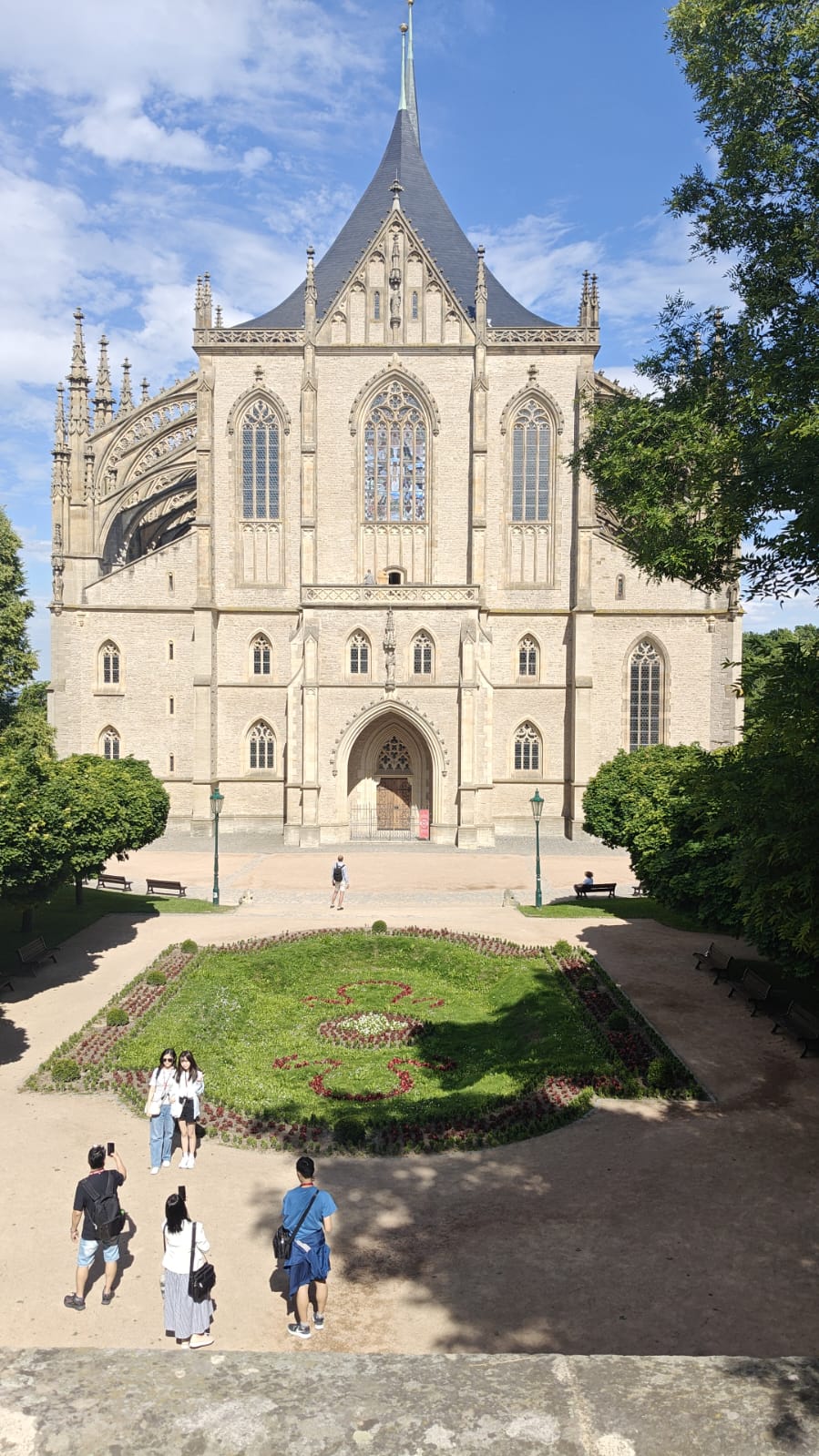
St. Barbara is the patron saint of miners, and there is a local legend about three miners who were led out of the mine by St. Barbara, and how one of them founded this church. The first church on that site dates back to the 14th century, but it has undergone continuous evolution and renovation, with subsequent rebuilding. The miners were exposed to multiple risks, including losing their way in the mines, being suffocated, falling into the cracks, and so on. And even without accidents, their health would deteriorate rapidly due to exposure to hazardous gases, high moisture, insufficient light, and other factors. The miners worked every day except Sunday, with no time off. It would take them about an hour and a half to get down to the mine, then they worked for six or seven hours, and it took them another hour and a half to get on the surface. With a life like this, they definitely needed the church full of light!

Continue reading “Kutna Hora. St. Barbara Church”

Silver Mines Museum

Traces of 14th century frescos on the walls
A tw0-key lock
15th-century iron storage door
“A reminder to be uncorruptable” 🙂
A picture of King Wenceslaus II giving the royal mining code Ius regale montanorum to the miners. This was a legal document that specified all administrative as well as technical terms and conditions necessary for the operation of mines.
The Bible of Martin Tishnov, 1489
Hand-written Hymn Book, 1470-1530, both Czech and Latin songs
The view from the museum balcony

Kutna Hora. Silver Mines

I didn’t read enough about this place before we went there, so I will need to get back to this post and add more details. Boris visited the Silver Mines of Kutna Hora about fifteen years ago, and he wanted me to see it as well, so we booked an English tour and arranged the ride. At the end of the day, everything was timed in the best possible way, but as I said, we had to use a taxi.

Kutna Hora is a Medieval Czech town which prospered due to the outstanding deposits of the silver ore, relatively close to the surface. At some point, about one-third of the all Europaen silver was mined at Kutna Hora. The mining stopped in the 17th century when the silver ore deposits were exhausted, and the mines were abandoned, but in the 1960s, they accidentally found an abandoned mine, which is now used as a tourist attraction.

As one can imagine, it’s difficult to take pictures inside the mine :), there are stretches when you can only move forward sidewise, and there are stretches where you have to bend almost in half (the height is a little bit over a meter). Just a little bit I’ve taken, in the mine itself, and in the museum.

An original 15th-century oil lamp used by the miners. They could not use candles because they would consume too much oxygen. Such a lamp would provide very little light, and if it did go down, a miner would have to work in complete darkness until the end of the shift.
Ore basket and other instruments
A model of the mine
The tour guide leads us to the entry point
The most spacious part of the mine. We are dressed in protective clothes similar to what the medieval miners used. They didn’t have any head protection, though, until much later when the leather caps were introduced – still a very minor protection, but more than nothing.
That’s me after we got out 🙂

I will post more pictures from Kutna Hora tomorrow!