Super-interesting piece on WBEZ Curious City about the Lower Wacker Drive. Not sure whether anybody outside Chicago would be interested, but copying here just in case somebody does 🙂
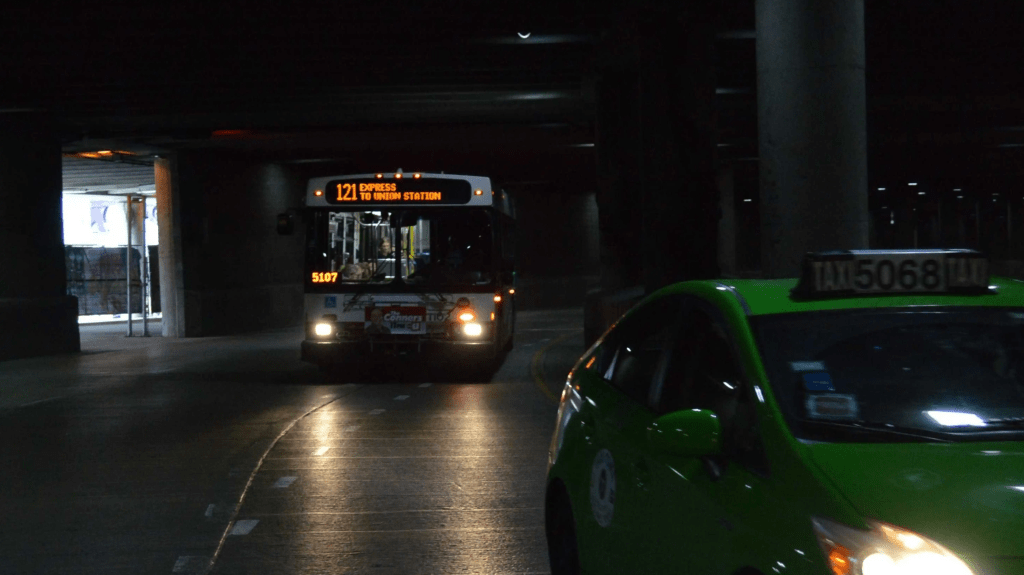
Cars and city buses use Lower Wacker Drive to bypass city traffic.
Mary Hall/WBEZ
Curious City History Architecture
What’s the deal with Lower Wacker? Answers to your questions about Chicago’s basement
Lower Wacker is a faster route from one corner of downtown to another. But if this double-decker street has ever left you mystified or terrified, you’re not alone.

WBEZ’s Curious City answers questions from listeners about Chicago and the region. We include the public in our storytelling, making journalism more transparent and interconnected.
Correction: A previous version of this article included the incorrect year for the World’s Fair.
On its face, the phrase “double-decker street” sounds unique and innovative. But once you actually enter the bowels of Wacker Drive, it can lose its allure quickly. Like the top level, Lower Wacker winds along the curves of the Chicago River. Add in the dim lighting, minimal signage and nonexistent GPS signal and you’re in for a far more daunting adventure than you anticipated on a trip downtown.
If Chicago’s basement has ever left you mystified — and often terrified — you’re not alone. Curious City has received several questions from listeners about Lower Wacker over the years, most of them tinged with tones of confusion and wonder.
So, we’re going to answer as many questions as we can about this mysterious underworld of downtown Chicago.
What’s the history behind Lower Wacker? Do other cities have streets like this?
It all started with city planner Edward Bennett and Daniel Burnham, the chief architect behind Chicago’s 1893 World’s Fair. Together, they created the 1909 plan of Chicago, which was the first comprehensive urban plan ever implemented in the U.S.
“Daniel Burnham had this vision of creating a leisurely, recreational level, street level for people, but then moving the mechanics of the city below and underground,” said Jennifer McElroy, a docent with the Chicago Architecture Center.

Construction of Wacker Drive as a double-decker street began in the 1920s, and its form has changed over time. However, the function has remained constant: alleviate traffic and keep the upper level beautiful. That meant reserving building loading docks, parking, waste management and employee entrances for the lower bowels of the city.
“The whole idea at that time was the ‘city beautiful’ movement, that people had the right as people, as humans, to live in a beautiful city,” McElroy said.
This separation is unique to Chicago. Take, for example, the Holland Tunnel beneath the Hudson River in New York City or the Big Dig in Boston. McElroy said these “straight shots” don’t compare to the complexity of Wacker Drive.
“It’s not an underground network, underground expressway,” she said.
Lower Wacker feels like a basement, but is it underground?
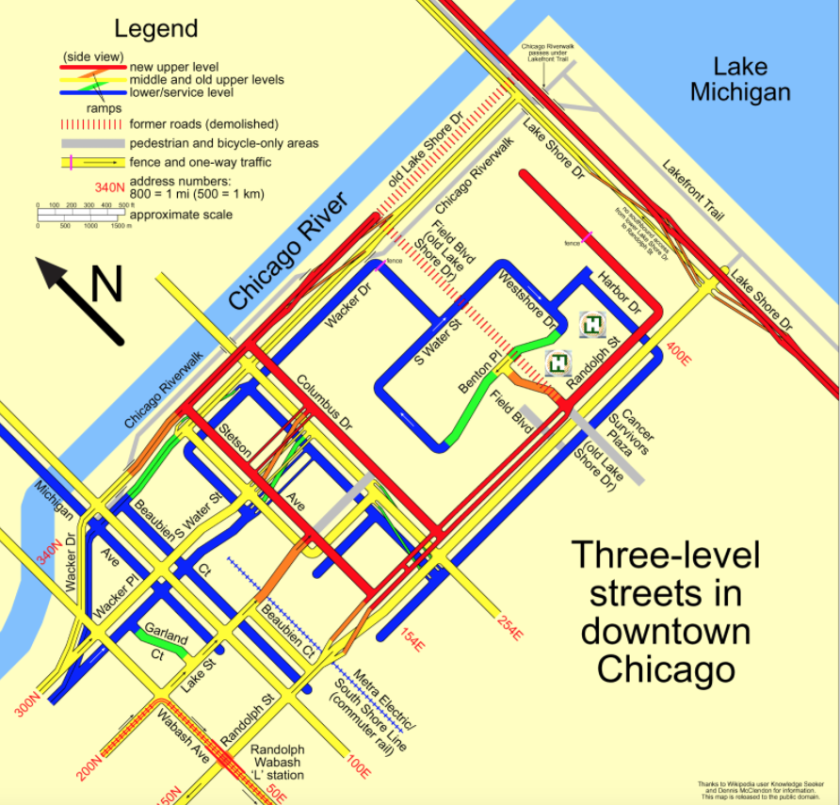
No, Lower Wacker and Lower Lower Wacker are actually at water level and above. That means Wacker’s top level — what’s considered the street level — is three stories above ground.
“The city is kind of built on a swamp,” McElroy said. “So, we don’t really have the opportunity or the option to build down into the bedrock, into below Chicago.”


However, there is at least one area of Lower Lower Wacker that dips below water level: on a brief stretch of Beaubien Court, where it intersects with East Lower Wacker Drive. It’s lined with loading docks and concrete pillars, with dumpsters between some of them.
“Five or six years ago, people used to live between these pillars,” said photographer and documentarian Lloyd DeGrane. He has been engaging with and documenting unhoused people in Lower Wacker for about 10 years.
Though Lower Wacker isn’t underground, it certainly feels like a basement. It’s dark and hidden away, so DeGrane said lots of folks set up house here for more privacy. Still, they’re taking a risk.
“The predators come looking for the weak here,” he said. “It’s like a jungle.”
This brings us to the question of safety.
Is it safe to walk around Lower Wacker?
Because of the dim lighting, minimal sidewalks, no crosswalks and few traffic lights, it is not recommended to walk around Lower Wacker.
Nonetheless, people do. During the day, it’s mostly service workers, loading and unloading deliveries to buildings. They park and walk along South Water Street, which has less car traffic and parallels Lower Wacker.
“It’s pretty much business during the day,” said DeGrane. “At night, Lower Wacker transitions to the people that stay here.”


DeGrane said because many unhoused people struggle with addictions, those who sell drugs are also common. In fact, an incident with a notorious drug dealer changed how people live here in 2018.
Prior to that time, an area called The Triangle was a densely populated homeless encampment. Then, Shomari Legghette, a well-known and feared drug dealer, shot and killed Police Commander Paul Bauer after an incident that started in The Triangle.
Afterward, the city cleared out that encampment and other areas where people were living in Lower Wacker. They added a floor-to-ceiling metal fence around The Triangle that still stands to this day.
“The population of Lower Wacker has dwindled from five years ago — about 150, 160 people — to maybe 20 or 30 people right now,” DeGrane said.
In a written statement, the Department of Family and Support Services said people have been living in Lower Wacker since the Depression era. The department said it offers housing and support services.
How is Lower Wacker cleaned?
In a written statement, DFSS said Lower Wacker is cleaned weekly and all trash is cleared on Thursdays, in coordination with Streets and Sanitation and the Chicago Police Department.
Concerns often arise among people living in Lower Wacker regarding whether their belongings will be removed during these cleanings. DFSS said a notice is posted seven days in advance, “and any oversized, non-portable possessions or unoccupied (abandoned) tents are removed.”


What about Lower Lower Wacker?
Also known as Sub Lower Wacker Drive, this is an even deeper level of Wacker. It’s also harder to access. But there is one reason Chicago drivers find themselves here every year: the Central Auto Pound.
Finding out your car has been towed is one thing. But navigating to the hidden entrance of the impound lot can be a different kind of unnerving. Michael Lacoco, deputy commissioner of the city’s Bureau of Traffic Services, says there’s actually a staircase in the Swissotel that leads here. But for most people, taking an Uber or taxi is the best bet.
Over a decade ago, Sub Lower Wacker was also a go-to for drag racing. After a fatal crash in 2015, the city took measures to put all racing to an end, including speed bumps and greater police presence.
Why doesn’t my GPS work down there?
It’s the layers of concrete above that cause the problem. When you’re on the top level downtown, in the open air, your device can access the signals from GPS satellites that orbit the Earth. But dense building materials like concrete (as opposed to more porous materials like wood) block that signal, especially Wacker Drive’s multiple concrete layers.
In 2018, the city of Chicago worked with the navigation app Waze and the parking app SpotHero to boost the GPS signal. They installed 400 navigational beacons every 100 feet, along the city’s 5 miles of multilevel roads.

But CBS News tested their navigation apps after the installation, and they concluded that the beacons didn’t help much. Odds are you’ve come to the same conclusion.
Since Lower Wacker coincides with the river, it’s unlikely it will ever feel less maze-like. But McElroy has some advice if you worry about getting lost: If there’s daylight, she said, go toward the light.
But what if you’re lost down there at night? McElroy said there’s always a way out: “Just go up. Once you just go up, you can orient yourself and you’re fine.”
Why does Lower Wacker have such an allure?
Lower Wacker has long been a road less traveled by for drivers who are brave enough, which makes it a faster route from one corner of downtown to another. But the aesthetics of this seeming netherworld have drawn attention from outside the city as well.
Twenty years ago, Lower Wacker was called the Emerald City, because there were green fluorescent lights installed down there. The city thought it would help drivers see.


That, along with the hidden basement vibe, has attracted Hollywood box office hits. Scenes from The Dark Knight and The Blues Brothers have brought tourists from around the world.
These days, there’s a mixture of UV and yellow sodium vapor lights installed, not green. But DeGrane says this slight change of scenery doesn’t make it any less alluring: “[The yellow lights] are my favorite down here, because it makes things so mysterious.”
Erin Allen is Curious City’s host.

 Hettie's Reflections