CSO Last Weekend

I was at CSO twice last weekend: one time with Nadia and one time with my mom.

On Saturday, we had a “Carnival of the Animals” concert, which was supposed to be for “bigger kids,” but many parents still brought very small children there. I don’t know why they are doing this, and more importantly, why they won’t leave when the child is evidently not enjoying the experience. The concert was very good, though, with just the right duration overall, the musical pieces of the right size, and a very good narration.

Once again, I had my CSO for Kids Ambassador perk: we were invited to meet one of the musicians after the concert. He was a cellist, and he started by asking the kids what they knew about the cello. After Nadia was the first to answer his questions three times in a row, he asked whether she was playing some musical instrument :).

Then, we had a whole hour of activities. Anna and Kira were able to join us, and both girls (and Anna) had fun making animal masks and trying different instruments at the musical instruments “zoo”:

The Sunday concert featured Estonian conductor Paavo Jarvi and an amazing young cellist Sheku Kanneh-Mason. I tried to find some of his recordings online; there are not that many, but hopefully, you can see how awesome he is! The second act was Nielsen’s Symphony No. 5, another outstanding piece, and overall, it was one of the best concerts of the season.

That’s the concerto he performed at the Sunday concert.

Theft, Building Access, And What To Do About It

We had several cases of stolen packages in our building back in December, and you may remember that some of my outgoing mail (four packages with holiday cookies) was stolen as well. At that point, our association raised a question of rekeying the building, but many residents doubted that the theft had happened due to somebody having the building key. They thought that, most likely, the residents were buzzing visitors in without looking. I doubt that (everyone has windows facing the gate, and it takes a second to check). Also, I knew that my packages were stolen during the night hours. In December, everybody agreed to wait till we got new management in January.

A week ago, there was another case of theft, and the same as with me, it happened during the night hours. Once again, there was a conversation about the building re-keying, but this time, our board member related that this project is expensive, and she does not think it will help since the locks are not difficult to break. She even shared the link where you can buy a “lock gun” online.

At first, I was distraught with the decision not to rekey the building, and I was about to write an angry letter to the board, especially when they suggested I could have my packages delivered to a nearby Walgreens (it’s not “nearby,” and time is the most precious resource for me). But then I thought about it and reread the email one more time. This time, I realized that she was right and that locks do not stop thieves, and I am very well aware of that. If somebody is determined to steal, no lock will stop them. The theft does not exist when there is no reason for it. I thought about how I was always against “gating” oneself from the rest of the world and how now I was about to suggest just that, so something was wrong with my moral compass. And then I thought I already knew the answer: the only way to reduce crime, including theft, in my community is to improve the community itself. And my participation in the beat meetings and my new idea to get involved with Howard Community Board were all about that.

I often hear people complaining about the increasing number of homeless people on the streets of Chicago, and I hear their cries, “What do police think?!” I understand that seeing a lot of this misery is disturbing and unpleasant. And I hear some well-off people articulating that they want to be able to pay for never seeing “all that.”

Recently, I thought about how it felt on the streets of Chicago 150 years ago, when there were a lot of very poor people and very few rich people, and how these rich people felt walking the streets and seeing other people’s misery, and how they probably didn’t want to see it, and the policemen were here ready to remove the beggars from the public places. And how these rich people could isolate themselves from the reality behind the closed gates. And I do not want to be one of them.

And I do not want to be that

Freakonomics

After years of listening to the Freakonomics podcast, I finally realized that there is a book and a documentary with this name and that the whole idea came from the book by Levitt and Dubner. Yes, I expect to have such late discoveries for the rest of my life! I watched the documentary last weekend (in parallel with doing other things), and I am going to read the book. It felt like a gap in my education that had to be filled. The documentary is almost twenty years old, and it’s surprising that so many things that are mentioned there are still not commonplace and still not taken into account. And politicians and voters still debate on the consequences of potential actions or lack of those without consulting the data which is already available. A couple of takeaways.

  1. The first episode in the documentary (about how a name defines a person’s future) is probably the only one that is well-known and frequently cited. In fact, the reason I turned “to the source” was a citation in another book I was reading at that moment. It’s good that we know what might drive our biases, but unfortunately, it rarely helps the situation.
  2. The episode about the impact of Roe-Wade on the crime decline twenty years later was a shock. I never saw this research results, I never heard anybody speaking publicly about it, and if that’s me, a person heavily involved in the reproductive rights struggle, what does it say about the general population? And another question – what should we expect twenty years from now?!
  3. The last episode (about monetary incentives for falling behind students to improve their grades) conveys a very important message, and not only in the field of education. It demonstrates that when the gap is too wide (somebody falls too far behind), even a relatively big incentive is not enough for a person to start moving in the right direction. That’s the rationale for many programs that offer support for people in a challenging situation to help them on their way out. For many people, no legislation and no financial support is enough to reverse the course of their lives, and more targeted actions are needed.

***

About what happened yesterday. Yes, that was yet another political murder. Yes, the cinicism with which people with even a slightest potential of attracting supporters are removed from this world, is unbelievable.

And no, what have happened, didn’t change my opinion on either Navalny or Putin.

Joffrey “Studies In Blue”

As I said, February is very culturally loaded. In addition to what was originally planned, since both my neighbor and I travel, we had to exchange several performances, and the exchanges ended up in February as well. “The Girl from the North Country ended up being a complete miss, and we left after the first act. I know that the show received many awards and a lot of praise from the critics, so I am ready to assume “that’s us ” or probably the mood we were both in.

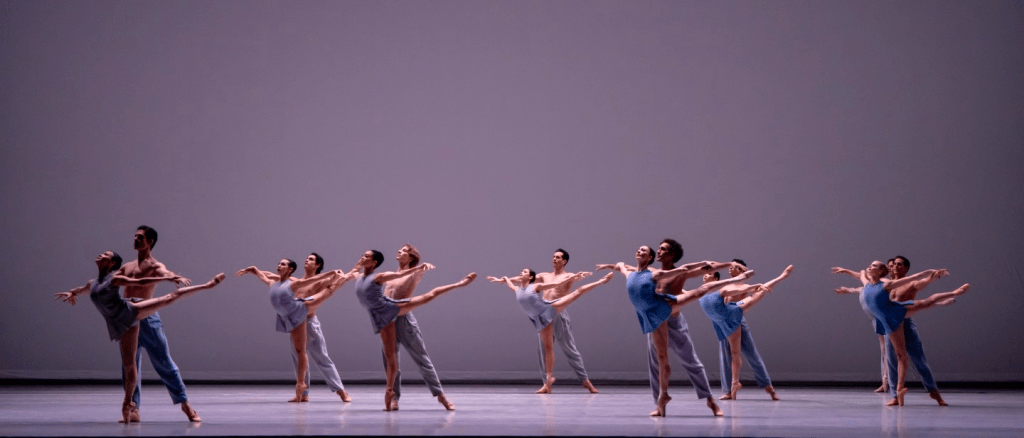
Just to compensate for the disappointment, Joffrey’s “Studies in Blue” was flawless as usual! The program consisted of three one-act ballets: Yonder Blue (inspired by the book Plea for Eros), Hungry Ghosts (they didn’t say it, but the name is definitely derived from the Realm of Hungry Ghosts), and Hummingbird. I especially liked the set in Hummingbird (although I would love to know whether there was any specific meaning in it; it looked like the artists were floating out of some hidden realm :)). The Hungry Ghosts was a World Premiere, and I think that was the first time I had an opportunity to be present at such an occasion.

Cinderella

February is coming packed with cultural activities, to compensate for a very “dry” January, indeed! I saw two operas in one week: the first was The Champion, and the second was Rossini’s Cinderella, which I saw on Saturday. I never saw this opera performance, and never heard the music, and it was so different from the story of the glass slippers – and I loved it! Both the prince and Cinderella are real characters, with the sense of self-wort and determined to be in control of their lives; you know that it’s not the magic that brought them together, but their actions. The opera is very long, more than three hours, but I didn’t even notice it! When the intermission started and I looked at my watch, I was so surprised to see that almost two hours had passed! Beautiful in all possible ways :).

Conference Prep

We have the conference schedule published. Our Talk Selection Committee did a really fantastic job. I don’t remember when (or whether it was!) the authors’ notifications, final acceptance, and scheduling – everything was on time!

But even with the best CfP committee ever, the conference takes all the time I have, plus more. Just saying 🙂

Apple Vision

It is the most challenging Apple product I own so far. I scheduled a consultation with Apple support to start it, and it took an hour, and I needed more. In fact, I had to terminate the session because my mom started to call me :). I had a chance to play with it more on the same day, and then more on Sunday. I am still learning how to operate it. It is as wild as you saw it in commercials. Pressing the key by focusing your gaze on them is a total Sci-Fi, and it’s not always convenient. Fortunately, you can also press them on an imaginary keyboard.

I chose an environment that places me on the shore of a tiny lake high in the mountains, and I can even hear the water splashing. I also watched a short episode on Nature, which showed rhinos in Africa, and they literally come by you and touch you with their noses. Surreal. There is a warning at the start of each movie: beware of your environment (aka remember that you are in the virtual reality, not just the reality), and now I know why they show it.

I already have a long list of questions that I need to look up :), including how I create a guest account and share with others.

There is no way to tell it, but that’s the 3-D picture taken by Apple Vision

Human Zoos

On our trip to Antwerp and Ghent, we had a photo stop at Atomium, and our tour guide told us about the Human Zoo which was open during the 1958 World Fair. I had not idea that they still existed in the 20th century, yet along that recently, so I rushed to read more about it. I am sure that everyone less ignorant than me saw that picture, but I saw it for the first time, and frankly, whatever else you read about Human Zoos wouldn’t make the same impression as that one photo. Shocking is not enough of a word.

It’s easy to Google more details about human zoos; I do not want to put any more links here. I can’t imagine people tossing bananas and other food in the direction of humans which are literally “on display.” Just can’t imagine.

Compressed Book(s) Review

No time to write the actual reviews, but I still wanted to leave a couple of notes about the books I recently read.

  • Last year, I read Henry at Work. I started reading it because it was recommended as a book about “the meaning of work,” especially “during the era of mass resignation,” and it sounded interesting. When I started to read it, I realized that first, I needed to read at least some works of Thoreau, so I started Walden. It was an incredibly difficult reading for me, in part because early nineteenth-century English is very different from the modern language and in part because the pace of the story is a hundred times slower than I am used to. I took it upon myself to beat this challenge and exercise patience, especially because it was sort of a point of Thoreau’s philosophy. I made it :), even though it was possibly the slowest reading in my adult life. I am still thinking to which extent I agree with Thoreau. Is my work meaningful? I hope it is because I am definitely not working “just so I can earn money to live.” But is it really meaningful? I am not sure. I am in the race for a big paycheck? Am I one of the people who wants things because others want them, and I might not need them? Judging by me being among the first to get Apple Vision, it seems like it, but that was probably the only purchase of that kind in many years. Are my desires to have more cultural experiences and travel more unworthy ones? Henry James Thoreau condemned trains, saying that there is no reason for people to get from one place to another “as fast as possible.” I find it hard to agree :).
  • Eat to beat your diet. I started reading it because I thought that it was going to be an anti-dieting book. The author claimed that “you do not need to eat less; you just need to eat the right foods, and you will be able to fight bad fats, and everything will be great.” In fact, when he talks about the studies, he mentions that people in them were not eating less, but they were given some special foods in addition. However, when it comes to meal plans, the first things he emphasizes are “eat in moderation,” intermittent fasting,” and similar calorie-restricting techniques.
  • Before the Coffee Gets Cold. I read it for the book club and loved it! I can’t even tell why I loved it so much and what’s the significance of this work, but I was completely taken! Loved it to the last drop! Possibly will read the next one in the series.
  • Red Alert - The Novel that Inspired Dr. Strangelove, or, How I Learned to Stop Worrying and Love the Bomb. I started reading it after I watched the movie. That’s shocking reading for anybody born in the Soviet Union. It’s hard to say “I loved it” about such kind of a book, so let’s say it left a long-lasting impression on me. I will try to write more about it next week.
  • Three more books “currently reading”.