


On family history, parenting, education, social issues and more
There is no connection between these two subjects except for the timing. On Tuesday, my neighbor and I were at the Chicago Symphony concert for the all-Russian (except for one Finnish piece) concert. The conductor was Hannu Lintu, and I didn’t like him. I didn’t hear any of his personal interpretation of either of the pieces. Yes, all the pieces were very well-known, but when Riccardo Muti conducts Tchaikovsky, it’s always a discovery, a revelation. The piano soloist was from Uzbekistan, and although his technique was excellent, he also didn’t add anything of his own vision to Tchaikovsky’s First Piano Concerto. Yes, this piece was so often performed in the Soviet Union that I remember almost every note of it, but once again – I heard more original performances! Also, for the anchor, the pianist played the “Neapolitan song” from Tchaikovsky’s Youth Album, and I was like – is it a joke?
The last piece was Shostakovich’s Ninth Symphony, and once again, I was wondering how one can make such a bold, unruly, almost hooligan-like piece so boring!
Usually, we do not talk much on our way home, or we talk about the show we just attended, but since we agreed on our disappointment, she asked me whether we could talk about Navalny. On February 16, she messaged me at 7 AM, expressing condolences, and I replied that although I was outraged with yet another political murder, Navalny’s views were not much better. She said that she wanted to hear more, and we agreed to talk about it.
By Tuesday, she watched that documentary, and said that she started to understand why I said what I said. We had a longer conversation, and I told her why I saw it as a problem that many people in and outside Russia would consider Navalny a good alternative to Putin, which, again, does not by any means justify this political murder. I gave her a short version of our conversation with Lena over the weekend and told her why I believe that “Navalny’s return” was staged. All I know about Putin supports this conclusion, as much as I hate conspiracy theories.
When Lena and I went to the Ukrainian rally, we made sure to be quiet and not speak Russian. On our way home, Lena said: all went well, we showed our support, and we didn’t get beaten at the Ukrainian rally.
I recalled what Boris said in the early days of the war: now, Russian sounds the same as German after WWII, and it will take at least fifty years, if not more, for this association to go away. (I would add – if…) I had an acute feeling of exactly that at that very moment, and looking at the posters depicting bloody Putin, I was thinking: screw you, what did you do with Ukraine?! What did you do with Russia?! And immediately, I stopped and thought: no, not him. We allowed it to be done.
After we got back home, we talked for several hours. We talked about the necessity of Russia’s complete defeat as the only way to start over. I shared with Lena Igor’s thoughts about educating people and creating the base from which another country could be born. Lena told me about the large Latvian community near where she lives, and how these Latvians were keeping the language and the culture alive for three generations, hoping to return “when the occupation will be over.” Still, when the occupation was over, none of them returned.
I understand what she says, and I agree that people who have lived away from their country for generations are extremely unlikely to go back. I do not think I will ever come back for good, but that’s because there was no political reason for me to leave Russia. I consciously chose the country I now call home. But I hope that the day will come when I will be able to come and help to build a new and better society.
But before that, as I promised to a person who is hopefully reading this now, I will invest in their nursery garden. And I am sure that this day is closer than we think.

On Saturday, Lena and I, and my mom, and Lena’s friend – all four of us went to see the Orchid show at the Chicago Botanic Garden; a tradition we had kept, strangely, since February 2020 – that was the last event we were able to attend before the lockdown.
This year’s show was exceptional! The staff at the exhibit told us that they have a new artistic director )or however this is called), and yes, it was something!
I recorded several immersion videos, which obviously, won’t play as immersion here, but I also took a lot of pictures, and I am going to show just a fraction of them here. The theme of the show was “The show,” so there were some elements of circus, amusement park, and so on.


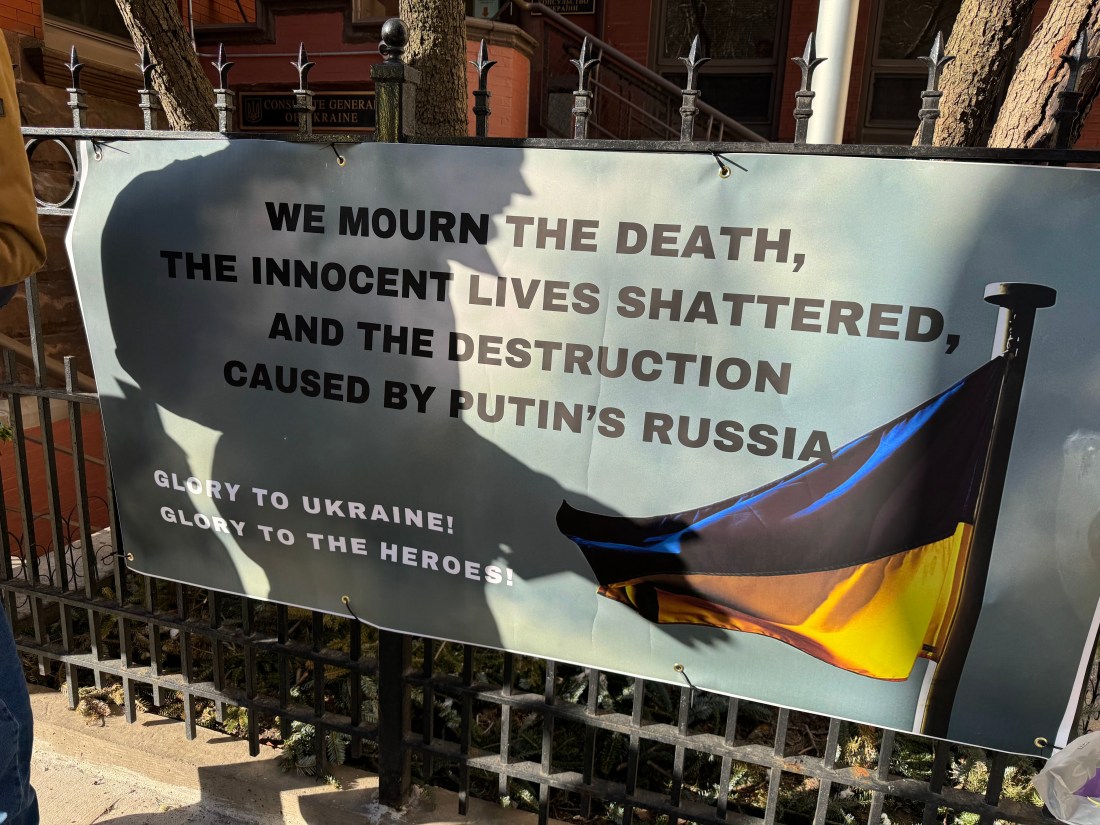

The day when we marched in a group of anti-putin Russians to pay respects to the victims of the Russian invasion, when we chanted, “Ukraine needs your help!” That day, I felt more hopeless than ever. I remember the somber mood of the first rallies in February and early March of 2022. I remember when the mood started to be more elevated and more hopeful, when we marched, fired by our anger and energy. Today, I marched, but I felt hopeless. On the way to the rally, I read an article in TIME magazine titled “Ukraine Can’t Win the War.” To tell you the truth, it does not matter what the article says exactly. You just don’t publish articles named like this on the grim anniversary of the invasion. Lena and I briskly walked to the meeting point of the Russian rally for Ukraine, holding the Ukrainian flags in our hands and passing the groups of tourists and locals for whom there was no war going on. Two years, and people are asking, “Which war?”
I know that the world is driven by the economy. I know that the world economy needs peace, and there is no industry, including weapons manufacturing, actually benefitting from the war. But why people don’t understand the consequences?
Lena and I chatted for hours tonight, asking each other the same questions: why do companies care about their profits next week and do not care what will happen to them and the world two years from now? I do not have an answer.


Last weekend, I tried several more things with Apple Vision, with intermittent success.
A very interesting article in TIME magazine, “Why we are more exhausted than ever,” addressed this very question: why so many people feel more tired these days? I sent this article to my Women’s mentoring circle at work, and the participants said it resonated with them. I am a little bit disappointed that this article has very few constructive suggestions, but I think it correctly points out that the most destructive stress is the one that is caused by out of our control circumstances. I also like that thought that the opposite of being stressed is being energized, because I often hear that “not stressed” is equal to “calm.” Even my dentist during my recent visit commented to the fact that “I am stressed” when I was actually full of motion and told him that there are many things going on in my life! So I think that the idea that to eliviate stress, you need to find things which energize you rather than “calm you down,” resonates with me!
Here is the full article text:
People are tired. Like, really tired. As evidenced by recent trends such as Quiet Quitting, Coffee Badging, Bare Minimum Mondays, and most of all, The Great Resignation—when over 47 million Americans voluntarily resigned from their positions—people are feeling a strain on more than just their work calendars; they’re feeling it on their spirits. We’re now in the era of “The Great Exhaustion,” what writer and computer science professor Cal Newport has called a time when people are looking to reestablish their relationship with work in order to reduce their pervasive sense of drain.
Most people aren’t surprised to hear about “The Great Exhaustion.” We know that we are tired, and we see it in the choices we make every day: ordering dinner because we don’t have the energy to make it, trying to find ways to work from home so we don’t have to add a two-hour commute to our day, infrequent social outings because it is impossible to coordinate busy adult schedules, complete de-prioritization of hobbies—the list goes on and on. People feel so fatigued that they are cutting out activities that used to be commonplace and low stress, like working out and going to the supermarket. Factor in recovering from the pandemic, inflation, and global stressors, and you’ve got a recipe for complete physical, mental, and emotional exhaustion.
So why are levels of exhaustion increasing? I speak with burned out professionals for a living, and I have heard countless unique reasons for exhaustion. The three factors that are commonly overlooked but that I believe are contributing the most are unsustainable lifestyles, exposure to stress outside of our control, and financial insecurity. These are facets of our lives that we have managed to normalize. But this normalization has caused us to disregard their impact on our physical and mental wellbeing.
Unsustainable lifestyles
What is the opposite of feeling exhausted? Feeling energized. But what, exactly, helps us to feel energized?
New York Times-bestselling author and researcher Dan Buettner spent his career studying “blue zones,” areas in the world where people live longer, healthier lives than anywhere else. In his work, he explains that people who live in blue zones have one thing in common: they live a human-needs-first lifestyle, in which the things that we need as human beings are prioritized. That means eating whole foods, having rich social lives, getting regular movement, and working with a purpose rather than for the sake of maximizing productivity.
This is a stark contrast to most people’s realities. Outside of these “blue zones,” most people eat processed foods, strategically plan activities to socialize and get movement, and treat work like it comes before everything else. Unfortunately, prioritizing elements found in blue zones requires spare time, energy, and money—things the average (tired) person does not have. An objective look at how most people are living day-to-day doesn’t paint a picture of human needs being met; it paints a picture of enduring our demands. We have not built a human-needs-first society; we have built a business-needs-first society, and it is starting to show.
Stress that is out of our control
Stress within our control (a big project we’re working on, balancing a demanding job and childcare, doing something that scares us) can be mitigated and builds confidence when addressed. Stress outside our control (violence in our cities, climate disasters, tragedy around the world, and inflation) makes us feel helpless. While it is important that we aren’t ignorant to what is going on in the world, it also weighs on us to take in so many stressors without the possibility of resolution.
That stress causes exhaustion is not revolutionary, but it is exposure to stress outside of our control that makes us lose hope. Hope is a powerful counter to exhaustion and burnout. We can endure difficulties with much higher morale when we retain hope that things will get better. When everywhere we turn there is news making us feel like things aren’t getting better, we begin to break down.
The biological effect of exposure to these types of stressors cannot be overstated. Scrolling on our phone and watching a troubling two-minute video triggers a stress response in our body that can impact the rest of our day. A stress response each day for years damages our physical and mental health in ways that we often overlook.
Financial Insecurity
Fifty years ago, a single income could afford you a house, car, wife, and kids. Nowadays, you’re lucky if a dual income can afford you some of those things. Having a hard job that supports your lifestyle is one thing; having a hard job that barely pays the bills is another. Much of the exhaustion we are seeing is frustration that working full-time (or more) doesn’t translate to the same security and buying power it used to. Why are we working if not to afford the lifestyle we desire?
When that lifestyle (going to a restaurant on special occasions, going to a concert with friends, getting your kids the Christmas gifts they want) becomes unaffordable, frustration is understandable. Frustration over time turns into defeat, and defeat looks an awful lot like exhaustion. We have been a work-centered society for generations; however, it is becoming increasingly harder to convince people to live a busy, work-centered life when it doesn’t translate to the quality of life that it used to.
The confluence of unsustainable lifestyles, stress out of our control, and financial insecurity creates a very tired group of people. The good news is that there are things within our control that can improve our quality of life and reduce exhaustion. Consider what augments your quality of life and makes you feel energized. Then consider what lowers your quality of life and makes you weary.
At the end of the day, how we feel is determined by small decisions we make. How much sleep we get, prioritizing a morning walk with a friend, consuming media thoughtfully, refusing to discuss work and work stress when we are off the clock—these small things make a big difference, but we must do them consistently and relentlessly. We can’t wait for changes to come from the top down; we must address the factors of exhaustion within our control to ensure we live healthy, peaceful, and satisfying lives.
The invitation to this event came from WTTW directly, and I immediately replied, because the topic of homelessness is on my top priorities list.
Below is a description of the event, which I copied from the link above (as usual, knowing very well that people do not like to click on the links!)
Four walls with a door that locks. Sufficient heat and food. A place to be safe, to rest, and to live. Most of us take these essentials for granted but, on any given day, it is estimated that as many as 65,000 men, women, and children are currently experiencing homelessness on Chicago’s streets, in shelters, or while “couch surfing.” Many are suffering from mental health issues or addiction, and as a result, they may be estranged from family and friends. Without a fixed address, any rental or credit history, forms of identification, and other basic resources, jobs and stability can be unattainable.
“Housing is the foundation for stability and security for people,” says Nicole Bahena, Vice President of Community Partnerships at All Chicago, an organization dedicated to ending and preventing homelessness. “Without it, it’s difficult to keep up with anything else in life – taking care of yourself, finding and keeping a job, getting medical care, caring for your family.”
In a series of documentaries, Firsthand: Homeless will go beyond the stereotypes society often assigns to unhoused individuals through the firsthand perspectives of real people who are navigating its complexities and hardships. And through expert talks, news reporting, and conversations with thought leaders and community members, the project will explore possible solutions.
“When you’re homeless, you’re [just] surviving. There’s not much room to live.”
How do people find themselves homeless in Chicago, and how do they survive? Turns out, each person’s story is different.
Yolanda, grandmother of four, lives with her fiancé Clarence in a tent under the Damen Avenue bridge, in the shadow of a Costco and a block from the abandoned Lathrop Homes where she once lived and worked as a live-in aide to a man who later died, leaving her without a home. She grapples with health issues, including depression, and spends her days panhandling for loose change on the street above her head. Despite it all, Yolanda shares what she has with others and stays true to her faith. As she watches her young grandsons playing at the beach, she knows that she must keep going for them. “Just hold on and have faith,” she says, hopeful that better times are coming.
Dan is also living on the streets. Homeless for more than 12 years since his suburban home went through foreclosure, he now kills time by riding the L and walking around the city. He takes viewers on a tour of some of his regular downtown haunts, including the 11th floor stairwell of a public parking garage where he sleeps. He is surprisingly sanguine about his situation, but it’s clear that navigating life without a home is challenging. Avoiding crimes against the homeless and overcoming an ongoing heroin addiction are Dan’s immediate concerns, but his search for housing just might soon be successful.
At least Jackie has a roof over her head. She lives in a homeless shelter with two of her three young children – out of necessity, her youngest child is living with her ex-husband. She works part-time as a bus operator for a subcontractor for the University of Chicago, a long daily commute from across the city. Jackie is attempting to mend fences with her mother, who previously struggled with drug addiction – it was an altercation between them that landed her and the kids on the streets in the first place. She is hoping to be approved for an apartment for her family soon, which will afford them some freedom and privacy.
Brian feels fortunate to have obtained a transitional apartment at St. Andrew’s Court and a job through the CTA’s Second Chance program. He explains that he spent years moving in and out of the prison system and cites a lack of stable, affordable housing as a key reason why he kept reoffending. To give back, he also works with the Chicago Coalition for the Homeless on the city’s proposed Bring Chicago Home ordinance that is designed to help others in his situation.
Like Brian, Kimberly is also working to improve conditions for unhoused people. With her toddler Jasmine, she has been part of a transitional living program since the nursing school she had been attending pulled a large portion of her financial aid when she became pregnant. As she tackles several daunting mental health issues, she strives to make lives better for homeless youth – even heading to Washington, DC to lobby Congress – and dreams of a better life for Jasmine.
Throughout the upcoming year, get to know the stories of people across Chicago who are experiencing and addressing homelessness through five documentaries; four talks by community and thought leaders offering insights, context, and possible solutions; text, audio, and visual journalism; a companion discussion guide for schools, libraries, and community organizations; and, in partnership with The Night Ministry, All Chicago, and the Chicago Public Library, community conversations extending the reach of the project into the many neighborhoods across Chicago.
As I said, I signed up without knowing any details. However, there was something else going on for the past three months.
I always make volunteering for the Night Ministry my top priority, but still, I barely went there for the past three months. It was a combination of things: my travels, Anna’s surgeries, my overall busy schedule, but also the budget cuts in the Night Ministry and the staff shortage. The last time I was there was a real disappointment because the staff was busy on a call with one of the families, and the youth were all in their rooms, and I ended up cooking solo and leaving. I emailed our volunteer coordinator to discuss what we wanted to do next, and we agreed to have a “Make your own pizza” night, but then, to my horror, I realized that I was double-booked for that night! And then he emailed me saying that he was transitioning to a different position, and I would have to coordinate with other people (fortunately, I knew one person from that list!)
This one person informed me that they could only arrange something on Tuesdays, and my Tuesdays are pretty much off-limits. Boris told me that I needed to figure out how I could fit this activity in so that it would be meaningful (which means at least twice a month).
That was my state of mind when I came to the WTTW event, and just when I entered, I saw all these people from the Nigh Ministry and the person who was my new contact, and we sat down and talked. She relayed to me that there will be no dedicated coordinator in the observable future and that they have no budget for the events anymore. I asked her what her plans were, and she said that she would be learning alongside me. And that’s when I realized that I couldn’t walk away.
Also, when everybody was leaving the event, I recognized the face of one young person in the audience and nodded in his direction. He said: I remember you! You were cooking at the ODS!
… I have a feeling that my leadership skills will be needed!
P.S. I didn’t get a chance to ask my question during the recording, and my question is – why do we have ten different lines for housing? Why the process is so convoluted? Why can’t we have a centralized database for people and housing resources? That’s where I would put money first!
Foto, travel, St.Petersburg, Stokholm, Tallin
aka operasandcycling.com
We explore and grow together
Jeremy Schneider
A journey of curiosity and unfinished thoughts
Shaken, not stirred
Information about SQL (PostgreSQL & SQL Server) from the Asylum.
Chasing Wellness
Curiosity to Infinity
SQL help, examples, tips
Musician and Network Engineer
Living life to the fullest
Life in Copenhagen, Denmark, after moving during Covid-19.
Spontaneous Blogger! Doze on Sunday @7 PM IST
a written collection of souvenirs
ramblings of a crazy lady living with MS
Every Family has a story to tell..........Welcome to mine
Travelling without Limits
Researching, Preserving, and Sharing Genealogical Information For Future Generations



 Hettie's Reflections